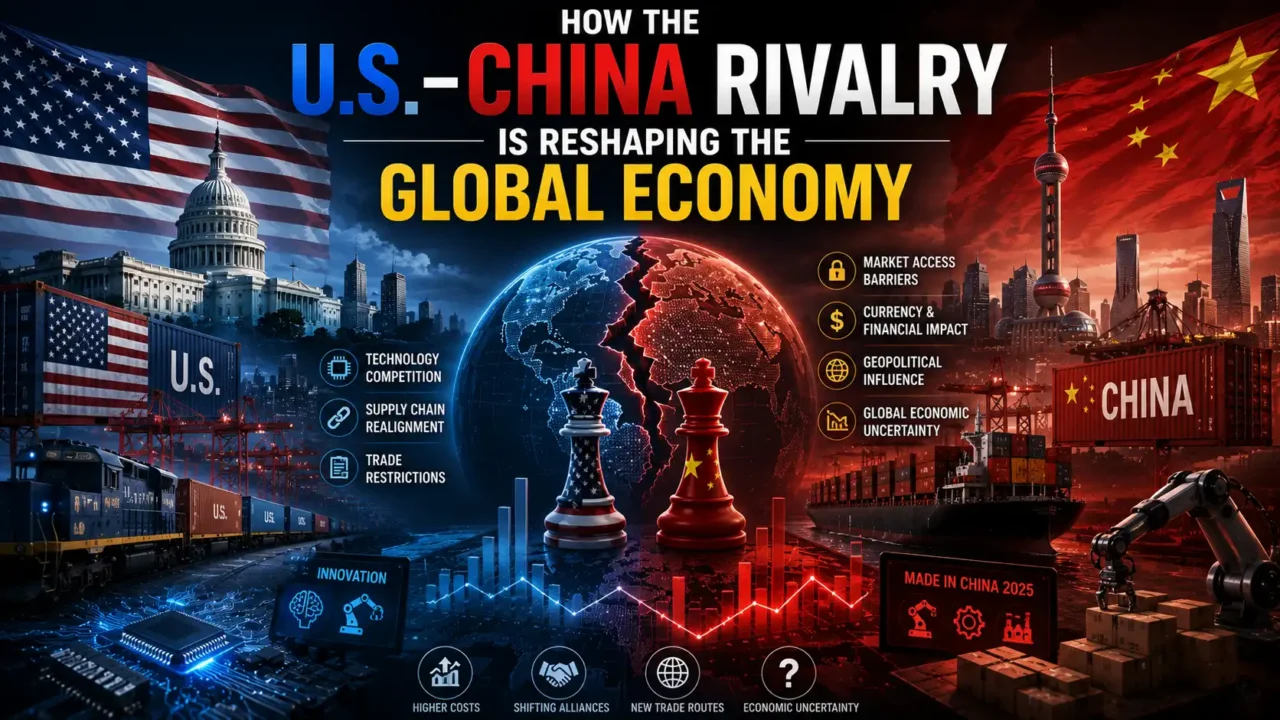
Ever wonder why your new phone might cost more, or why certain tech brands feel harder to find lately? A lot of that traces back to one massive rivalry playing out on the world stage. The competition between the U.S. and China isn’t just political, it’s rewriting the rules of the entire global economy.
From Trade Partners to Strategic Rivals
For decades, the U.S. and China built one of the most interconnected economic relationships in modern history. That relationship has shifted from cooperative trade toward cautious competition, and in some areas, outright rivalry. What was once mutual economic benefit is increasingly viewed through the lens of national security and strategic advantage.
Tariffs and Trade Wars Reshape Commerce
Tariffs imposed by both countries have disrupted industries ranging from agriculture to electronics manufacturing. Businesses on both sides have had to absorb costs, adjust pricing, or find entirely new suppliers to avoid penalties. These trade barriers, once temporary measures, have increasingly become a permanent feature of doing business between the two nations.
The New Cold War: Is the World Splitting Into Two Economic Blocs?
The Battle for Technological Supremacy
Semiconductors and artificial intelligence have become the new frontlines of this economic rivalry. The U.S. has restricted access to advanced chip technology, while China has invested heavily in building its own domestic alternatives. Whoever leads in these critical technologies stands to gain significant long-term influence over global industries.
Supply Chains Are Being Rerouted
Companies once heavily reliant on Chinese manufacturing are now diversifying operations across countries like Vietnam, India, and Mexico. This strategy, often called “de-risking,” aims to reduce dependence on any single country amid rising geopolitical uncertainty. The shift is costly and gradual, but it’s fundamentally altering how global manufacturing networks are structured.
Global Businesses Caught in the Crossfire
Multinational companies now face the difficult task of operating profitably in both American and Chinese markets simultaneously. Navigating differing regulations, political expectations, and consumer sentiment has become a delicate balancing act for many corporations. Some businesses have chosen to scale back operations in one market entirely rather than risk being caught between competing demands.
Other Countries Are Adjusting Too
Nations beyond the U.S. and China are recalibrating their own economic strategies in response to this rivalry. Countries in Southeast Asia and Latin America are attracting new investment as companies look for alternative manufacturing hubs. This redistribution of economic activity is creating unexpected winners in regions that were previously overlooked.
The New Cold War: Is the World Splitting Into Two Economic Blocs?
Currency and Financial Systems Under Pressure
Beyond trade and technology, the rivalry is also influencing global financial systems and currency dynamics. China has pushed to reduce reliance on the U.S. dollar in certain trade agreements, promoting alternatives where possible. While the dollar remains dominant for now, these efforts signal a longer-term push toward financial diversification among nations wary of overexposure to any single power.
What This Means for the Future
Economists largely agree that this rivalry will continue shaping global economic patterns for years, if not decades, to come. The interconnected efficiency of previous decades is giving way to a more cautious, security-focused approach to international trade. Businesses and governments alike are learning to operate in a world where economic decisions are increasingly inseparable from geopolitical strategy.
Final Thoughts
The U.S.–China rivalry has moved far beyond diplomatic tension, actively reshaping supply chains, technology development, and global trade patterns. Businesses, governments, and everyday consumers are all feeling the ripple effects of this shifting relationship. As both nations continue competing for economic and technological leadership, the global economy will keep adapting in response.
What impact do you think this rivalry will have on everyday consumers like us? Share this article with someone who follows global economics, and let us know your thoughts in the comments below.
Call to Action
The global economy is changing faster than ever, driven by geopolitics, technology, and shifting trade relationships. Continue exploring the Aziz Publishing Knowledge Library for thoughtful, evidence-based analysis of world affairs, economics, science, and emerging technologies to better understand the forces shaping the future.