You’ve probably heard a conflict described as a “proxy war” in the news without anyone actually explaining what that means. It’s not just a fancy term for any conflict involving multiple countries, it describes a very specific, deliberate strategy. Here’s what’s actually going on when powerful nations fight through others instead of each other.
What a Proxy War Actually Is
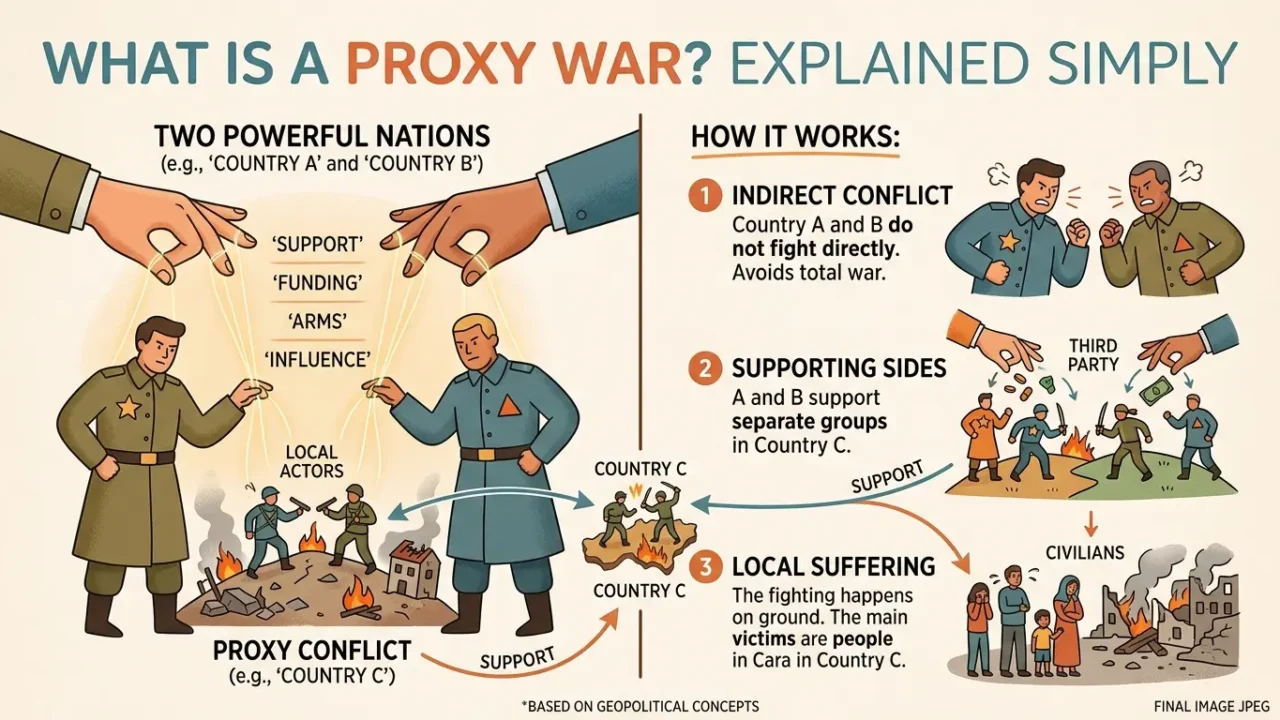
A proxy war is a conflict where two or more outside powers support opposing sides in someone else’s fight, rather than directly fighting each other on the battlefield. This support usually comes in the form of funding, weapons, training, or intelligence, given to local forces, governments, or rebel groups who do the actual fighting. The defining feature is indirection, the powers with the biggest stake in the outcome deliberately avoid direct confrontation with each other. This distinguishes a proxy war from a conventional war, where the opposing powers themselves are the ones exchanging fire.
Why Countries Choose This Strategy Instead of Direct War
Direct conflict between major powers, especially nuclear-armed ones, carries catastrophic risk that most governments are desperate to avoid under almost any circumstance. Fighting through a proxy allows a country to pursue its strategic interests, weakening a rival, gaining influence in a region, or supporting an ideological ally, without triggering the kind of direct war that could spiral into something far larger and costlier. It’s also considerably cheaper, both financially and in terms of the sponsoring country’s own military casualties, since local forces absorb most of the actual fighting and loss of life. This combination of lower risk and lower cost is exactly why proxy wars have remained such a consistently used strategy throughout modern history.
Hard Power vs Soft Power: What’s the Real Difference?
The Cold War Made This Strategy Famous
The term “proxy war” became especially prominent during the Cold War, when the United States and the Soviet Union avoided direct military conflict with each other while backing opposing sides in numerous regional conflicts around the world. Both superpowers understood that direct war between them risked nuclear escalation, so instead they funneled weapons, funding, and military advisors to allied governments and movements across Asia, Africa, and Latin America. This pattern played out in conflicts from Korea to Angola to Nicaragua, each one shaped significantly by outside support even though the fighting itself was carried out by local forces. This era essentially established proxy war as a defining feature of great power competition for the following decades.
The Vietnam War as a Clear Historical Example
Vietnam remains one of the most studied examples of Cold War proxy dynamics, with the Soviet Union and China supporting North Vietnam while the United States backed South Vietnam. Both superpowers provided weapons, funding, training, and strategic support, but crucially avoided direct military engagement with each other’s forces throughout the conflict. The war caused enormous human and economic costs for Vietnam itself, while the sponsoring superpowers, despite investing heavily, never faced each other directly on the battlefield. This case illustrates a recurring pattern in proxy wars, the country hosting the conflict typically bears the overwhelming majority of the devastation, while the sponsoring powers absorb a comparatively smaller cost.
The Soviet-Afghan War and Its Long Shadow
During the 1980s, the Soviet Union directly invaded Afghanistan to support its communist government, while the United States, alongside Pakistan and Saudi Arabia, funneled weapons and funding to Afghan resistance fighters known as the mujahideen. This support significantly raised the cost of the Soviet occupation and is widely cited as a contributing factor to the Soviet Union’s eventual withdrawal and broader economic strain. However, this proxy conflict also produced long-term consequences that extended well beyond the original Cold War context, including the rise of militant networks that would shape regional and global security concerns for decades afterward. This example highlights a genuine risk of proxy wars, the local forces empowered during the conflict don’t simply disappear once the sponsoring powers lose interest.
How Proxy Wars Continue to Shape Conflicts Today
Proxy dynamics remain a significant feature of contemporary conflicts, with regional and global powers often providing weapons, funding, or political support to different factions within ongoing wars rather than intervening directly themselves. This pattern shows up in various forms across multiple modern conflicts, where outside powers pursue their own strategic interests through the support they provide, even while publicly framing their involvement in humanitarian or diplomatic terms. Understanding this dynamic helps explain why some conflicts persist for years despite seemingly clear paths to resolution, since ending the fighting often requires cooperation among multiple outside sponsors with genuinely competing interests. This is part of why modern conflict analysis increasingly focuses on the web of external support behind a conflict, not just the visible combatants on the ground.
Balance of Power: Meaning, Examples & Why It Matters
The Real Costs Proxy Wars Create
While proxy wars reduce direct risk for the sponsoring powers, they don’t reduce the overall human cost of conflict, they simply shift most of that cost onto the country where the fighting actually takes place. Local populations bear the overwhelming burden of casualties, displacement, and infrastructure destruction, while the sponsoring nations remain comparatively insulated from the conflict’s most severe consequences. Proxy wars can also prolong conflicts significantly, since continued external support can sustain fighting that might otherwise end sooner due to resource exhaustion on either side. This creates a genuine ethical tension at the center of the strategy, it protects the sponsoring powers’ own populations while often extending the suffering of the people caught in the middle.
Why Understanding This Matters for Reading the News
Recognizing proxy war dynamics helps make sense of confusing international headlines, particularly when a conflict seems to involve far more outside interest and resources than the region’s size would otherwise suggest. Asking who is funding, arming, or training each side in a conflict often reveals far more about the true strategic stakes than the stated public justifications alone. This lens doesn’t require cynicism about every international conflict, but it does encourage a more informed reading of why certain conflicts persist, escalate, or attract disproportionate global attention. Once you start looking for these patterns, a lot of previously confusing geopolitical news starts making considerably more sense.
Final Thoughts
Proxy wars are a deliberate strategy allowing powerful nations to pursue their interests and weaken rivals while avoiding the catastrophic risk and cost of direct confrontation with each other. From the Cold War through today, this pattern has repeatedly shaped conflicts around the world, with the heaviest costs consistently falling on the countries where the actual fighting takes place.
Next time you read about a conflict involving unusually heavy outside interest, ask who’s actually funding and arming each side, it often explains far more than the headlines alone. If this breakdown helped clarify a term you’d heard but never fully understood, share it with someone who’s just as tired of nodding along through confusing world news.
Call to Action
Next time you read about a conflict with unusually heavy outside interest, ask who’s actually funding and arming each side. If this breakdown helped a confusing term finally click, share it with someone tired of nodding along through world news. Explore the Aziz Publishing Knowledge Library for in-depth guides on world affairs, artificial intelligence, international trade, and the forces shaping the future of global power.