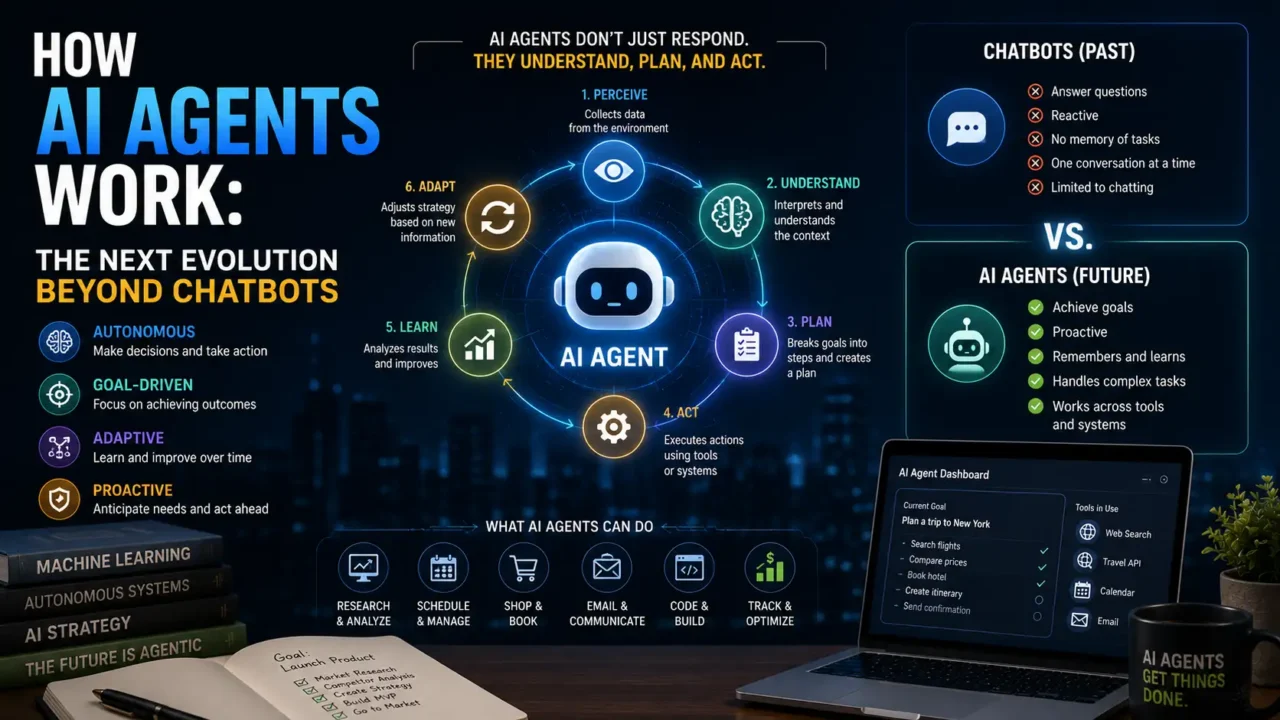
A chatbot answers your question and stops there. An AI agent takes that same question, figures out what actually needs to happen next, and goes and does it. That shift from talking to doing is the entire story behind the AI agent boom, and here’s how it actually works under the hood.
The Core Difference Between a Chatbot and an Agent
A traditional chatbot is fundamentally reactive, it waits for input, generates a response, and then waits again, with no memory of taking any real-world action in between. An AI agent, by contrast, is built to pursue a goal across multiple steps, deciding on its own what actions are needed and executing them without waiting for a human to approve every single move. This means an agent might check a calendar, query a database, send an email, and confirm a booking, all triggered by a single instruction rather than five separate prompts. The defining trait isn’t intelligence, it’s autonomy, the ability to act rather than just respond.
The Basic Loop: Perceive, Plan, Act
Underneath the hood, most AI agents run on a repeating cycle often described as perceive, plan, and act. In the perceive stage, the agent gathers relevant information, whether that’s your instruction, data from a connected tool, or the result of its own previous action. In the plan stage, it reasons through what needs to happen next to move closer to the goal, often breaking a large task into smaller, ordered steps. In the act stage, it actually executes that step, then loops back to perceive the new state of things before planning the next move, continuing until the task is complete.
Best AI Tools for Students in 2026
Why Tools and Connections Matter So Much
An AI agent without access to outside tools is really just a chatbot with extra reasoning steps, which is why tool access is what actually makes agents useful in practice. Tools give an agent the ability to search the web, query a database, run code, send a message, or interact with another piece of software, extending its capabilities far beyond generating text. Standards like MCP have emerged specifically to make it easier for agents to connect to these external tools and data sources in a consistent, structured way. Without this connective layer, even the smartest reasoning model would be stuck describing what it would do rather than actually doing it.
Memory: How Agents Keep Track of What They’re Doing
Multi-step tasks require agents to remember what’s already happened, which is why memory plays a much bigger role in agents than in simple chatbots. Short-term memory keeps track of the current task’s progress, like which steps are already completed and what the next action should be. Some more advanced agents also use longer-term memory, storing information from past interactions so they can apply relevant context to future tasks without starting completely from scratch each time. This memory layer is what allows an agent to handle a genuinely multi-step task, like planning a trip or debugging a codebase, without losing track of where it is partway through.
Single Agents vs. Multi-Agent Systems
A growing trend in this space involves multiple specialized agents working together rather than relying on one generalist agent to handle everything. Industry researchers have compared this setup to musicians in an orchestra, where each agent focuses on a specific task, like research, coding, or review, and coordinates with the others rather than trying to do it all alone. This division of labor often produces better results than a single do-everything agent, since narrow specialization tends to outperform broad generalization on complex, multi-part tasks. Standards for agent-to-agent communication have emerged specifically to help these coordinated systems share information and hand off tasks smoothly between each other.
ChatGPT vs Claude vs Gemini: Which AI Assistant Is Right for You?
Where Human Oversight Still Fits In
Despite the push toward autonomy, most well-designed agent systems still include checkpoints where a human reviews or approves significant actions before they’re finalized. This is especially common for actions with real consequences, like sending money, publishing content, or modifying important files, where a mistake would be costly or hard to reverse. Some agents operate with full autonomy for low-risk, reversible tasks while requiring explicit human approval for anything higher-stakes, creating a practical middle ground between full automation and full manual control. This layered oversight approach reflects a broader industry recognition that autonomy and safety need to scale together, not one without the other.
Real-World Examples of Agents in Action
Coding agents like Devin and Cursor can plan out a programming task, write the code, test it, debug errors it finds, and submit the finished work largely without step-by-step human guidance. Customer service agents, like those built by Sierra, don’t just answer scripted questions, they triage issues, resolve problems directly, escalate when necessary, and follow up automatically across multiple channels. Research-oriented agents can browse the web, synthesize information from dozens of sources, and generate a structured report, compressing what used to be hours of manual work into a few focused minutes. These examples share a common thread, each one takes a broad instruction and independently handles the many smaller decisions required to actually complete it.
Where This Is Headed Next
The trajectory in this space points toward increasingly specialized, increasingly coordinated systems rather than one universal agent trying to do everything. Businesses are already running an average of around a dozen AI agents simultaneously, a number expected to keep climbing as more narrow, task-specific agents get deployed across different departments. Improvements in reasoning, memory, and tool integration are all compounding together, making agents more reliable and capable of handling longer, more complex tasks with less human intervention required along the way. Understanding this basic architecture now gives you a genuine head start on making sense of whatever comes next in this fast-moving space.
Final Thoughts
AI agents represent a real architectural shift from chatbots that talk to systems that actually do, built on a repeating loop of perceiving, planning, and acting, supported by tools, memory, and increasingly coordinated multi-agent systems. Understanding this basic mechanism demystifies a term that gets thrown around constantly without much explanation.
Next time you hear “AI agent” in a headline or product pitch, you’ll actually know what’s happening underneath rather than just nodding along. If this breakdown helped make the concept click, share it with someone who’s still picturing agents as just fancier chatbots.
Call to Action
Next time “AI agent” comes up in a headline, you’ll actually know what’s happening underneath. If this breakdown helped it click, share it with someone still picturing agents as just fancier chatbots. Explore the Aziz Publishing Knowledge Library for in-depth, evidence-based articles on artificial intelligence, emerging technologies, productivity, and the future of work to stay informed in an increasingly AI-driven world.