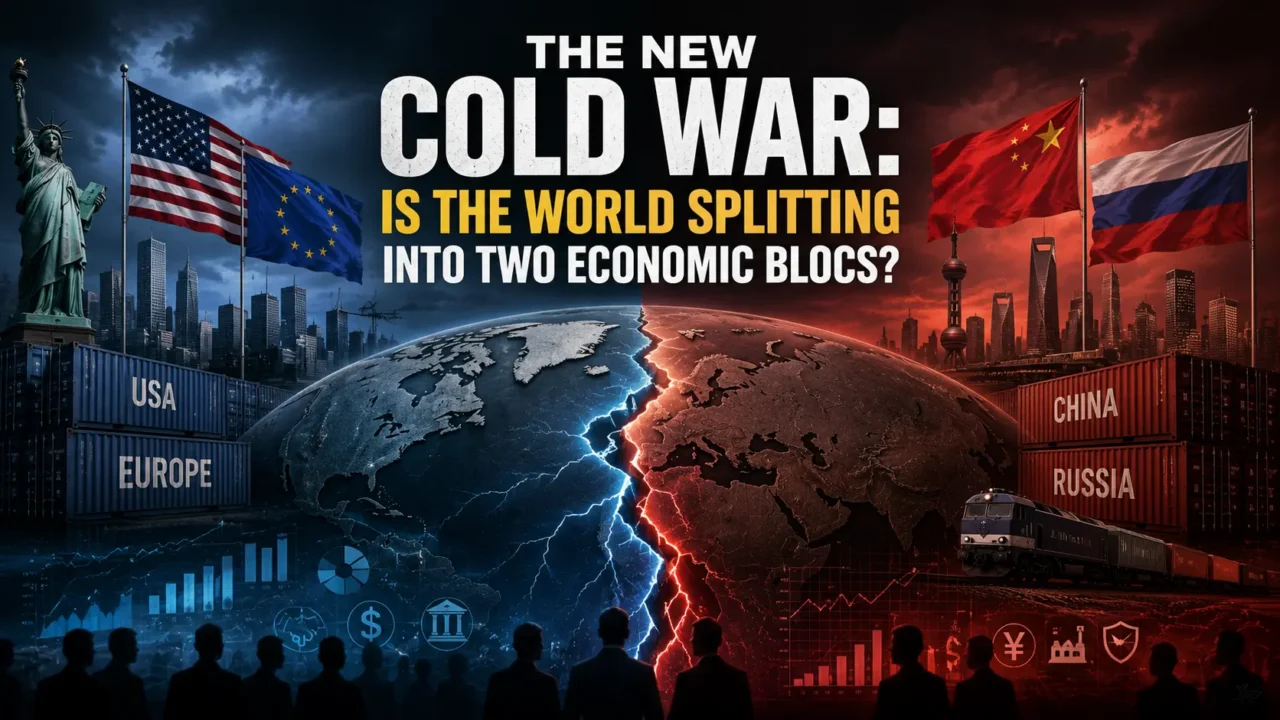
Ever notice how your phone, your car, and even your groceries seem caught in the middle of a global tug-of-war? That’s not your imagination, it’s the emerging reality of a fractured world economy. Some experts call it a new Cold War, just fought with tariffs instead of tanks.
What People Mean by “New Cold War”
The term describes rising tension between the United States and China, along with their respective allies, that increasingly mirrors the old US-Soviet rivalry. Unlike the original Cold War, this one centers on trade, technology, and economic dependence rather than direct military standoff. It’s less about ideology and more about who controls the supply chains of the future.
Iran–US War Escalation Explained: Why the Strait of Hormuz Could Reshape the Global Economy
The Push Toward “Friend-Shoring”
Countries are increasingly choosing trade partners based on political alignment rather than pure cost efficiency. This strategy, often called friend-shoring, means shifting manufacturing and supply chains toward politically friendly nations. The result is a slow but steady reshaping of global trade routes that once prioritized economics above all else.
Technology as the New Battleground
Semiconductors, AI development, and advanced technology have become central to this economic divide. Export restrictions on chips and tech components are being used as strategic tools rather than simple trade policy. Whoever controls cutting-edge technology increasingly holds outsized influence over the rest of the global economy.
Two Different Economic Philosophies
At the heart of this split are two competing economic models: one built on open markets and democratic governance, the other on state-directed growth and centralized control. These differing philosophies shape everything from investment rules to data privacy laws. Countries caught in between often have to choose which system aligns better with their own interests.
Countries Caught in the Middle
Not every nation wants to pick a side in this growing divide, and many are trying not to. Countries like India, Indonesia, and several Gulf states are pursuing multi-alignment, maintaining strong ties with both blocs simultaneously. This balancing act allows them to benefit from trade and investment opportunities on multiple fronts at once.
Supply Chains Are Being Redrawn
Global supply chains built over decades are being restructured in response to rising geopolitical risk. Companies are diversifying manufacturing locations to avoid overreliance on any single country or region. This shift is costly and slow, but many businesses see it as necessary insurance against future disruptions.
How Artificial Intelligence Is Reshaping Global Power
The Risk of Global Fragmentation
Economists warn that a fully divided world economy could reduce efficiency, raise prices, and slow innovation for everyone involved. Shared global systems for trade, finance, and technology have historically driven massive economic growth worldwide. A split into rigid blocs threatens to reverse some of those decades-long gains.
Is a Full Split Actually Inevitable?
Despite growing tension, complete economic separation remains unlikely in the near term due to deep interdependence. Global trade, financial systems, and even climate cooperation still require significant collaboration between rival powers. Many analysts believe a more likely outcome is a messy, partial split rather than two entirely separate global economies.
Final Thoughts
The world isn’t fully divided yet, but the direction of travel is becoming harder to ignore. Trade decisions, tech restrictions, and shifting alliances are quietly reshaping the global economic map in real time. Whether this leads to two distinct blocs or a more fragmented middle ground, the era of one unified global economy may already be behind us.
What do you think, are we heading toward two separate economic worlds? Share this article with someone who follows global affairs, and let us know your thoughts in the comments below.
Call to Action
Global affairs are evolving rapidly, and understanding the forces behind these changes is becoming an essential skill for professionals, investors, students, and informed citizens alike. Explore the Aziz Publishing Knowledge Library for thoughtful, evidence-based analysis of geopolitics, technology, world affairs, economics, and the emerging trends shaping the future of our interconnected world.