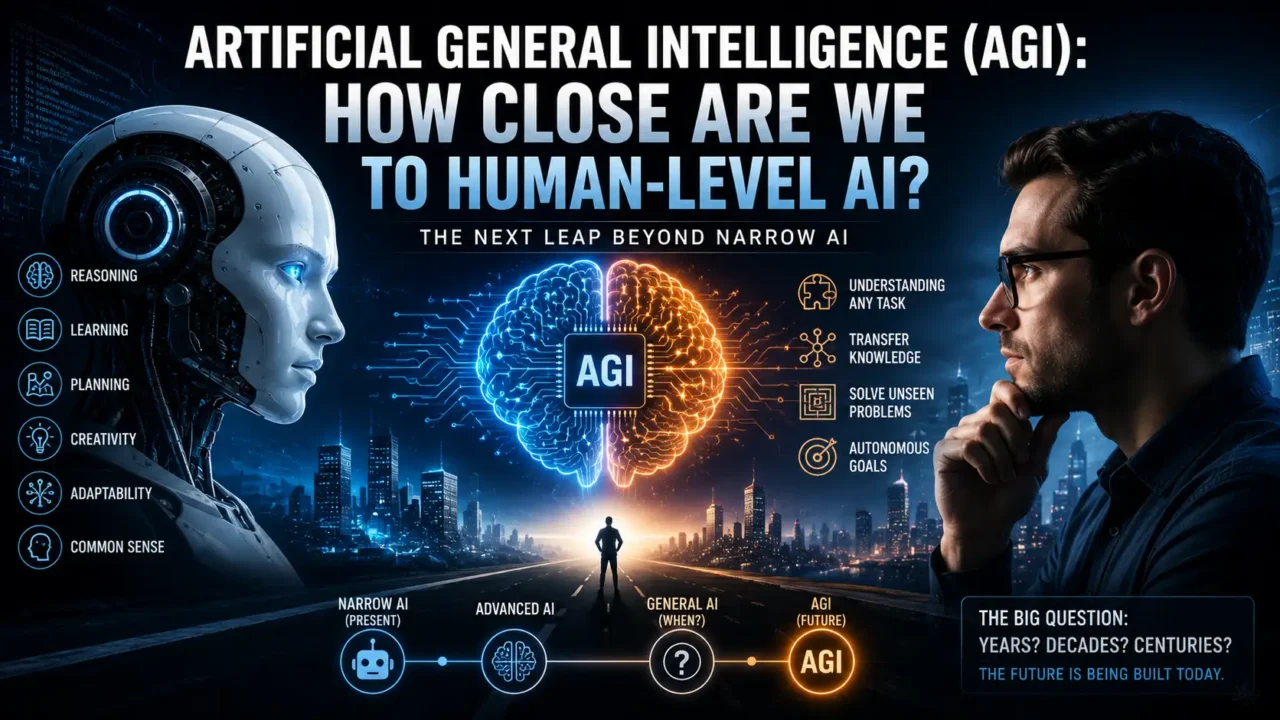
Ever wonder if AI could one day think, reason, and learn just like a human? That’s the promise, and the mystery, behind artificial general intelligence. It’s one of tech’s biggest questions, and nobody agrees on the answer.
What Exactly Is AGI?
AGI refers to AI that can understand, learn, and apply knowledge across any task, just like a human. Unlike today’s AI, which excels at narrow, specific jobs, AGI would adapt fluidly across completely different domains. This flexibility is what separates AGI from the specialized AI tools we already use daily.
How Today’s AI Is Different
Current AI systems, even powerful ones, are considered “narrow AI” because they excel at specific tasks only. A chatbot can write essays, but it can’t drive a car or diagnose an illness without separate training. AGI would remove these boundaries, applying general reasoning across countless unrelated situations.
Artificial Intelligence Explained: How AI Is Changing the World
Why Predicting AGI’s Arrival Is So Hard
Experts wildly disagree on when, or even if, AGI will actually be achieved. Some researchers predict it within a decade, while others believe it remains many decades away, if possible at all. This uncertainty stems from AGI requiring breakthroughs we haven’t fully figured out yet.
The Technical Hurdles Still Standing
Building AGI requires solving problems like common sense reasoning, transfer learning, and genuine understanding, not just pattern matching. Today’s models are excellent at recognizing patterns but struggle with true comprehension or adaptable reasoning. These technical gaps remain some of the biggest obstacles between current AI and true AGI.
Signs of Progress Worth Watching
Recent AI models show increasingly impressive reasoning, problem-solving, and multi-task capabilities compared to just a few years ago. These improvements have led some experts to argue AGI might arrive sooner than previously expected. Still, most agree these advances remain far from true general intelligence.
The Debate Over Consciousness and Understanding
A major sticking point in the AGI conversation involves whether AI can ever truly “understand” rather than just simulate understanding. Critics argue current systems only mimic intelligence through statistical patterns, without genuine comprehension. This philosophical debate remains unresolved, even among leading AI researchers themselves.
Quantum Computing Explained: Will It Change Everything?
The Risks Tied to AGI Development
If achieved, AGI could bring enormous benefits, but also serious risks if not developed responsibly. Concerns include loss of human control, unintended consequences, and significant economic disruption. This is why many researchers emphasize safety and alignment research alongside AGI’s technical development.
What This Means for the Near Future
Regardless of when true AGI arrives, today’s AI advances are already reshaping industries and daily life significantly. Staying informed helps separate realistic expectations from media hype surrounding this rapidly evolving field. The AGI conversation will likely stay central to tech discussions for years to come.
Final Thoughts
AGI remains one of technology’s most exciting and uncertain frontiers, with experts split on when it might actually arrive. While current AI is impressive, true human-level intelligence still requires breakthroughs we haven’t achieved yet. Whether AGI comes in years or decades, it’s a conversation worth following closely.
Call to Action
Do you think true AGI will arrive in our lifetime? Share this article with someone fascinated by AI and drop your thoughts in the comments below. Continue exploring the Aziz Publishing Knowledge Library for practical, evidence-based articles on artificial intelligence, science, productivity, psychology, and global trends to better understand the innovations shaping the future.