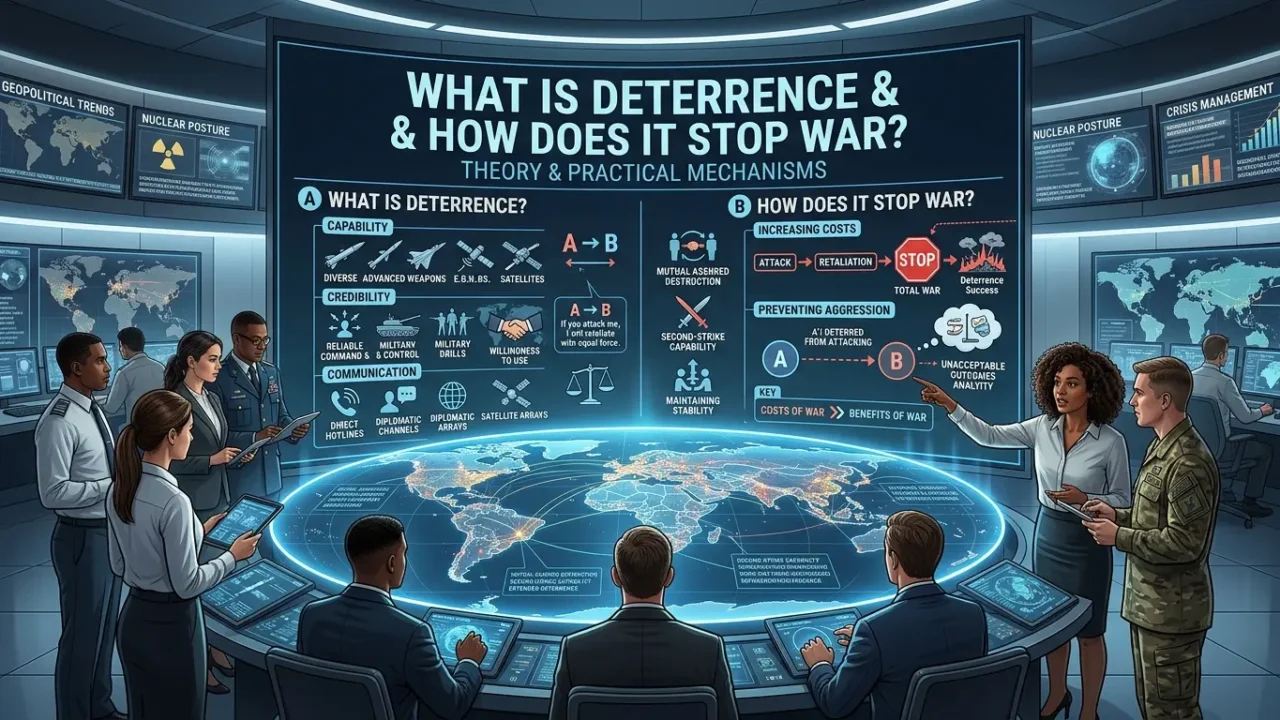
Ever wonder why two rival nations with massive armies sometimes never fire a single shot at each other? That’s deterrence quietly doing its job behind the scenes. It’s one of the oldest strategies in the world, and it still shapes global peace today.
What Deterrence Actually Means
Deterrence is the strategy of preventing an enemy from acting by convincing them the cost will outweigh any possible benefit. It doesn’t rely on actually using force, just on making the threat of retaliation feel real and unavoidable. The goal isn’t to win a war, it’s to make sure the war never starts in the first place.
The Logic Behind the Threat
At its core, deterrence works on a simple psychological principle: fear of consequences changes behavior. If a country believes an attack will trigger a devastating response, the perceived risk often outweighs any potential gain. This calculation, repeated across governments and generals alike, has quietly prevented countless conflicts throughout history.
10 Real Examples of Soft Power in Action
Nuclear Weapons and Mutual Destruction
The Cold War gave us the clearest example of deterrence in action through the doctrine of mutually assured destruction. Both the United States and the Soviet Union knew that a nuclear strike would trigger a response devastating enough to destroy both sides. That terrifying certainty, ironically, is what kept both superpowers from ever launching a single missile.
Deterrence Beyond the Battlefield
Deterrence isn’t limited to tanks, missiles, or military hardware alone. Economic sanctions, cyber capabilities, and diplomatic isolation can all serve as deterrents by raising the cost of aggression. Modern deterrence often blends multiple tools together, making the potential consequences harder to predict or ignore.
When Deterrence Actually Fails
Deterrence isn’t foolproof, and history offers plenty of examples where threats failed to prevent conflict. Miscalculation, misread signals, or sheer desperation can push a country to act despite clear warnings of retaliation. These failures remind us that deterrence depends heavily on both sides interpreting threats rationally and accurately.
The Role of Credibility
A threat only works if the other side actually believes it will be carried out. Nations spend enormous resources building military strength and showcasing resolve simply to maintain that credibility over time. Without a believable follow-through, even the most powerful threat can quickly lose its deterrent effect.
Hard Power vs Soft Power: What’s the Real Difference?
Alliances as a Deterrent Tool
Military alliances like NATO extend deterrence beyond a single country’s borders by promising collective retaliation. An attack on one member becomes an attack on all, which dramatically raises the potential cost for any aggressor. This shared commitment has helped maintain relative stability across large parts of the world for decades.
Deterrence in Everyday Life
Interestingly, deterrence isn’t just a tool used between nations, it shows up in everyday human behavior too. Security cameras, warning signs, and even visible locks all work on the same psychological principle of discouraging bad behavior before it happens. Understanding this concept helps explain why prevention often works better than punishment after the fact.
Final Thoughts
Deterrence proves that sometimes the strongest form of protection isn’t action, but the credible threat of it. From nuclear arsenals to simple security cameras, the same psychological logic keeps conflicts from escalating in the first place. As global tensions evolve, understanding deterrence remains essential to making sense of international peace and security.
Call to Action
Found this breakdown of deterrence helpful? Share it with someone curious about global politics, and let us know your thoughts in the comments below. Explore the Aziz Publishing Knowledge Library for in-depth guides on world affairs, artificial intelligence, international trade, and the forces shaping the future of global power.