World Affairs

Why Critical Minerals Have Become the World’s Most Valuable Strategic Resource

Discover why critical minerals such as lithium, cobalt, rare earth elements, and graphite have become essential for clean energy, AI, semiconductors, and global geopolitics.

Why Critical Minerals Have Become the World’s Most Valuable Strategic Resource

For decades, oil was widely regarded as the world’s most important strategic resource. Nations competed to secure energy supplies because economic growth, industrial production, transportation, and military power all depended heavily on access to petroleum. While oil remains indispensable, a new group of resources is rapidly becoming just as strategically significant. These are critical minerals—the raw materials that power electric vehicles, advanced electronics, renewable energy systems, semiconductors, artificial intelligence infrastructure, and modern defense technologies.

Unlike oil, critical minerals rarely attract public attention. Most people never think about lithium inside a smartphone battery, cobalt in an electric vehicle, gallium used in advanced semiconductors, or rare earth elements inside wind turbines and missile guidance systems. Yet these materials have quietly become the foundation of the twenty-first-century economy. Governments increasingly view them not merely as commodities but as strategic assets capable of influencing national security, technological leadership, and geopolitical power.

Understanding why critical minerals matter requires looking beyond mining itself. Their growing importance reflects a broader transformation in the global economy, where control over advanced technologies increasingly determines economic competitiveness and international influence.


What Are Critical Minerals?

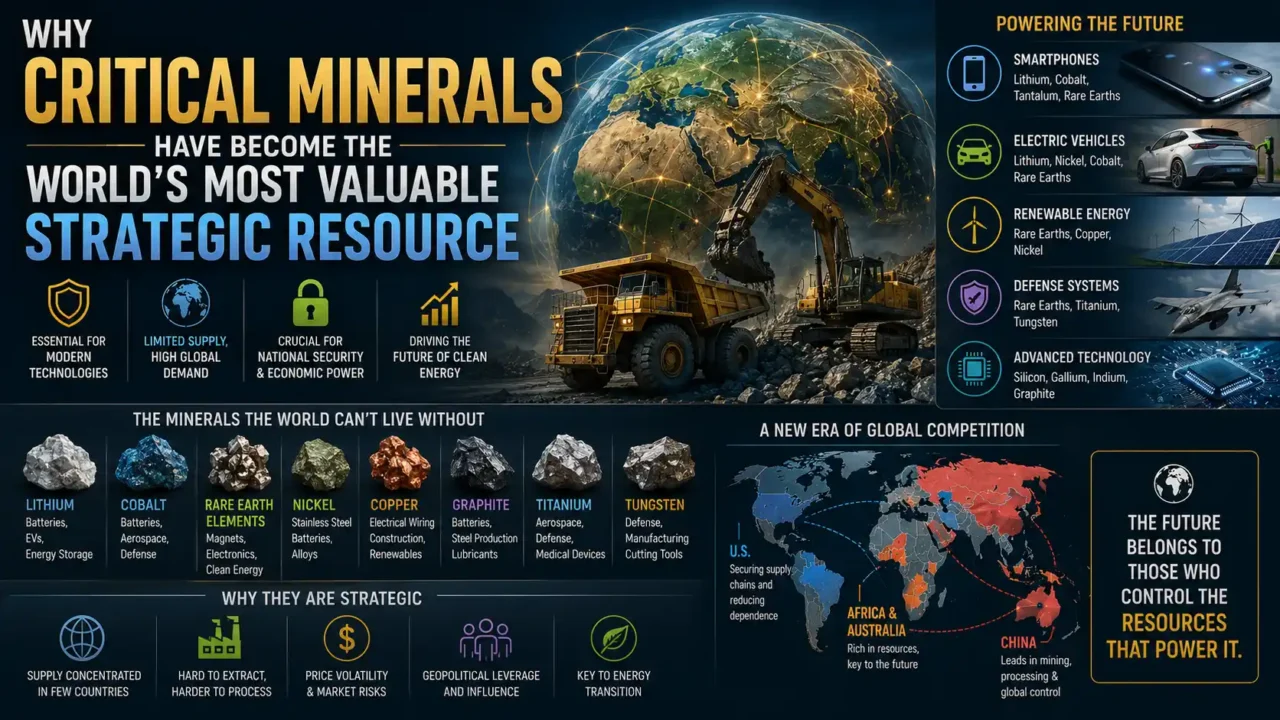
Critical minerals are naturally occurring materials considered essential to a country’s economy, technological development, or national security while also facing significant risks of supply disruption. The exact list varies by country, but commonly recognized critical minerals include lithium, cobalt, nickel, graphite, manganese, copper, rare earth elements, gallium, germanium, and tungsten.

These minerals serve as essential components in products that define modern life. Lithium, nickel, cobalt, and graphite are central to rechargeable batteries powering electric vehicles and energy storage systems. Rare earth elements are used in high-performance magnets found in wind turbines, medical equipment, smartphones, and advanced military technologies. Gallium and germanium play important roles in semiconductor manufacturing, telecommunications, and satellite systems.

Their importance lies not in their rarity alone but in the fact that many advanced technologies simply cannot function without them.


The Clean Energy Transition Is Driving Demand

One of the primary reasons critical minerals have become strategically important is the global transition toward cleaner energy systems.

Electric vehicles require substantially more mineral inputs than traditional gasoline-powered cars because of their battery systems. Wind turbines depend on specialized magnets containing rare earth elements, while solar panels require minerals used in photovoltaic technologies and electrical infrastructure. Large-scale battery storage, increasingly important for renewable electricity grids, further increases demand for lithium, nickel, graphite, and other materials.

As governments invest in reducing greenhouse gas emissions and expanding renewable energy capacity, demand for these minerals continues to grow rapidly.

Unlike fossil fuels, renewable technologies depend heavily on upfront material inputs rather than continuous fuel consumption. Securing reliable access to these materials has therefore become a central element of long-term energy strategy.


Technology Depends on Mineral Security

Critical minerals are equally important for the digital economy.

Modern smartphones contain dozens of different minerals. Artificial intelligence data centers require advanced semiconductors that depend on specialized materials. Cloud computing, telecommunications networks, robotics, aerospace engineering, quantum computing, and high-performance electronics all rely on carefully engineered supply chains supported by critical minerals.

This means technological leadership increasingly depends not only on software innovation or scientific research but also on reliable access to the raw materials that enable advanced manufacturing.

The competition for leadership in artificial intelligence, semiconductor production, and next-generation communications therefore extends far beyond computer laboratories.

It begins in mines, refineries, and mineral processing facilities.


Why Supply Chains Have Become a Geopolitical Issue

Possessing mineral deposits represents only one stage of a much larger supply chain.

Critical minerals must be mined, refined, processed, manufactured into industrial components, and ultimately incorporated into finished products. In many cases, these stages are concentrated within relatively small numbers of countries.

This concentration creates strategic vulnerabilities.

If geopolitical tensions disrupt mining operations, refining capacity, or international trade, industries around the world may experience shortages affecting manufacturing, technological development, and economic growth. Governments increasingly recognize that dependence on highly concentrated supply chains introduces risks extending well beyond commercial considerations.

As a result, many countries are investing in domestic mining, expanding refining capacity, supporting recycling technologies, and strengthening partnerships with trusted suppliers to diversify access to critical materials.

The objective is resilience rather than simple cost efficiency.


Critical Minerals and Global Power

The growing importance of critical minerals has transformed them into instruments of geopolitical influence.

Countries possessing significant mineral resources have gained increased strategic importance because global demand continues expanding. At the same time, nations with advanced refining capabilities occupy particularly influential positions within international supply chains.

Governments are responding through industrial policies, international investment agreements, export regulations, and strategic partnerships designed to strengthen long-term resource security.

Competition over critical minerals increasingly resembles earlier competition over energy resources, although with an important difference.

Instead of powering combustion engines, these materials increasingly power digital economies, clean energy technologies, and advanced manufacturing systems.

Resource security has therefore become closely connected to technological sovereignty.

How the U.S.–China Rivalry Is Reshaping the Global Economy


Challenges Beyond Geopolitics

Although demand for critical minerals continues increasing, expanding supply presents important environmental and social challenges.

Mining operations can affect ecosystems, water resources, and local communities if not managed responsibly. Processing minerals often requires substantial energy and chemical inputs, creating additional environmental considerations. Governments and companies therefore face the challenge of balancing growing demand with sustainable extraction practices and stronger environmental oversight.

Recycling offers one potential solution.

Recovering valuable minerals from used batteries, electronics, and industrial equipment may gradually reduce pressure on newly mined resources while strengthening supply chain resilience. Researchers are also exploring alternative battery chemistries and new materials that could reduce dependence on certain scarce minerals.

Innovation will therefore influence not only how minerals are used but also how efficiently they are recovered and reused.


Why This Matters for the Future

The significance of critical minerals extends far beyond mining companies or commodity markets.

These materials influence the pace of clean energy adoption, the competitiveness of manufacturing industries, the future of artificial intelligence, national defense capabilities, and the resilience of global supply chains. Decisions made today regarding mineral exploration, processing, recycling, and international cooperation will shape technological development for decades.

Businesses increasingly consider mineral availability when planning investments. Governments incorporate resource security into industrial strategy. Universities expand research into advanced materials, battery technologies, and sustainable mining methods.

Critical minerals have become foundational infrastructure for the digital age.

Just as oil shaped the geopolitical landscape of the twentieth century, these resources are increasingly shaping the strategic landscape of the twenty-first.

How Artificial Intelligence Is Reshaping Global Power


Conclusion

Critical minerals have become some of the world’s most valuable strategic resources because they sit at the intersection of energy, technology, economics, and national security. They enable electric vehicles, renewable energy systems, advanced electronics, artificial intelligence, aerospace innovation, and modern defense technologies that define contemporary economic competitiveness.

Their growing importance reflects a broader shift in global priorities. Nations are no longer competing only for access to energy supplies. They are also competing for the materials that will determine leadership in future industries.

Understanding critical minerals therefore provides more than insight into resource markets.

It offers a clearer understanding of why geopolitics, technological innovation, environmental sustainability, and economic strategy have become increasingly interconnected.

The countries that successfully secure reliable, responsible, and resilient mineral supply chains will likely possess significant advantages in shaping the next era of global development.


Call to Action

From electric vehicles and renewable energy to artificial intelligence and advanced manufacturing, critical minerals are becoming one of the defining strategic resources of the twenty-first century. Explore the Aziz Publishing Knowledge Library for evidence-based analysis of world affairs, geopolitics, science, and emerging technologies to better understand the forces shaping the global economy.


Stop Letting Your Mind Sabotage You

Continue with the Book

Stop Letting Your Mind Sabotage You

Explore the deeper framework for understanding self-sabotage, rebuilding self-trust, and creating meaningful personal change.