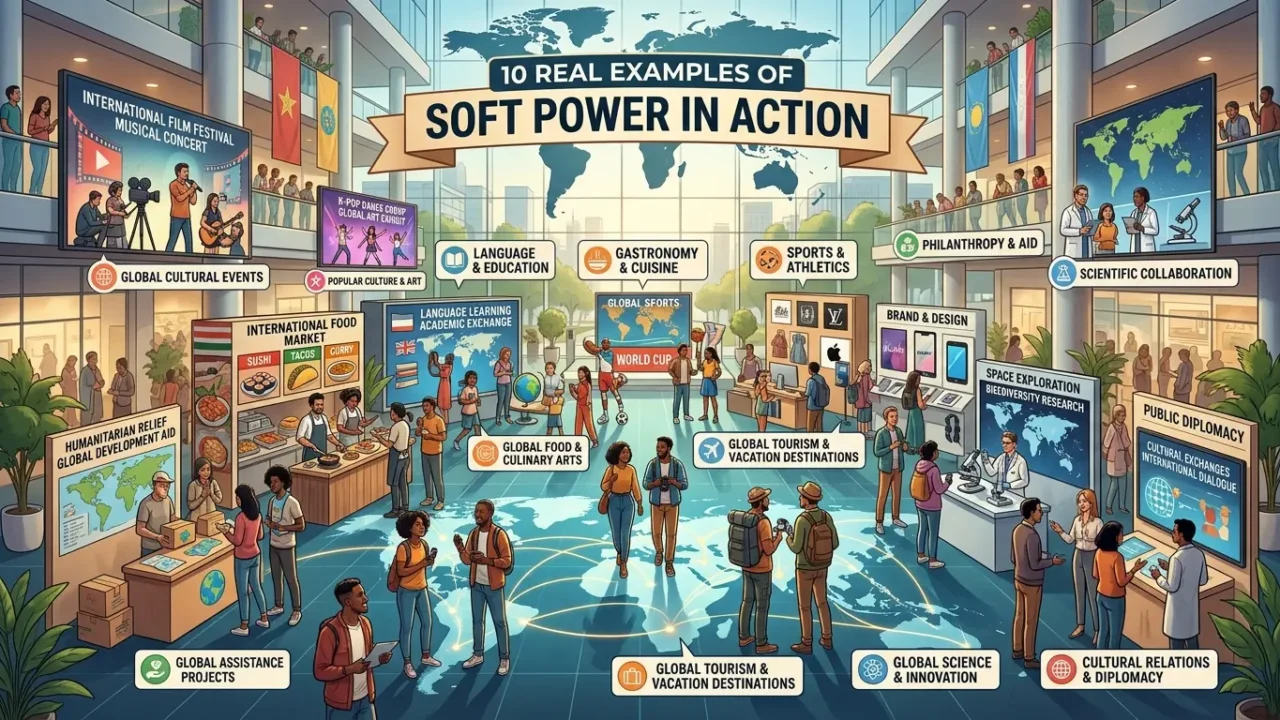
Ever wonder why a K-pop song can dominate headlines more than an actual trade deal? That’s soft power quietly doing its job. It’s the art of winning hearts and minds instead of battles, and it shapes global politics far more than most people realize.
What Is Soft Power Anyway?
Soft power is a nation’s ability to influence others through attraction rather than force or coercion. It works through culture, values, education, and diplomacy instead of tanks, tariffs, or threats. The term was coined by political scientist Joseph Nye, and it explains why some countries simply feel more “likable” on the world stage than others. Unlike military or economic power, soft power builds slowly through admiration and trust rather than pressure. It doesn’t demand loyalty; it earns it over years of consistent cultural presence. Once that trust takes hold, it often proves more durable and effective than any single policy or treaty.
Music and Entertainment Take the World Stage
South Korea’s Hallyu wave is one of the clearest examples of cultural soft power in the modern era. Groups like BTS and BLACKPINK have turned K-pop into a global export bigger than many of the country’s traditional industries. Fans around the world learn Korean, travel to Seoul, and buy Korean products simply to feel closer to the culture they admire.This kind of influence isn’t accidental or organic alone. The South Korean government has actively funded and promoted entertainment exports for decades as part of a deliberate cultural strategy. The result is a nation now globally associated with creativity, cool aesthetics, and innovation rather than just its geopolitical tensions.
Hard Power vs Soft Power: What’s the Real Difference?
Movies That Shape Minds
Hollywood has long served as America’s unofficial cultural ambassador to the rest of the world. Its films quietly spread American values, humor, fashion, and lifestyle into homes on nearly every continent. Many people form their first impressions of the United States through movies long before they ever set foot there. Bollywood plays a strikingly similar role for India, especially across South Asia, the Middle East, and parts of Africa. Its music, colorful storytelling, and larger-than-life drama create emotional connections that outlast any diplomatic visit or trade summit. Together, both film industries prove that stories and songs often travel faster and land deeper than official speeches ever could.
Teaching Language, Building Influence
China’s Confucius Institutes bring Mandarin language classes and cultural programming to universities across dozens of countries. They’re carefully designed to build familiarity, curiosity, and goodwill toward Chinese culture among younger generations. Critics argue it’s a form of propaganda, but there’s no denying its steady reach into classrooms worldwide. The British Council has run a remarkably similar playbook for nearly a century now. By teaching English and promoting British literature, art, and music, it keeps the UK culturally relevant long after its empire faded from global power. Language, as both examples show, remains one of the most effective and long-lasting soft power tools any country can use.
Sports as a Global Stage
Hosting the Olympics is one of the most visible displays of national soft power in action. Countries spend billions not just to host the games themselves, but to showcase their infrastructure, hospitality, and modern global standing to a watching world. Both Beijing and Tokyo used their respective Olympics to signal progress, discipline, and technological advancement on the world stage. Qatar’s 2022 World Cup followed a similar logic, but on the scale of a much smaller nation. The tournament was used strategically to boost tourism, attract foreign investment, and dramatically increase the country’s international visibility. In just a few weeks, a single sporting event reshaped how millions of people around the world perceived the country.
What Is a Proxy War? Explained Simply
Tech and Innovation as National Pride
Silicon Valley isn’t just an economic engine; it also functions as a powerful soft power tool for the United States. Companies like Apple, Google, and Meta shape how billions of people communicate, work, and consume information every single day. That kind of constant daily presence builds a form of influence that money alone simply cannot buy. When people rely on American apps, devices, and platforms, they’re also quietly absorbing American design values, habits, and cultural norms. Innovation slowly becomes identity, and identity eventually becomes influence on a global scale. It’s soft power hiding in plain sight, arriving one notification and one update at a time.
Kindness as Strategy
Nordic countries like Sweden and Norway have built strong global reputations through generous and consistent foreign aid programs. Their long-term support for global health initiatives, education, and peacebuilding efforts earns them outsized respect and trust internationally. Despite having small populations, these nations wield surprisingly large moral and diplomatic influence. This approach proves that soft power doesn’t always require glitz, spectacle, or massive budgets to be effective. Sometimes it’s built quietly, through decades of reliable goodwill and consistent humanitarian commitment. Trust earned this patient; steady way tends to be remarkably hard to shake once it’s established.
Final Thoughts
From K-pop concerts to quiet humanitarian aid programs, soft power shows up in countless ways that we consume constantly but rarely stop to notice. These ten examples together prove that culture, creativity, and genuine kindness can shift global perception just as powerfully as any policy paper or trade agreement. In today’s connected world, influence is increasingly earned through admiration rather than enforced through pressure.
Call to Action
Which of these examples surprised you the most, and why? Share this article with a friend who loves geopolitics, pop culture, or both, and let us know your thoughts in the comments below. Explore the Aziz Publishing Knowledge Library for in-depth guides on world affairs, artificial intelligence, international trade, and the forces shaping the future of global power.