World Affairs

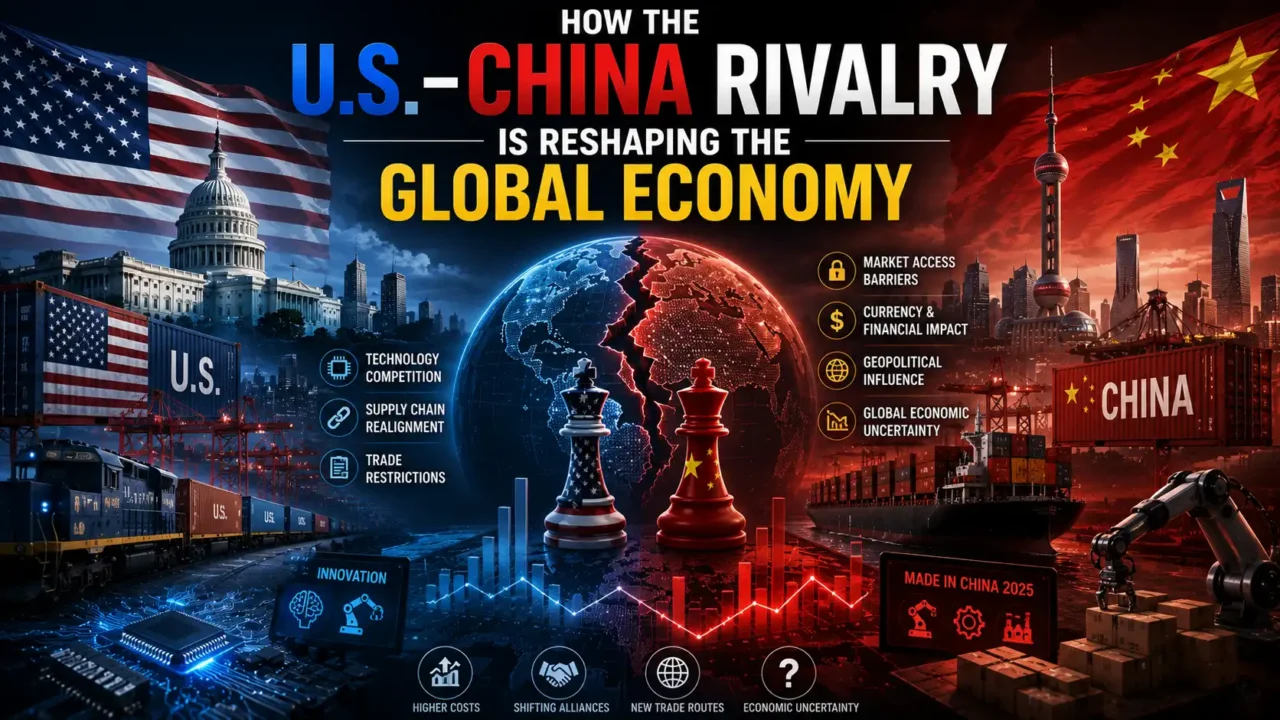
How the U.S.–China Rivalry Is Reshaping the Global Economy

The competition between the United States and China is redefining globalization. Learn how technology, trade, supply chains, and geopolitical strategy are reshaping the future of the global economy.

How the U.S.–China Rivalry Is Reshaping the Global Economy

For much of the past four decades, the global economy was built on an assumption that seemed almost unshakable: countries could compete politically while becoming increasingly integrated economically. Businesses optimized supply chains across continents, consumers benefited from lower prices, and international trade expanded at an unprecedented pace. The United States and China became the two central pillars of this interconnected system—one leading in finance, innovation, and consumption, the other becoming the world’s manufacturing powerhouse.

That era is entering a new phase.

Today, the relationship between the United States and China is increasingly defined by strategic competition rather than simple economic cooperation. Trade disputes, technology restrictions, investment screening, semiconductor competition, supply chain diversification, and national security concerns have fundamentally altered how governments and businesses think about globalization. The question is no longer whether the rivalry matters. It is how deeply it will reshape the global economy over the coming decades.

The effects already extend far beyond Washington and Beijing. Companies, investors, workers, and consumers around the world are adapting to a new economic landscape in which geopolitical strategy has become inseparable from business strategy. Understanding this transformation requires looking beyond headlines and examining the structural changes taking place beneath the surface of global commerce.


From Economic Partnership to Strategic Competition

When China joined the World Trade Organization in 2001, many economists believed that deeper economic integration would encourage greater international cooperation. Global companies invested heavily in Chinese manufacturing, while China’s rapidly growing economy created enormous opportunities for foreign businesses. The relationship generated substantial benefits for both countries and accelerated global economic growth.

Over time, however, areas of disagreement expanded. Concerns surrounding intellectual property, technology transfer, industrial policy, cybersecurity, trade imbalances, and national security became increasingly prominent. Rather than viewing economic interdependence as an unquestioned strength, policymakers began examining the risks associated with relying heavily on strategic competitors.

The result has been a gradual shift from maximizing efficiency toward balancing efficiency with resilience. Governments now evaluate economic policies through both commercial and geopolitical lenses.


Technology Has Become the Center of the Rivalry

Although tariffs initially dominated public discussion, technology has become the defining arena of U.S.–China competition. Artificial intelligence, advanced semiconductors, quantum computing, biotechnology, telecommunications, and cloud infrastructure are no longer viewed solely as commercial industries. They are increasingly considered strategic assets with significant implications for economic growth and national security.

Semiconductors illustrate this transformation particularly well. Modern chips power smartphones, automobiles, medical equipment, military systems, and artificial intelligence models. Because advanced semiconductor manufacturing requires highly specialized expertise and equipment, governments have introduced export controls, domestic investment programs, and industrial policies designed to strengthen their own technological capabilities.

Competition for technological leadership is therefore influencing research funding, corporate investment, higher education, and international partnerships. Scientific innovation has become closely connected to geopolitical strategy.


Supply Chains Are Being Redesigned

One of the most significant consequences of the rivalry is the restructuring of global supply chains.

For decades, businesses concentrated manufacturing where costs were lowest. Efficiency became the dominant objective. Recent disruptions—including the COVID-19 pandemic, geopolitical tensions, and regional conflicts—revealed that highly concentrated supply chains could also create substantial vulnerabilities.

Many multinational companies are now pursuing supply chain diversification rather than complete relocation. Manufacturing is expanding into countries such as India, Vietnam, Mexico, Indonesia, and several Southeast Asian economies. This strategy, often described as China Plus One, reduces dependence on a single production base while preserving access to global markets.

The objective is not necessarily abandoning China.

Instead, businesses increasingly seek flexibility, resilience, and reduced geopolitical risk.

This gradual diversification is reshaping patterns of global investment and creating new opportunities for emerging economies.

The New Cold War: Is the World Splitting Into Two Economic Blocs?


A More Fragmented Trading System

Globalization is not disappearing, but it is becoming more selective.

Governments increasingly distinguish between ordinary consumer goods and strategically important industries. Critical minerals, batteries, artificial intelligence, advanced manufacturing, pharmaceuticals, telecommunications infrastructure, and semiconductor production now receive far greater policy attention than they did a decade ago.

This shift has contributed to policies encouraging friend-shoring, where countries strengthen trade relationships with trusted political partners, and near-shoring, where production moves closer to major consumer markets.

Although international trade remains extensive, economic relationships are becoming increasingly influenced by political alignment and national security considerations.

The global trading system is evolving from one centered primarily on efficiency toward one balancing efficiency with strategic resilience.


Opportunities and Challenges for the Rest of the World

The U.S.–China rivalry is not affecting only the world’s two largest economies.

Many middle-income countries are finding themselves in advantageous positions as companies diversify investment. Nations including India, Vietnam, Malaysia, Indonesia, Mexico, and several Gulf economies have attracted increased manufacturing, infrastructure investment, and technology partnerships.

At the same time, governments face difficult diplomatic choices. Many countries prefer maintaining productive economic relationships with both Washington and Beijing rather than aligning exclusively with either side. This approach allows them to benefit from multiple investment sources while preserving strategic flexibility.

The emerging international economy therefore appears increasingly multipolar rather than divided into two completely separate blocs.

Countries are adapting pragmatically instead of making absolute geopolitical choices.


What This Means for Businesses and Consumers

For businesses, geopolitical analysis has become an essential component of corporate strategy.

Investment decisions now consider political stability, regulatory risk, supply chain resilience, export controls, cybersecurity, and trade policy alongside traditional financial metrics. Executives increasingly recognize that international events can directly affect production costs, investment opportunities, and long-term competitiveness.

Consumers are also experiencing the consequences, although often indirectly. Diversified supply chains, domestic manufacturing initiatives, and technology restrictions can increase production costs, which may contribute to higher prices for certain goods. At the same time, greater investment in advanced manufacturing may strengthen long-term economic resilience and reduce vulnerability to future disruptions.

The relationship between geopolitics and everyday economic life has become significantly closer than it was only a decade ago.


Competition Without Complete Separation

Despite growing tensions, describing the relationship as complete economic decoupling would oversimplify reality.

The United States and China remain among each other’s significant trading partners. Financial markets remain interconnected, multinational corporations continue operating across both economies, and global scientific collaboration persists in many fields.

Rather than complete separation, the more accurate description is selective decoupling or de-risking. Countries seek greater independence in strategically sensitive sectors while maintaining cooperation where mutual economic benefits remain substantial.

This distinction is important because it suggests that competition and cooperation will continue existing simultaneously.

The future global economy is unlikely to consist of isolated economic systems.

Instead, it will be characterized by increasingly complex relationships where collaboration and rivalry coexist.

How Artificial Intelligence Is Reshaping Global Power


Conclusion

The U.S.–China rivalry is reshaping the global economy in ways that extend far beyond trade disputes or diplomatic negotiations. It is influencing technological innovation, investment decisions, manufacturing strategies, supply chains, labor markets, and the future direction of globalization itself.

Rather than signaling the end of international economic integration, this transformation represents its evolution. Governments are placing greater emphasis on resilience, technological leadership, and national security while businesses adapt to a world where geopolitical considerations increasingly shape commercial decisions.

For individuals, understanding these changes is becoming an essential form of economic literacy. Careers, investments, product availability, and technological innovation will all be influenced by how this relationship continues to evolve.

The defining question is no longer whether globalization will continue.

It is what kind of globalization will emerge in an era where economic cooperation and strategic competition increasingly exist side by side.


Call to Action

The global economy is changing faster than ever, driven by geopolitics, technology, and shifting trade relationships. Continue exploring the Aziz Publishing Knowledge Library for thoughtful, evidence-based analysis of world affairs, economics, science, and emerging technologies to better understand the forces shaping the future.


Stop Letting Your Mind Sabotage You

Continue with the Book

Stop Letting Your Mind Sabotage You

Explore the deeper framework for understanding self-sabotage, rebuilding self-trust, and creating meaningful personal change.