Ever typed a vague question into an AI chatbot and gotten back something equally vague in return? That’s not the AI being unhelpful, it’s usually a prompting problem, and it’s almost always fixable. Here’s how to actually get the results you’re looking for.
What Prompt Engineering Actually Means
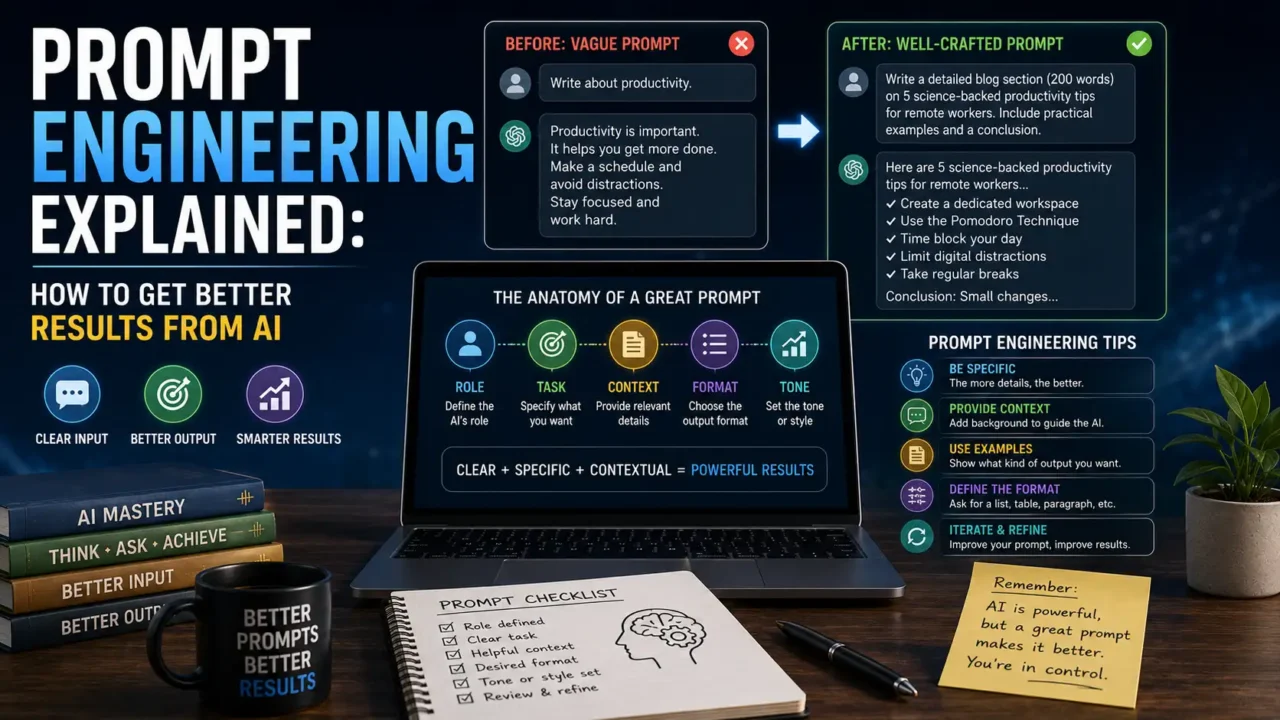
Prompt engineering is simply the practice of writing your instructions to an AI model in a way that gets you a more accurate, useful, or specific response. It’s not a mysterious technical skill reserved for developers, it’s closer to learning how to ask a very capable but very literal assistant for exactly what you need. The core idea is that AI models respond to the quality of your input, vague prompts tend to produce vague, generic outputs, while clear, detailed prompts tend to produce clear, detailed outputs. Once you understand this cause and effect, improving your prompts becomes mostly a matter of practice rather than technical expertise.
Be Specific Instead of Vague
The single biggest lever for better AI output is simply being more specific about what you actually want. Instead of asking “write me a blog post about marketing,” specifying the topic, target audience, tone, and length gives the model far more to work with, resulting in something closer to what you actually need on the first try. Vague prompts force the model to guess at your intent, and guesses are rarely as good as clear direction. Treating your prompt like a brief you’d hand to a freelancer, with enough context that they wouldn’t need to ask follow-up questions, is a genuinely useful mental model here.
Give the AI a Role or Persona
Assigning the AI a specific role at the start of your prompt often shapes the response more effectively than you’d expect. Asking it to respond “as an experienced financial advisor” or “as a high school science teacher explaining this to a beginner” shifts both the tone and the depth of the answer toward that specific perspective. This technique works because it narrows the range of plausible responses the model considers, steering it toward the vocabulary, structure, and level of detail associated with that role. It’s a small addition to a prompt that frequently produces a noticeably more targeted result.
How AI Agents Work: The Next Evolution Beyond Chatbots
Show, Don’t Just Tell, With Examples
Providing a concrete example of the output you want, sometimes called few-shot prompting, is one of the most reliable ways to improve consistency in AI responses. If you want a specific formatting style, tone, or structure, showing one example of what “good” looks like communicates far more precisely than trying to describe it in words alone. This is especially useful for repetitive tasks, like writing product descriptions or email templates, where consistency across multiple outputs actually matters. Even a single well-chosen example can dramatically narrow the gap between what you’re imagining and what the model actually produces.
Break Complex Tasks Into Steps
Asking an AI to do too much in a single, complicated prompt often produces a rushed, shallow response that tries to touch everything without doing anything particularly well. Breaking a complex task into smaller, sequential steps, first asking for an outline, then asking for a draft based on that outline, generally produces stronger, more coherent results. This mirrors how a human would naturally approach a complicated project, working through it in stages rather than trying to nail everything in one pass. For genuinely complex work, this step-by-step approach is often the single biggest quality improvement available.
Encourage Step-by-Step Reasoning
For tasks involving logic, analysis, or problem-solving, explicitly asking the model to think through its reasoning step by step before giving a final answer tends to improve accuracy significantly. This technique, sometimes called chain-of-thought prompting, gives the model room to work through intermediate steps rather than jumping straight to a conclusion that might skip important considerations. It’s particularly useful for math problems, multi-part decisions, or anything where the reasoning behind an answer matters as much as the answer itself. Simply adding a phrase like “walk through your reasoning before answering” can noticeably improve the quality of more complex responses.
Specify Format and Length Explicitly
AI models can produce output in almost any format, but they need to be told which one you actually want rather than left to guess. Specifying whether you want a bulleted list, a table, a short paragraph, or a specific word count removes ambiguity and saves you the extra step of manually reformatting the response afterward. This becomes especially important for tasks that will be used somewhere specific, like a report with defined section headers or a social media post with a strict character limit. A few extra words specifying format upfront usually save far more time than they cost to write.
Best AI Tools for Students in 2026
Iterate Instead of Starting Over
One of the most underused prompting strategies is simply treating the first response as a draft rather than a final answer, then refining it through follow-up instructions. Telling the model what specifically didn’t work, too long, too formal, missing a key point, generally produces a better result faster than abandoning the conversation and starting a fresh prompt from scratch. This iterative back-and-forth mirrors how editing actually works with a human collaborator, and AI models are well-suited to incorporating specific, targeted feedback. Treating your first prompt as a starting point rather than a one-shot attempt changes the entire dynamic of the interaction.
Final Thoughts
Prompt engineering isn’t about finding secret magic words, it’s about communicating clearly, providing useful context, and treating the interaction as a genuine back-and-forth rather than a single perfect request. Specificity, examples, step-by-step breakdowns, and iteration consistently produce better results than vague, one-shot prompts across nearly every use case.
Next time an AI response falls short, before assuming the tool isn’t capable enough, try adding more specific context or breaking the task into smaller steps first. If this breakdown helped you get better results from AI, share it with someone who’s still typing one-line prompts and wondering why the answers feel generic.
Call to Action
Next time an AI response falls short, try adding more specific context or breaking the task into smaller steps first. If this helped you get better results, share it with someone still typing one-line prompts and wondering why the answers feel generic. Explore the Aziz Publishing Knowledge Library for practical, evidence-based guides on AI, productivity, technology, and lifelong learning to build the skills that matter in the age of intelligent machines.