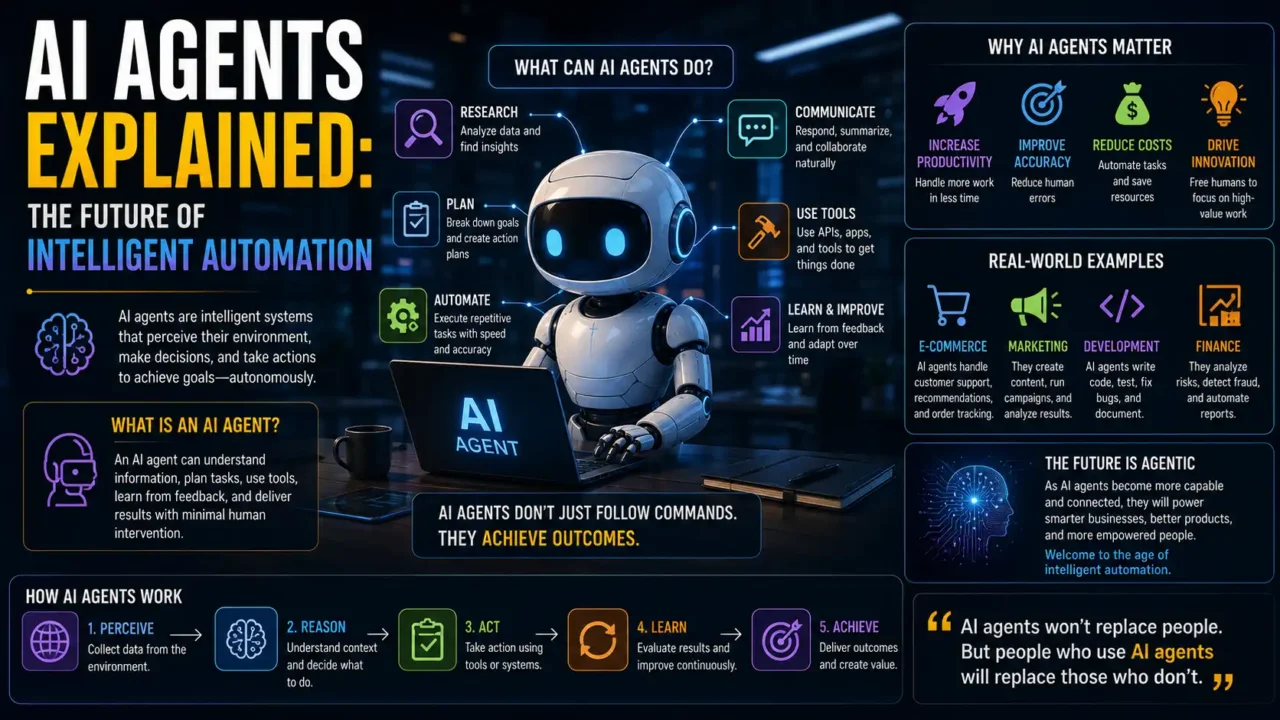
Automation used to mean rigid, rule-based systems that broke the moment something unexpected happened. AI agents are changing that entirely, bringing genuine judgment and adaptability to tasks that used to require constant human oversight. Here’s what’s actually driving this shift, and where it’s headed next.
What Makes an AI Agent Different From Old-School Automation
Traditional automation follows fixed, pre-programmed rules, if this happens, do that, with zero flexibility when a situation falls outside those exact conditions. AI agents work fundamentally differently, using reasoning to interpret a goal and figure out the best path to achieve it, adapting as circumstances change along the way. This means an agent can handle situations its creators never explicitly anticipated, something rule-based automation simply can’t do. The shift from rigid rules to adaptive reasoning is exactly why AI agents are being described as the next real evolution in automation, not just a faster version of the same old approach.
The Business Case Driving Rapid Adoption
Companies aren’t adopting AI agents out of curiosity, they’re adopting them because the return on investment has become genuinely measurable. The average business now runs around a dozen AI agents simultaneously, a number expected to keep climbing as more departments find specific, high-value use cases. Agentic AI is increasingly deployed across cybersecurity, sales, marketing, and customer service, treated as practical infrastructure rather than an experimental side project. This growing adoption reflects a simple business reality, a single capable agent can often replace several separate software subscriptions or reduce the manual workload a team used to require.
How Agents Actually Get Work Done
Most AI agents operate on a repeating cycle of perceiving information, planning next steps, and taking action, then looping back to reassess before continuing. In the perceive stage, an agent gathers relevant information, whether that’s a user’s instruction or the result of its own previous action. In the plan stage, it reasons through what needs to happen next, often breaking a complex task into smaller, sequential steps. In the act stage, it actually executes that step, whether that means querying a database, sending a message, or updating a record, before looping back to check progress and plan the next move.
How AI Agents Work: The Next Evolution Beyond Chatbots
Why Multi-Agent Systems Are Becoming the Norm
Rather than relying on one generalist agent to handle everything, a growing trend involves multiple specialized agents working together, each focused on a specific piece of a larger task. Industry researchers often compare this to musicians in an orchestra, where each agent handles its own part and coordinates with the others rather than one soloist trying to play every instrument at once. This division of labor tends to outperform single, do-everything agents, since narrow specialization generally produces better results on complex, multi-part work. Standards for agent-to-agent communication have emerged specifically to help these coordinated systems hand off tasks and share information smoothly between each other.
Real Industries Already Being Transformed
In customer service, AI agents now triage incoming issues, resolve problems directly, and escalate only when genuinely necessary, handling far more than the scripted responses of older chatbot systems. In software development, coding agents can plan out a task, write the code, test it, debug errors, and submit finished work with minimal step-by-step guidance from a human developer. In legal and professional services, specialized agents help draft contracts, review documents, and research case law significantly faster than traditional manual processes. Each of these examples shares a common thread, agents taking a broad instruction and independently handling the many smaller decisions required to actually complete it.
The Infrastructure Making This Possible
None of this works without a connective layer letting agents actually reach outside tools, databases, and other software rather than being limited to generating text alone. Standards like MCP have emerged specifically to give agents a consistent, structured way to connect with external systems, turning isolated reasoning into genuine real-world action. Memory systems also play a growing role, letting agents track progress on a task and, in more advanced cases, apply relevant context from past interactions to new situations. This underlying infrastructure, tools, memory, and communication standards, is what’s quietly enabling the leap from experimental demos to dependable business tools.
AI Agents vs Chatbots: What’s the Real Difference?
Where Human Oversight Still Belongs
Despite the push toward autonomy, well-designed agent systems still include checkpoints where a human reviews or approves higher-stakes actions before they’re finalized. This matters especially for decisions with real consequences, like financial transactions, published content, or changes to critical systems, where a mistake could be costly or difficult to reverse. Many organizations are settling into a practical middle ground, full autonomy for low-risk, reversible tasks, and required human approval for anything with meaningful stakes attached. This layered approach reflects a broader recognition across the industry that autonomy and safety need to scale together rather than racing ahead independently.
What This Means for the Future of Work
The trajectory points toward increasingly specialized, increasingly coordinated agent systems rather than one universal tool trying to do everything for everyone. As reasoning, memory, and tool integration continue improving together, agents will likely handle longer, more complex tasks with less direct human intervention required at each step. This doesn’t necessarily mean mass job displacement overnight, but it does mean the tools professionals rely on daily are evolving faster than most job descriptions have managed to catch up with. Understanding this shift now, rather than after it’s already reshaped your industry, offers a genuine practical advantage.
Final Thoughts
AI agents represent a real shift from rigid, rule-based automation to adaptive systems capable of reasoning, planning, and taking independent action across genuinely complex tasks. From customer service to coding to legal work, the industries already being transformed offer a clear preview of where intelligent automation is headed next.
Start paying attention to which agent categories are gaining traction fastest in your own industry, since that’s usually the clearest signal of what’s coming for your specific role. If this breakdown helped make sense of where automation is actually headed, share it with a colleague still picturing AI as nothing more than a fancier chatbot.
Call to Action
Start paying attention to which agent categories are gaining traction fastest in your industry, that’s usually the clearest signal of what’s coming next. If this helped clarify where automation is headed, share it with a colleague still picturing AI as just a fancier chatbot. Explore the Aziz Publishing Knowledge Library for in-depth, evidence-based articles on artificial intelligence, emerging technologies, productivity, and the future of work to stay informed in an increasingly AI-driven world.