Software is now being written by people who describe what they want in plain English instead of typing code themselves. It is called vibe coding, and after being named the Collins Dictionary 2025 Word of the Year, it has gone from developer slang to a mainstream phenomenon. Here is what vibe coding actually is, how it works, and whether you should try it.
What Vibe Coding Actually Means
Vibe coding is a way of building software where you describe what you want in natural language and let an AI system write the actual code. Instead of learning a programming language, memorizing syntax, or debugging cryptic error messages, you hold a conversation: you explain the app or feature you want, the AI generates working code, and you test the result and ask for changes.
The term was coined by AI researcher Andrej Karpathy in February 2025 to describe creating software while being able to “forget that the code even exists.” It caught on fast. Collins Dictionary named it the 2025 Word of the Year, defining it as the use of artificial intelligence prompted by natural language to assist with writing computer code. Merriam-Webster followed by adding it to the dictionary in 2026.
The numbers behind the trend are striking. By early 2026, nearly half of all new code committed globally was AI-generated, and Y Combinator reported that a quarter of its Winter 2025 startups had codebases that were 95 percent AI-written. Even Linus Torvalds, the famously hands-on creator of Linux, revealed in January 2026 that he used an AI coding tool to build a visualization program and found the experience surprisingly productive.
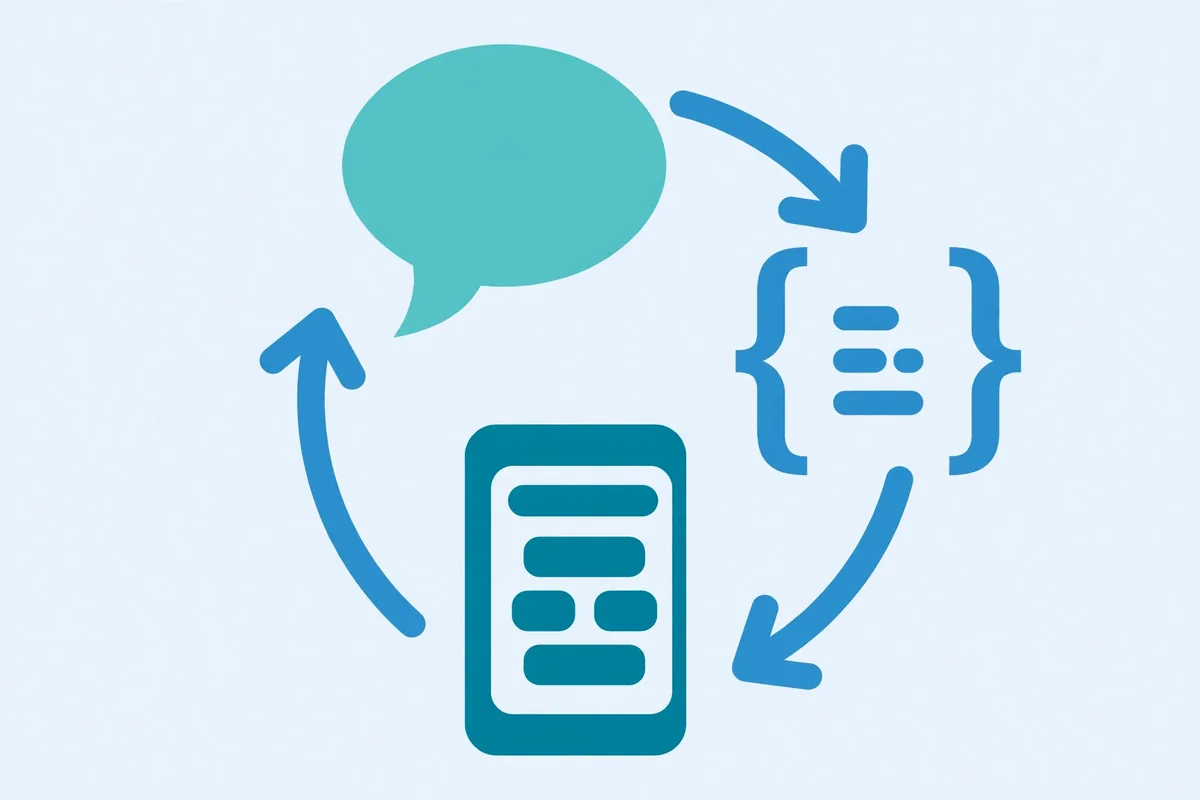
How It Works: Describe, Generate, Refine
The vibe coding loop is simple enough that a complete beginner can follow it. First, you describe what you want the way you would explain it to a friend: “Build me a personal budget tracker with a monthly spending chart and a dark mode toggle.” The more specific your description, the better the first result tends to be.
Next, the AI generates a working version, often in seconds. You click through it, test the buttons, and see what it actually built. Then comes the part that matters most: refinement. You point at what is wrong or missing and describe the fix in plain words. “Make the chart bigger.” “Add a login screen.” “This looks broken on my phone.” Each round of feedback gets you closer to what you imagined.
This loop is the whole methodology. There is no separate planning document, no architecture diagram, no manual wrestling with syntax errors. The AI handles the translation from human intent to machine instructions, and you handle the judgment calls about what looks and feels right. If you have followed the rise of Inside the AI Agent Boom: Why Every Tech Giant Is Racing to Build One, you will recognize the same pattern: describe the outcome, let the AI do the doing.
The Most Popular Vibe Coding Tools
A whole ecosystem of tools has grown up around this way of building. Here are the ones people reach for most in 2026:
- Lovable: turns a text prompt into a full web app with hosting included. Popular with founders building prototypes and landing pages fast.
- Bolt: a similar prompt-to-app approach with a strong focus on polished, shippable interfaces straight from a description.
- Replit: a longtime favorite for beginners, now with AI agents that can build, test, and deploy projects from conversation.
- Cursor: an AI-first code editor for people who want more control, blending traditional coding with AI generation and editing.
- Claude Code: a terminal-based assistant that can read your project, make changes across files, and run tests for you.
Which one fits depends on where you are starting from. Non-programmers tend to do best with Lovable, Bolt, or Replit, where the AI does nearly everything. Developers who already code usually prefer Cursor or Claude Code, which keep them closer to the underlying code. For a tour of the autonomous systems powering many of these tools, see 10 Famous AI Agents Explained: Devin, Cursor and More.
Why Some Developers Love It and Others Do Not
Fans of vibe coding point to speed. A prototype that once took a weekend of careful coding can now exist before lunch. For founders testing an idea, designers exploring interactions, or analysts automating a tedious workflow, that speed changes what is worth attempting. Ideas that were too expensive to try become cheap experiments.
Critics raise a fair counterpoint: if you cannot read the code, you cannot truly evaluate it. AI-generated programs can contain subtle bugs, inefficient patterns, or security holes that only surface later. Experienced developers warn about technical debt on autopilot, code that works today but becomes painful to maintain because nobody fully understands how it was built.
Both sides have a point, and the honest answer depends on what you are building. A weekend side project or an internal tool is a great candidate for vibe coding. Software that handles payments, medical data, or critical infrastructure deserves a human who understands every line.
The Real Risks: Security, Bugs, and Ownership
The biggest practical risk is security. AI models generate code that looks correct and often runs fine, but they can quietly introduce vulnerabilities, from unsafe data handling to weak authentication. If you are building anything that touches real user data, have someone knowledgeable review the code before it goes live.
Then there is the question of who owns AI-generated code. The legal picture is still developing and varies by jurisdiction and by the terms of the tool you use. For personal projects this rarely matters. For commercial products, it is worth reading the terms of service of whatever tool generates your code and getting proper legal advice for anything serious.
Finally, there is the skill question. Vibe coding does not teach you programming the way writing code by hand does. That is fine if your goal is to ship a product, but if your goal is to become a software engineer, the shortcut skips foundations that employers still test for.
Key Takeaways
- Vibe coding means building software by describing what you want in plain language while AI writes the code.
- The term was coined by Andrej Karpathy in 2025, named Collins Dictionary Word of the Year, and added to Merriam-Webster in 2026.
- Popular tools include Lovable, Bolt, Replit, Cursor, and Claude Code, each suited to different skill levels.
- It is excellent for prototypes and personal projects, but risky for anything handling sensitive data without expert review.
- The core skill is shifting from writing code to clearly describing what you want built.
Final Thoughts
Vibe coding is not a gimmick. It is a genuine shift in how software gets made, recognized by dictionary editors and adopted by everyone from startup founders to Linus Torvalds himself. Like any powerful tool, it rewards people who understand both what it can do and where its limits are.
Call to Action
If this breakdown helped you understand vibe coding, share it with someone who is curious about building with AI. Explore the Aziz Publishing Knowledge Library for more guides on artificial intelligence, including Inside the AI Agent Boom: Why Every Tech Giant Is Racing to Build One and Artificial General Intelligence (AGI): How Close Are We to Human-Level AI?.
Frequently Asked Questions
What is vibe coding in simple terms?
Vibe coding is building software by telling an AI what you want in everyday language instead of writing programming code yourself. You describe the app, the AI generates it, and you refine the result through conversation.
Is vibe coding safe?
For learning and prototypes, yes. For anything handling real user data or payments, be cautious: AI-generated code can contain security flaws that are not obvious. Have the code reviewed by someone knowledgeable before relying on it for anything critical.
Can non-programmers use vibe coding?
Yes, that is the main appeal. Tools like Lovable, Bolt, and Replit are designed so people with no coding background can describe an idea and get a working app. You do not need to learn a programming language to start.
How is vibe coding different from traditional coding?
In traditional coding, you write every line of code yourself using a programming language. In vibe coding, you write descriptions and feedback in plain English, and the AI produces the code. You trade precise control for much greater speed.
Will vibe coding replace programmers?
It changes what programmers do more than it replaces them. AI handles routine implementation faster, but designing systems, reviewing code for security, and solving novel problems still need human engineers. The developers thriving in 2026 are the ones who learned to direct AI effectively.