A full day can disappear without producing anything that truly mattered. You answer messages, attend meetings, fix small problems, check notifications, and finish tasks that were easy to complete. By evening, you are exhausted—but the important work is still waiting. This is the real problem of productivity: having a task list is easy; deciding what deserves your limited attention is much harder.
The Eisenhower Matrix has become one of the best-known frameworks for solving this problem. It divides tasks according to urgency and importance, helping people distinguish between work that demands immediate attention and work that creates long-term value. But a useful framework is not automatically the best framework for every situation. Sometimes four categories create more complexity than clarity. For many people, a simpler prioritization system can produce better decisions with less mental effort.
What the Eisenhower Matrix Actually Helps You See
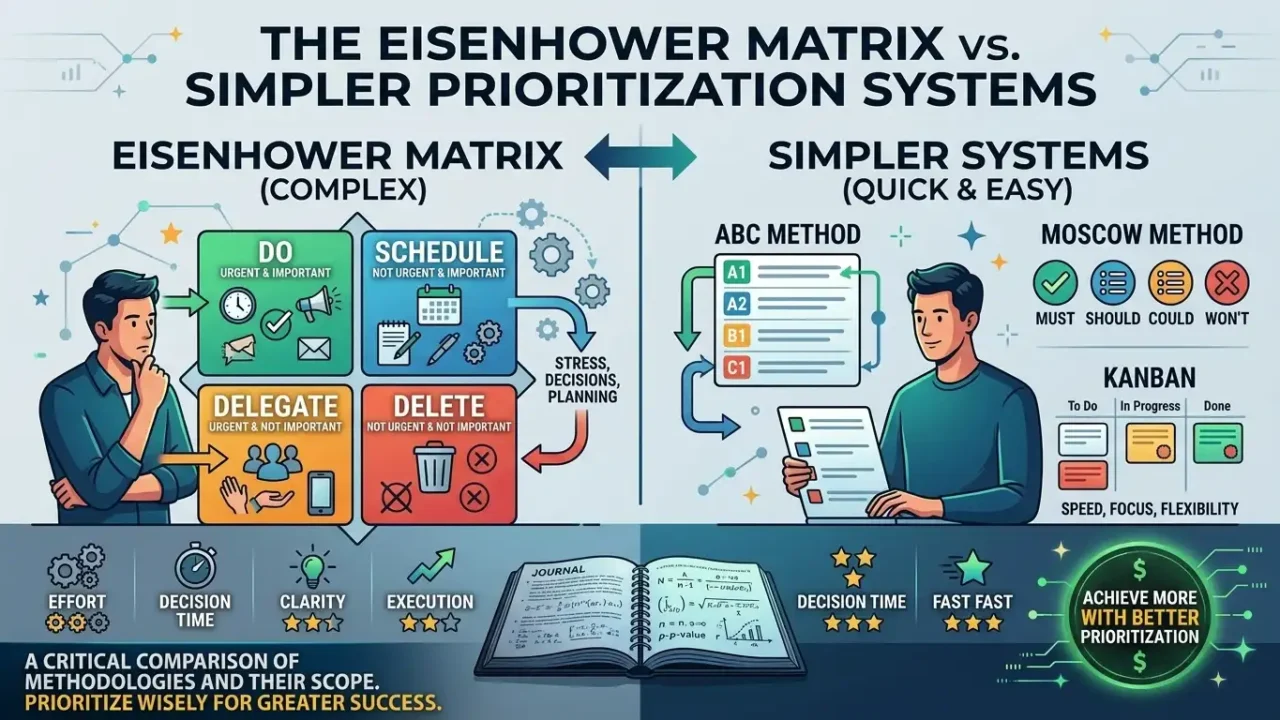
The Eisenhower Matrix is built around two questions: Is this task important? Is it urgent? Combining those questions produces four categories. Important and urgent tasks require immediate attention. Important but non-urgent tasks deserve deliberate planning. Urgent but less important tasks may be delegated or minimized. Tasks that are neither important nor urgent are candidates for elimination.
Its greatest strength is that it exposes a common mistake: confusing urgency with importance. An incoming message may feel urgent because someone expects a response, while learning a valuable skill may feel unimportant because nobody is demanding it today. Yet the second activity may have a far greater effect on your future.
This distinction is particularly useful because human attention naturally responds to immediate signals. A notification is concrete; a long-term goal is abstract. The Eisenhower Matrix therefore acts as a decision filter. It asks you to evaluate work according to consequences rather than emotional pressure.
Consider a writer with three tasks: answering emails, completing an article, and learning a new research method. An email may be urgent, the article may be important and time-sensitive, while learning the research method may be important but not urgent. Without a prioritization system, the writer may spend an hour clearing the inbox because those tasks provide immediate psychological satisfaction.
The Problem With Treating Every Task as a Four-Box Decision
The matrix is useful, but it can become cumbersome when every small task requires classification. If you have twenty-five tasks, repeatedly asking where each one belongs can become another form of procrastination.
There is also an important limitation: importance is not always objective. A task may be important because it supports your career, relationships, health, finances, or personal values. The matrix can tell you to consider importance, but it cannot decide what importance means for you.
Another problem is that the four quadrants can create a false sense of precision. Real life is rarely divided neatly into four boxes. Some tasks are moderately important and moderately urgent. Others become important only because another task depends on them. Priorities can also change during the day.
This is why prioritization should be treated as a thinking process rather than a rigid productivity ritual.
Deep Work vs Multitasking: Which One Actually Makes You Productive?
When a Simple “Top Three” System Works Better
For many people, the simplest effective system is to identify the three most important outcomes for the day. Instead of categorizing every task, ask: If I could make meaningful progress on only three things today, which three would matter most?
The advantage is cognitive simplicity. You are forced to choose rather than organize endlessly. A long task list gives your attention dozens of possible destinations; a short priority list gives it direction.
Imagine a student preparing for an exam. Their list might contain reading notes, answering messages, organizing files, watching lectures, cleaning their desk, and completing practice questions. A sophisticated system could classify everything. A simpler system might identify three priorities: complete the practice questions, review difficult concepts, and prepare tomorrow’s study plan. The remaining tasks become secondary.
This approach is especially useful when your work is relatively stable and you already understand what matters. You do not always need a sophisticated framework to make a straightforward decision.
The One-Question Method: What Creates the Most Value?
An even simpler system is to ask one question:
What is the most valuable thing I could do next?
This works particularly well when circumstances change rapidly. Rather than planning the entire day in advance, you continually reassess the highest-value action.
For example, a business owner may begin the morning intending to write a report. Then an important customer problem appears. The Eisenhower Matrix might classify both tasks, but the more fundamental question is whether resolving the customer issue creates greater value right now.
This method shifts productivity away from task completion and toward consequence management. Finishing ten low-value tasks is not necessarily better than completing one task that substantially changes the outcome of your week.
The danger, however, is that “most valuable” can become an excuse for chasing whatever feels exciting. That is why long-term goals still matter. Value should be measured against your broader objectives, not simply today’s mood.
Best Productivity Apps Compared: Which One Should You Use in 2026?
A Better Approach: Match the System to the Situation
The real lesson is not that the Eisenhower Matrix is better or worse than simpler systems. Different situations require different levels of structure.
Use the Eisenhower Matrix when your workload feels chaotic and you cannot distinguish genuine priorities from interruptions. It is particularly useful when everything seems urgent.
Use the Top Three approach when you understand your responsibilities but need sharper daily focus. It reduces complexity and protects attention.
Use the One Most Valuable Task approach when conditions are changing quickly and you need flexibility. It helps you repeatedly redirect effort toward the action with the greatest expected consequence.
There is also a useful hybrid approach: use the Eisenhower Matrix once a week to examine your broader responsibilities, then use a Top Three system each morning. The matrix provides strategic perspective; the shorter list provides daily execution.
This creates an important distinction between prioritization and planning. Prioritization determines what deserves attention. Planning determines when and how you will act on it. Confusing the two can produce beautifully organized schedules filled with low-value work.
The Deeper Productivity Lesson
The purpose of a prioritization system is not to help you do more things. It is to help you become more selective about what deserves your time.
That distinction matters because time cannot be increased through better organization. You can improve your calendar, automate repetitive work, delegate responsibilities, and eliminate distractions, but every day still contains a finite amount of attention.
The best prioritization system therefore creates a form of productive resistance. It makes you pause before saying yes. It forces you to notice when urgency is stealing attention from importance.
A useful question to carry beyond any productivity framework is this: If I continue spending my time this way for the next year, what will my life look like? That question moves prioritization from today’s task list to tomorrow’s consequences.
The Eisenhower Matrix is valuable because it teaches this way of thinking. Simpler systems are valuable because they make the thinking easier to apply. The goal is not to find the perfect productivity framework. It is to build a reliable habit of choosing deliberately.
When your system becomes complicated enough that managing your priorities consumes more attention than doing meaningful work, simplify it. The best productivity system is rarely the one with the most categories. It is the one that consistently helps you recognize what matters—and act on it.
The Hidden Cost of Constant Distractions
Call to Action
Your attention is one of your most valuable resources, and how you protect it shapes the quality of your work and your life. If you want to improve how you work, continue exploring Aziz Publishing Knowledge Library for more evidence-based articles on productivity, psychology, habits, and mindset to help you build systems that support deeper focus, better decisions, and lasting personal growth.