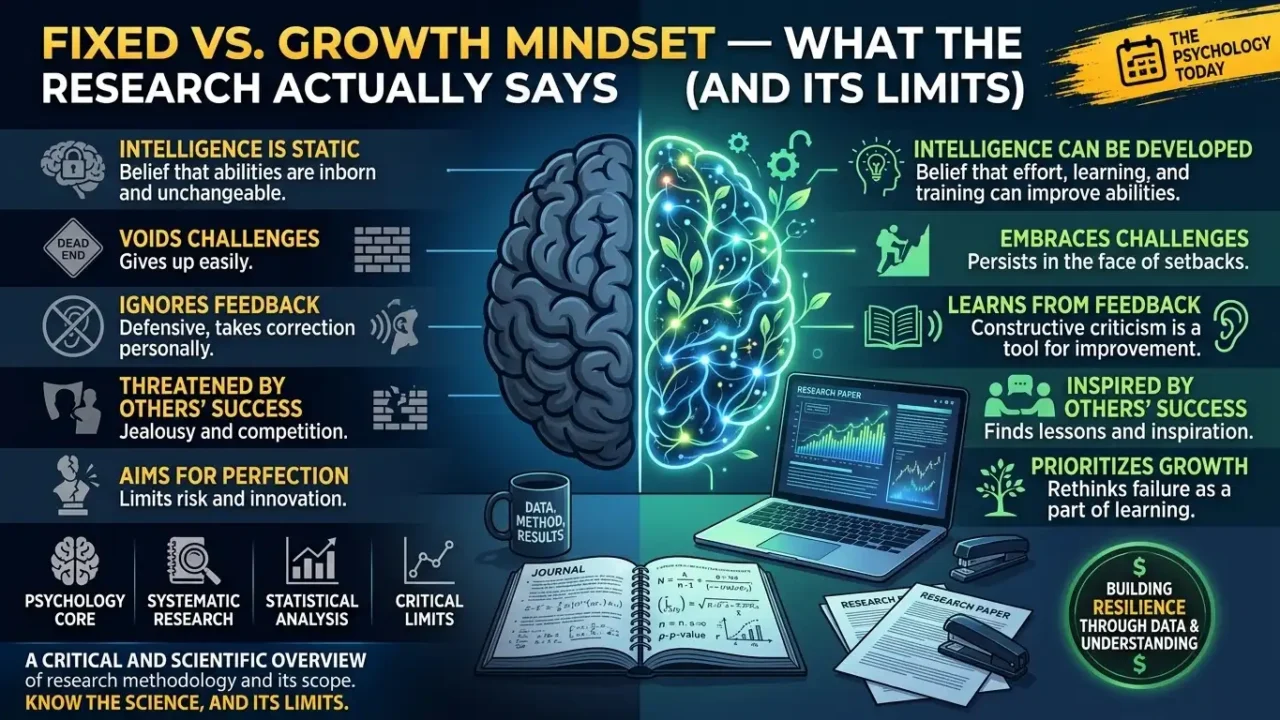
A person can spend years believing that intelligence is something you either have or you do not. Another person can look at the same difficult subject and think, “I cannot do this yet.” Those two reactions may seem like small differences in language, but they represent very different beliefs about human ability.
The distinction between a fixed mindset and a growth mindset became widely known through the work of psychologist Carol Dweck and colleagues. The basic idea is straightforward: people can hold different beliefs about whether abilities such as intelligence are relatively fixed or can develop through learning and experience. But the popular version of the theory is often much simpler than the research actually supports. A growth mindset is not a magical formula for success, effort alone does not guarantee improvement, and having a fixed mindset does not mean someone is incapable of learning.
The more interesting question is what these beliefs actually change—and where their influence stops.
What Is a Fixed Mindset?
A fixed mindset is the belief that an important personal ability is relatively stable. Someone who strongly holds this belief may interpret difficulty as evidence about who they are.
Imagine a student who performs poorly on a mathematics exam. A fixed interpretation might be, “I am simply bad at mathematics.” The problem is not merely the disappointing grade. The grade has been converted into a judgment about identity.
That interpretation can influence behavior. If difficult work threatens someone’s sense of competence, avoiding the difficulty can become psychologically attractive. Choosing an easier task protects the feeling of being capable. Asking for help may also feel uncomfortable because it can be interpreted as admitting inadequacy.
A fixed mindset therefore matters less as a label and more as a lens for interpreting evidence. Failure can become a verdict rather than information.
The same pattern can appear at work. An employee who believes they are naturally poor at public speaking may avoid presentations, interpret nervousness as proof of inability, and never accumulate enough practice to become comfortable.
What Does a Growth Mindset Actually Mean?
A growth mindset involves viewing an ability as capable of development. Difficulty does not necessarily mean “I lack the ability”; it can mean that the current level of skill is insufficient for the task.
This distinction changes the meaning of effort. Under a fixed interpretation, needing substantial effort may feel embarrassing because talented people are expected to perform naturally. Under a growth interpretation, effort can be part of skill development.
But there is an important qualification: a growth mindset is not the belief that you can accomplish anything if you simply try hard enough.
Skill development depends on many factors, including practice quality, prior knowledge, feedback, teaching, resources, opportunity, and the difficulty of the task. Someone can spend enormous amounts of time practicing the wrong method and improve very little.
A useful growth mindset therefore sounds less like “I can do anything” and more like “My current ability is not necessarily my final ability, so what would help me improve?”
That is a much more defensible psychological position.
Growth Mindset Examples in Everyday Life: 8 Practical Lessons for Success
What Does the Research Actually Show?
The research presents a more complicated picture than many popular articles suggest. A major 2018 meta-analysis examined 273 studies involving more than 365,000 participants and found that the overall relationship between growth mindset and academic achievement was weak. A second meta-analysis examining mindset interventions also found generally small effects, although some evidence suggested that students who were academically at risk or from lower socioeconomic backgrounds might benefit more.
That finding matters because it corrects a common misconception. If someone says, “Growth mindset makes students successful,” the evidence does not justify such a broad claim. Mindset may influence learning, but it is only one variable within a much larger system.
At the same time, the evidence should not be interpreted as showing that mindset is meaningless. A large national experiment published in Nature in 2019 tested a brief growth-mindset intervention among 12,490 ninth-grade students across 65 U.S. public schools. The researchers found improvements in grades among lower-achieving students and increased enrollment in advanced mathematics courses. Importantly, the effects depended partly on the surrounding school environment and peer norms.
This is one of the most useful findings in the entire debate: beliefs interact with environments.
Telling a student that abilities can develop is unlikely to compensate for poor instruction, inadequate resources, hostile classroom norms, or a lack of meaningful opportunities to practice. A belief becomes powerful when the environment gives that belief somewhere to go.
Why Fixed Mindsets Can Become Self-Reinforcing
One of the deeper insights behind mindset theory is that beliefs can influence the way people respond to evidence.
Suppose two employees receive difficult feedback. One thinks, “This shows I am not good enough.” The other thinks, “This identifies something I need to improve.” The feedback itself is identical. What changes is the interpretation.
The first employee may become defensive or avoid similar challenges. The second may seek additional information, practice the weak skill, or ask for coaching. Over time, those different responses can produce different experiences, which then appear to confirm the original beliefs.
This creates a feedback loop: belief influences behavior, behavior produces experience, and experience can strengthen belief.
That does not mean mindset determines destiny. External circumstances remain extremely important. But it explains why the interpretation of difficulty can matter even when the difficulty itself cannot immediately be changed.
The same principle applies outside education. Someone trying to become a better writer may produce an awkward first draft. If the draft is treated as evidence of permanent inability, writing becomes something to avoid. If it is treated as diagnostic information, the writer can identify weaknesses in structure, clarity, research, or editing and work on them deliberately.
The Problem With Turning Growth Mindset Into a Slogan
The popularity of growth mindset has created a second problem: growth mindset itself can become a fixed rule.
People sometimes feel guilty when they become frustrated, discouraged, or doubtful. They may think, “I am supposed to have a growth mindset, so I should never think negatively.” That misses the point.
People naturally move between different beliefs depending on the situation. Someone may be highly confident that they can improve their writing but strongly believe they are incapable of mathematics. Another person may embrace challenges at work but become defensive when receiving criticism.
Mindset is therefore better understood as something that can vary by context rather than a permanent personality category.
Research also suggests caution about assuming that mindset interventions automatically produce large improvements. A 2023 systematic review and meta-analysis examined growth-mindset interventions and emphasized the importance of understanding for whom, how, and under what conditions these interventions work.
That is a more useful way to think about the theory. Instead of asking, “Do growth mindsets work?” we should ask, “When does changing beliefs about ability produce meaningful changes in behavior and achievement?”
A Better Way to Apply Growth Mindset
The most practical application is not forcing yourself to say positive things. It is changing the questions you ask when something goes wrong.
Instead of “Am I good at this?” ask, “Which part of this can I improve?”
Instead of “Why did I fail?” ask, “What does this result tell me about my current approach?”
Instead of “I am terrible at this,” ask, “What specific skill is missing?”
This shifts attention from identity to process.
It also makes feedback more useful. If your goal is to protect an image of being intelligent, criticism feels threatening. If your goal is to improve a skill, criticism becomes information. You do not have to enjoy criticism to learn from it.
Perhaps the most important distinction is between effort and effective effort. Working harder is not automatically growth. Growth requires a process that produces learning. That may involve changing strategies, seeking instruction, practicing deliberately, receiving feedback, and giving yourself enough time to consolidate the skill.
Why Willpower Alone Doesn’t Create Lasting Change (And What Does)
The Research Supports a Nuanced Middle Ground
The strongest conclusion is neither “fixed mindset is bad” nor “growth mindset solves everything.”
Human abilities can change, but they do not change without conditions. Beliefs matter, but they operate alongside instruction, opportunity, prior knowledge, motivation, environment, and resources. Growth mindset interventions can help some students under some conditions, but the average effects found across large bodies of research are generally modest.
That nuance actually makes the idea more useful.
You do not need to convince yourself that every limitation is imaginary. Some limitations are real. You may have less experience, fewer resources, weaker foundations, or genuine constraints. A growth-oriented perspective simply refuses to confuse current performance with permanent identity.
That may be the most valuable lesson of the entire framework.
A poor result can describe where you are without defining where you must remain. Intelligence, skill, and expertise are not infinitely malleable, but neither are they perfectly frozen. The practical question is not whether you can become anything you imagine. It is whether you can identify what is changeable, understand what would improve it, and then create the conditions for that improvement.
That is a much more realistic—and much more powerful—way to think about growth.
How to Develop a Growth Mindset: 7 Practical Ways to Unlock Your Potential
Call to Action
If you want to understand how beliefs influence behavior, explore more psychology and mindset articles in the Aziz Publishing Knowledge Library—and keep questioning the ideas that shape how you see yourself. Continue exploring the Aziz Publishing Knowledge Library for evidence-based articles on psychology, mindset, habits, productivity, and emotional well-being. The more you understand how your mind works, the more intentionally you can shape the way you think, decide, and live.