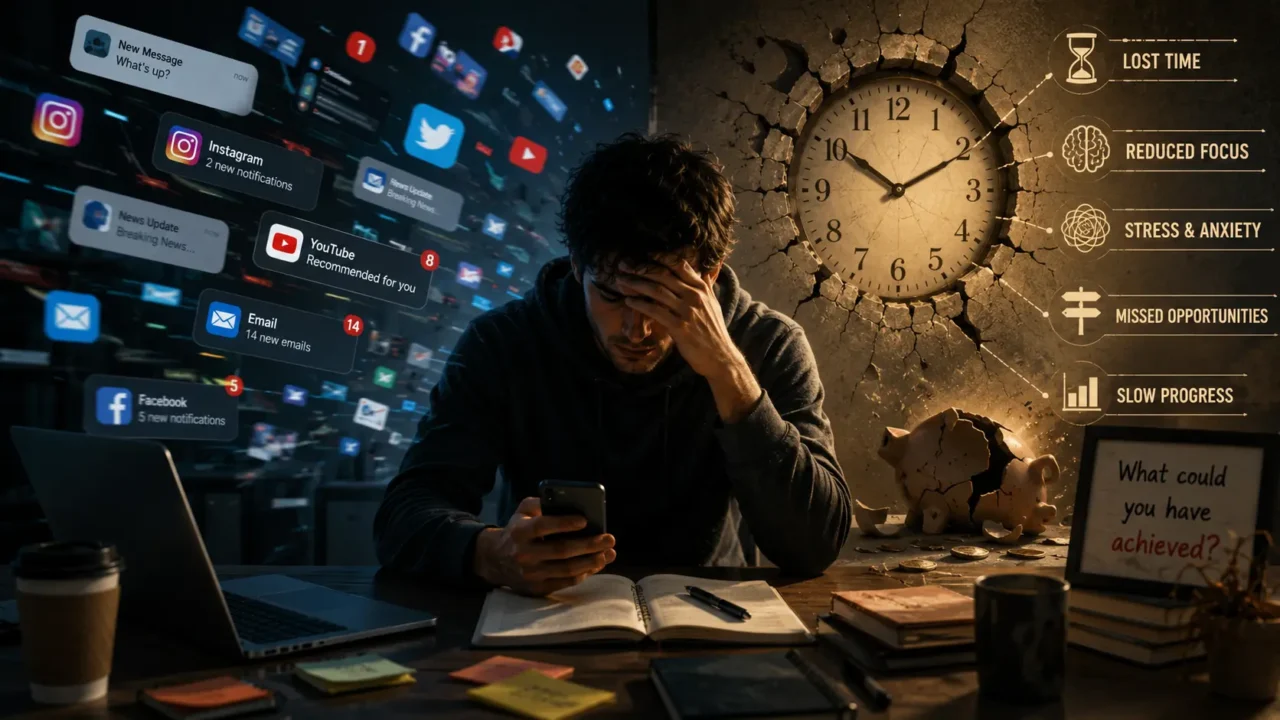
Modern productivity is often portrayed as a problem of time management. People search for better calendars, more efficient to-do lists, and sophisticated productivity apps, believing that better organization will solve their struggle to accomplish meaningful work. Yet for many people, the real obstacle is not a lack of time. It is a lack of uninterrupted attention.
Constant distractions have quietly become one of the greatest barriers to deep thinking, creativity, and sustained performance. Notifications interrupt conversations before ideas fully develop. Emails arrive while reports are being written. Social media fills the smallest moments of boredom. Even when no external interruption occurs, many people instinctively reach for their phones the moment a task becomes mentally demanding.
The result is a workday that feels busy but produces surprisingly little progress.
Understanding the hidden cost of constant distractions requires looking beyond lost minutes. Every interruption affects how the brain processes information, makes decisions, and maintains focus. The true price is measured not only in reduced productivity but also in diminished creativity, lower-quality thinking, and the gradual loss of our ability to concentrate on meaningful work.
Why the Brain Struggles With Frequent Interruptions
Human attention is a limited cognitive resource. Although people often describe themselves as excellent multitaskers, decades of cognitive psychology suggest otherwise. In most situations, the brain does not perform multiple demanding tasks simultaneously. Instead, it rapidly switches attention from one activity to another.
Each switch carries a mental cost.
When writing an important report, solving a complex problem, or learning a new skill, the brain gradually builds what psychologists sometimes call a mental context. This context includes relevant information, goals, and relationships between ideas. An interruption forces the brain to abandon part of that mental framework before reconstructing it again after returning to the task.
Even brief distractions therefore consume more than the few seconds required to check a notification. They disrupt momentum, increase mental fatigue, and reduce the quality of subsequent thinking.
This explains why a day filled with constant interruptions often feels exhausting despite accomplishing relatively little.
The Attention Residue Effect
One reason distractions are so damaging is a phenomenon researchers refer to as attention residue. When people switch from one unfinished task to another, part of their attention remains attached to the previous activity. Although the body has moved to a new task, the mind continues processing what was left behind.
Imagine writing an important proposal when a message arrives requesting immediate attention. After responding, you return to the proposal, but part of your thinking remains occupied by the earlier conversation. The transition feels complete, yet cognitive resources remain divided.
Over an entire day, dozens of small interruptions accumulate into significant mental fragmentation.
Rather than giving full attention to one important activity, the brain spends much of its energy repeatedly rebuilding focus.
This hidden cost rarely appears on productivity trackers, yet it profoundly influences the quality of knowledge work.
Why Distractions Feel Rewarding
If distractions reduce performance, why do people seek them so frequently?
The answer lies partly in the brain’s reward system.
Novel information triggers curiosity. A new notification, message, or social media update carries uncertainty, and uncertainty activates dopamine pathways involved in motivation and reward. The brain learns that checking the phone might produce something interesting, entertaining, or socially rewarding.
Importantly, the reward is not guaranteed.
It is unpredictable.
Psychologists have long known that unpredictable rewards strengthen habits more effectively than predictable ones. This is one reason social media feeds, news updates, and messaging platforms become so compelling. Every refresh offers the possibility of discovering something valuable, even though most interactions provide little lasting benefit.
Over time, people begin checking devices automatically, not because the information is important, but because the habit itself has become deeply reinforced.
How to Break Bad Habits Without Relying on Willpower
The Cost to Creativity and Learning
Deep work requires sustained attention.
Whether writing a book, solving a scientific problem, learning a language, or developing a business strategy, meaningful progress depends upon remaining mentally engaged long enough for complex ideas to develop.
Creativity rarely appears instantly. It often emerges after extended periods of focused thought during which the brain explores possibilities, forms unexpected connections, and refines incomplete ideas.
Frequent distractions interrupt this process before it matures.
Learning suffers for similar reasons. Research consistently shows that concentrated study produces stronger memory formation than fragmented attention. Every interruption reduces the brain’s ability to organize new information into long-term knowledge.
The consequence is subtle but significant.
People may spend hours working while making surprisingly little progress because their attention never remains focused long enough to perform their best thinking.
Deep Work vs Multitasking: Which One Actually Makes You Productive?
Designing an Environment That Protects Attention
Improving focus depends less on becoming mentally stronger and more on reducing unnecessary cognitive friction.
Environment shapes attention.
A phone placed beside the keyboard invites checking. Constant notification sounds encourage interruptions. Multiple browser tabs increase temptation to switch tasks. Open-office conversations fragment concentration even when no direct interaction occurs.
Small environmental changes can therefore produce disproportionately large improvements. Turning off non-essential notifications, scheduling dedicated periods for email, placing the phone outside immediate reach, and working in distraction-free environments all reduce opportunities for automatic attention switching.
Equally important is protecting blocks of uninterrupted time.
Instead of attempting to focus between interruptions, deliberately create periods during which distractions are intentionally removed. These uninterrupted sessions allow the brain to build momentum, sustain concentration, and engage in deeper thinking.
The objective is not simply working longer.
It is creating conditions where attention can fully develop.
Productivity Is Really About Attention Management
Many people measure productivity by visible activity. They answer emails quickly, attend numerous meetings, respond instantly to messages, and constantly move between tasks. These behaviors create the appearance of efficiency while often reducing meaningful output.
The most productive individuals typically protect attention rather than merely managing schedules.
They recognize that high-quality work depends on uninterrupted cognitive effort. Instead of maximizing responsiveness, they maximize concentration.
This shift changes an important question.
Rather than asking, “How can I fit more tasks into today?” the better question becomes, “How can I give my full attention to the task that matters most?”
The quality of attention frequently determines the quality of results.
Conclusion
The hidden cost of constant distractions extends far beyond lost minutes. Every interruption fragments attention, weakens memory, reduces creativity, and increases mental fatigue. Over weeks and years, these small cognitive disruptions shape not only productivity but also the depth of our thinking and the quality of our work.
Technology itself is not the problem. Smartphones, messaging platforms, and digital tools provide extraordinary benefits when used intentionally. The challenge arises when they begin controlling attention instead of serving it.
Protecting your focus is therefore not an act of isolation.
It is an investment in better thinking.
In a world competing relentlessly for every moment of attention, the ability to concentrate without interruption is becoming one of the most valuable professional and personal skills anyone can develop.
The future will not belong solely to those who work the hardest.
It will increasingly belong to those who can think the deepest.
Call to Action
Your attention is one of your most valuable resources, and how you protect it shapes the quality of your work and your life. Explore the Aziz Publishing Knowledge Library for more evidence-based articles on productivity, psychology, habits, and mindset to help you build systems that support deeper focus, better decisions, and lasting personal growth.