Artificial intelligence has become part of ordinary conversation, but the language surrounding it can make the technology seem more complicated than it really is. We hear about AI, machine learning, deep learning, neural networks, generative AI, and large language models as though they were interchangeable terms. They are not. They describe related ideas at different levels.
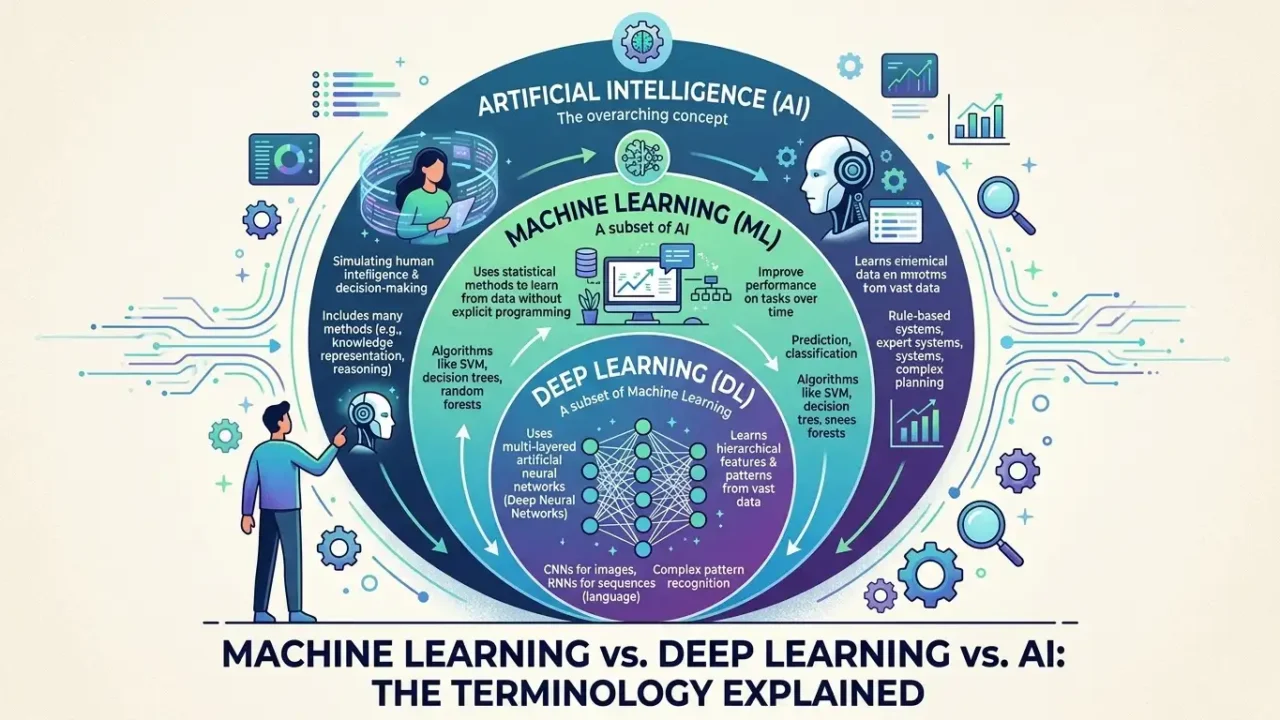
The easiest way to understand the relationship is to imagine a set of nested circles. Artificial intelligence is the broadest category. Machine learning is one approach within AI. Deep learning is a specialized approach within machine learning. Modern generative AI systems, including large language models, are largely built with deep-learning techniques. Stanford and IBM describe essentially this same relationship, although the boundaries between terms can become more nuanced depending on context.
Understanding these distinctions matters because it changes how you interpret almost every AI headline. Instead of treating AI as one mysterious technology, you can begin to see the different layers that make modern intelligent systems possible.
What Artificial Intelligence Actually Means
Artificial intelligence, or AI, is the broadest term. It refers to computer systems designed to perform tasks associated with forms of intelligence, such as recognizing information, making decisions, solving problems, understanding language, learning from experience, or acting toward goals. Stanford describes AI as a broad field concerned with systems capable of tasks involving human-like intelligence, while noting that modern AI frequently relies on pattern recognition in large amounts of data.
AI does not necessarily mean that a machine thinks like a human. A system can be considered an AI system because it performs a particular intelligent task without possessing human consciousness, emotions, or general understanding.
Consider a navigation application. It can examine traffic conditions, estimate travel times, compare possible routes, and recommend one to you. That can involve AI techniques, but it does not mean the application possesses a human-like mind.
The same broad category includes systems for speech recognition, computer vision, recommendation engines, robotics, game-playing systems, fraud detection, and language processing. Some AI systems learn from data; others can rely more heavily on explicitly designed rules or algorithms.
That distinction is important because AI is the field or umbrella, not one particular algorithm.
How Large Language Models Actually Work (Explained Simply)
Machine Learning: When Systems Learn From Data
Machine learning is a major subset of artificial intelligence. Instead of requiring programmers to specify every rule for a task, machine-learning systems can learn patterns from examples or data and use those patterns to make predictions or decisions. Stanford defines machine learning as a branch of AI in which computers learn patterns and make decisions from data rather than being explicitly programmed with rules for every situation.
Imagine building a system that identifies unwanted email. A traditional program might contain manually written rules such as looking for particular words or suspicious patterns. A machine-learning approach can instead be trained using examples of emails labeled as spam or legitimate. The model learns statistical patterns that help it distinguish the two categories.
Machine learning is much broader than today’s generative AI. It includes methods such as decision trees, linear and logistic regression, support vector machines, clustering, random forests, and neural networks.
This is one reason the phrase “AI” can be misleading. A company might say it uses AI to predict customer demand, but the underlying technology could simply be a machine-learning model trained on historical sales data.
Machine learning is therefore best understood as one of the principal ways of building AI systems.
Deep Learning: Machine Learning With Neural Networks
Deep learning sits one level deeper. It is a subset of machine learning that uses multi-layer neural networks to learn increasingly complex patterns from data. Stanford describes deep learning as the use of large, multilayer neural networks that can automatically learn complex representations.
A traditional machine-learning system may depend more heavily on humans to identify useful features in the data. For an image-recognition task, for example, engineers might need to determine which characteristics are useful for distinguishing one object from another.
Deep-learning systems can learn increasingly abstract representations themselves. In image recognition, early layers may respond to relatively simple visual patterns, while later layers can combine those patterns into more complex representations. The network adjusts internal parameters during training so that its outputs become more useful for the task.
This ability becomes particularly powerful when enormous amounts of data and computational resources are available. Deep learning has become central to modern speech recognition, computer vision, natural-language processing, and generative AI.
The word “deep” refers primarily to the multiple layers of computation within the neural network. It does not mean that the machine possesses deeper human understanding.
Where Neural Networks and Generative AI Fit
Neural networks are computational models made of interconnected processing units arranged in layers. They are an important foundation of deep learning, although not every neural network should automatically be described as a deep-learning system. The distinction generally concerns the architecture and depth of the network.
Modern generative AI adds another important layer to the picture. Generative AI refers to systems capable of producing new content, including text, images, audio, video, or code. Large language models are a prominent example: they are trained on large amounts of data and can generate language based on learned patterns and context.
Many modern language models use transformer architectures, which rely heavily on attention mechanisms. Stanford identifies transformers as neural-network architectures capable of incorporating context efficiently when processing and generating sequences such as language.
So when you interact with a modern AI assistant, you are not dealing with “AI” as one indivisible technology. You are interacting with a system built from several layers of ideas: artificial intelligence as the broad field, machine learning as the learning approach, deep learning as a particular machine-learning paradigm, neural networks as the underlying computational architecture, and specialized architectures such as transformers for particular applications.
ChatGPT vs Claude vs Gemini: Which AI Assistant Is Right for You?
A Simple Example: Teaching a Computer to Recognize Cats
Consider a computer-vision system designed to recognize cats in photographs.
AI is the broad objective: creating a system capable of performing a task that normally requires some form of human perception.
Machine learning provides an approach: give the system examples and allow it to learn patterns associated with cats rather than manually specifying every possible rule.
Deep learning provides a powerful technique: use a multilayer neural network capable of learning increasingly complex visual representations.
The neural network contains parameters that are adjusted during training. After training, the system can process an unfamiliar image and produce a prediction based on the patterns it learned.
The important point is that these terms are not competitors. AI, machine learning, and deep learning describe different levels of the same technological landscape.
Best AI Skills to Learn in 2026 to Earn Online
Why the Difference Matters
Understanding the terminology helps you evaluate AI claims more intelligently. If someone says, “Machine learning is replacing AI,” the statement is conceptually confused because machine learning is one subset of AI. If someone says, “Deep learning and machine learning are completely different technologies,” that is also misleading because deep learning is itself a type of machine learning.
The distinctions also matter when choosing technology for a real problem. Not every problem requires a massive deep-learning model. Some tasks can be handled effectively by simpler statistical or machine-learning techniques. Deep learning becomes especially valuable when dealing with complex patterns in large-scale data, such as images, speech, and language.
There is another important lesson here: the sophistication of a model does not automatically make the result reliable. AI systems depend on data, training procedures, model design, evaluation, and deployment conditions. Poor data or inappropriate modeling can produce poor results regardless of how advanced the technology sounds.
This is why learning AI terminology is more than memorizing definitions. It gives you a framework for asking better questions: What problem is being solved? What data is involved? How does the system learn? What model is being used? How is performance evaluated? What limitations remain?
The Mental Model to Remember
You do not need to memorize dozens of technical definitions to understand the basic relationship.
Think of AI as the destination, machine learning as one major route, and deep learning as a specialized route within machine learning. Neural networks provide the machinery behind much of modern deep learning, while architectures such as transformers have enabled powerful applications in language and other sequential data.
Once you see these technologies as layers rather than competing buzzwords, the AI landscape becomes much easier to navigate.
And that understanding is increasingly useful. AI will continue producing new terminology, new models, and new applications. The specific names will change, but the underlying relationships will remain easier to understand if you know which layer of the technology you are looking at.
Call to Action
Want to understand AI beyond the buzzwords? Explore more Aziz Publishing articles on artificial intelligence and learn how the technology works, where it is useful, and where its limitations begin. Explore the Aziz Publishing Knowledge Library for practical guides on artificial intelligence, productivity, psychology, writing, and emerging technologies that help you work smarter, think more clearly, and make better decisions in an AI-powered world.