Science & Technology

CRISPR Gene Editing Explained: Can We Rewrite Human DNA?

Learn how CRISPR gene editing works, its medical applications, ethical challenges, and whether scientists can truly rewrite human DNA in the future of medicine.

CRISPR Gene Editing Explained: Can We Rewrite Human DNA?

For most of human history, genetic diseases were viewed as an unavoidable part of life. If a person inherited a faulty gene that caused conditions such as sickle cell disease, cystic fibrosis, or certain forms of blindness, medicine could often manage symptoms but not correct the underlying cause. The genetic code itself seemed permanent—a biological instruction manual written before birth and impossible to edit.

That assumption has changed dramatically with the development of CRISPR gene editing, one of the most significant scientific breakthroughs of the twenty-first century. For the first time, researchers possess a tool capable of locating specific sections of DNA and modifying them with remarkable precision. What once belonged to science fiction has become an active area of medical research, with gene-editing therapies already approved for some diseases and many more undergoing clinical trials.

The possibilities are extraordinary, but so are the ethical and scientific challenges. Can we truly rewrite human DNA? If so, where should the line between treating disease and enhancing human abilities be drawn? Understanding CRISPR requires examining not only how the technology works but also why it has the potential to reshape medicine, biotechnology, and society itself.


Understanding DNA and Why Gene Editing Matters

Every cell in the human body contains DNA, a molecule that stores the biological instructions required for growth, development, and normal function. These instructions are organized into genes, each carrying information that helps produce proteins responsible for countless processes, from transporting oxygen through the bloodstream to supporting the immune system.

Sometimes these instructions contain errors. A single change in DNA can disrupt protein production and contribute to inherited diseases. Traditional medicine often focuses on treating the symptoms caused by these genetic changes. Gene editing represents a fundamentally different approach because it attempts to correct the source of the problem rather than its consequences.

This shift is comparable to repairing corrupted software code instead of repeatedly fixing the errors it produces. Rather than managing disease throughout a person’s life, scientists hope to prevent the disease from developing in the first place by modifying the genetic instructions themselves.


What Is CRISPR?

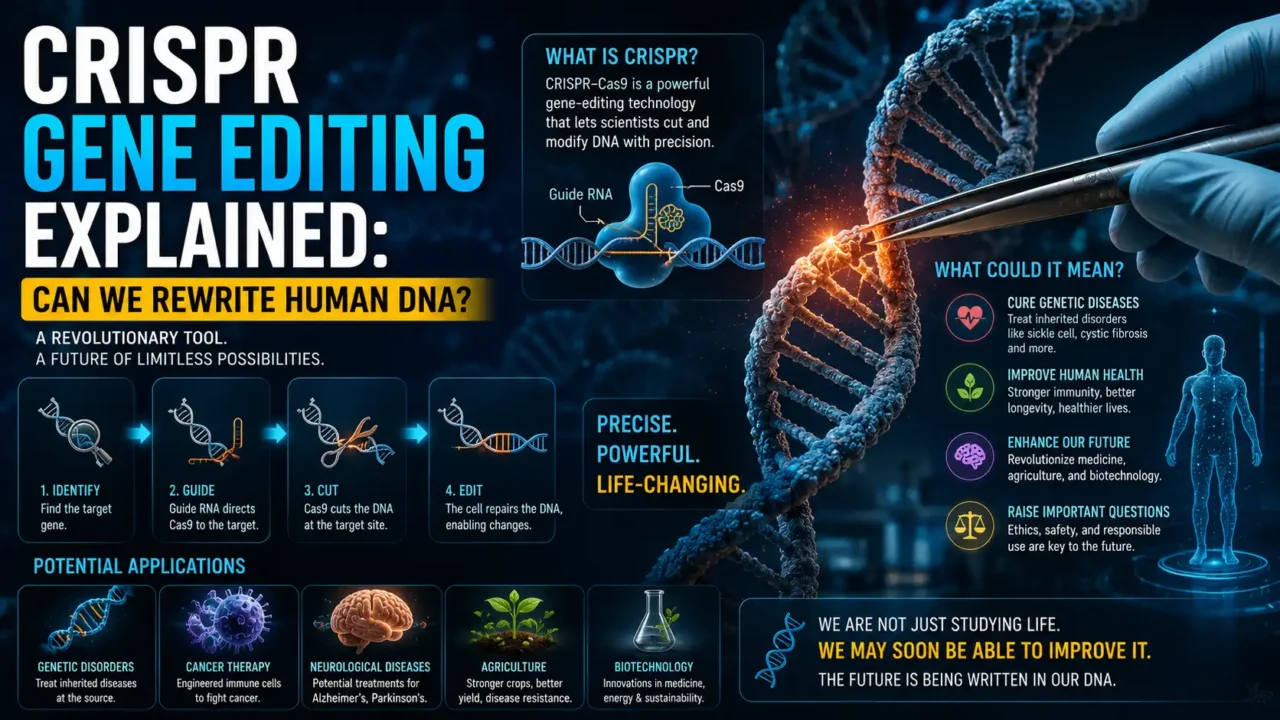
CRISPR, short for Clustered Regularly Interspaced Short Palindromic Repeats, originated not as a human invention but as a natural defense mechanism used by bacteria. When viruses attack bacteria, some bacteria store fragments of the viral DNA within their own genetic material. If the same virus attacks again, specialized proteins recognize the stored sequence and cut the invading viral DNA, protecting the cell.

Scientists realized this biological system could be adapted for medicine.

Today, the most widely known CRISPR system combines a guide RNA, which identifies a specific DNA sequence, with an enzyme called Cas9, which functions like highly precise molecular scissors. The guide RNA directs Cas9 to the desired location within the genome, where the enzyme cuts the DNA. The cell’s natural repair mechanisms then repair the break, allowing researchers to remove, disable, or replace selected genetic sequences.

Although the process is more complex than simply “cutting and pasting” DNA, this analogy helps explain why CRISPR has become such a powerful scientific tool.


How CRISPR Is Already Changing Medicine

The greatest promise of CRISPR lies in treating diseases caused by identifiable genetic mutations. Researchers have investigated its potential in conditions including sickle cell disease, beta thalassemia, inherited blindness, muscular disorders, certain immune deficiencies, and some cancers.

In recent years, gene-editing therapies targeting sickle cell disease and beta thalassemia achieved historic regulatory approvals in several countries after demonstrating that modifying a patient’s own blood stem cells could substantially reduce or eliminate severe disease symptoms for many individuals. These milestones marked an important transition from laboratory research to real-world medical treatment.

Beyond inherited disorders, scientists are exploring how CRISPR might improve cancer therapies by enhancing immune cells, combat viral infections, and accelerate the development of personalized medicine. Although many applications remain experimental, the technology is already changing how researchers approach diseases once considered untreatable.


The Scientific Challenges

Despite its precision, CRISPR is not perfect.

One important concern involves off-target effects, where gene-editing tools modify DNA sequences other than the intended target. Even rare unintended changes could potentially affect healthy genes, making safety a central focus of ongoing research.

Another challenge is delivering CRISPR to the correct cells. Editing blood cells outside the body is relatively straightforward because scientists can modify the cells in a laboratory before returning them to the patient. Reaching organs such as the brain, heart, or lungs safely and efficiently remains considerably more difficult.

Researchers are also developing newer gene-editing technologies, including base editing and prime editing, which aim to make even more precise genetic changes while reducing unwanted alterations. These advances illustrate that gene editing continues to evolve rapidly rather than remaining limited to the original CRISPR-Cas9 system.


The Ethical Questions Society Must Answer

The scientific possibilities of CRISPR inevitably raise ethical questions that extend beyond medicine.

Most experts distinguish between somatic gene editing, which affects only the treated individual, and germline gene editing, which changes reproductive cells or embryos in ways that future generations could inherit. Somatic therapies intended to treat disease have gained increasing acceptance under appropriate regulatory oversight. Germline editing remains far more controversial because the long-term consequences may affect people who cannot consent and because unintended genetic changes could be passed to future generations.

Another concern involves the possibility of using gene editing not to treat disease but to enhance normal human characteristics such as intelligence, athletic performance, or physical appearance. Such applications raise questions about fairness, inequality, and access to advanced medical technologies.

These debates demonstrate that scientific capability alone cannot determine how technology should be used. Ethical reasoning, public discussion, and responsible regulation remain equally important.


Can We Really Rewrite Human DNA?

The answer is both yes and no.

Scientists can already rewrite sections of human DNA under carefully controlled conditions. This is no longer theoretical. Patients have received gene-editing treatments for specific diseases, and the results continue to shape modern medicine.

However, rewriting the human genome remains extraordinarily complex. Most human traits—including intelligence, personality, height, and many common diseases—are influenced by hundreds or even thousands of genes interacting with environmental factors. Editing one gene rarely provides simple control over these complex characteristics.

This distinction is essential.

CRISPR is an exceptionally powerful medical technology, but it is not a tool for designing human beings according to simple preferences. Biology remains far more intricate than popular headlines often suggest.

Artificial General Intelligence (AGI): How Close Are We to Human-Level AI?


Conclusion

CRISPR gene editing represents one of the most important scientific developments of our time because it changes what medicine is capable of attempting. Instead of treating symptoms alone, researchers can increasingly target the genetic foundations of disease, offering hope to patients whose conditions were once considered incurable.

Yet the technology’s greatest impact will depend not only on scientific progress but also on the wisdom with which society chooses to use it. Safety, accessibility, ethical responsibility, and international cooperation will shape whether gene editing becomes a transformative force for global health or a source of new social and moral challenges.

The ability to rewrite human DNA is no longer a question of science fiction.

It is becoming a scientific reality.

The greater question now is whether humanity can match this remarkable technological achievement with equally thoughtful decisions about when, why, and how it should be applied.


Call to Action

Breakthroughs like CRISPR are reshaping medicine, biology, and the future of healthcare. Explore the Aziz Publishing Knowledge Library for clear, evidence-based articles on science & technology, artificial intelligence, and the innovations that are transforming our understanding of the world.

Stop Letting Your Mind Sabotage You

Continue with the Book

Stop Letting Your Mind Sabotage You

Explore the deeper framework for understanding self-sabotage, rebuilding self-trust, and creating meaningful personal change.