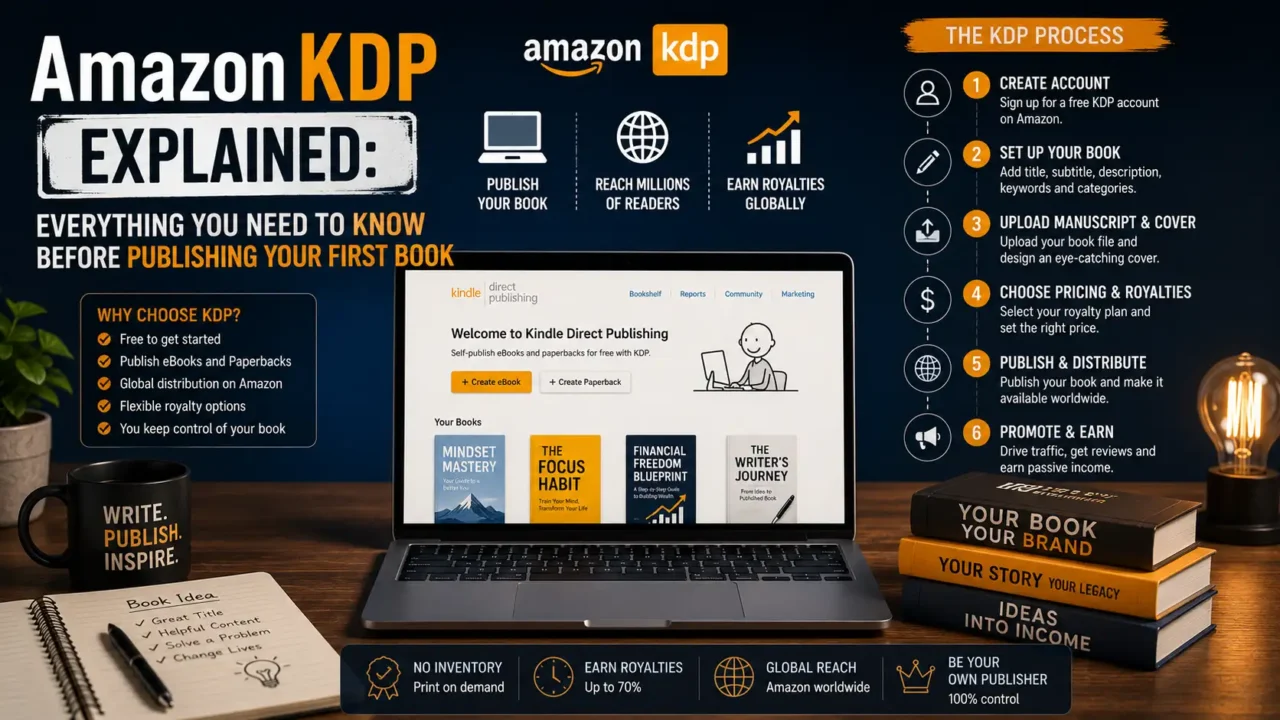
For generations, publishing a book required convincing a traditional publisher that your manuscript deserved a place on bookstore shelves. The process was highly competitive, often taking months or even years, and many talented writers never reached readers simply because they could not secure a publishing contract. Digital publishing fundamentally changed that equation. Today, an individual can write a book, upload it online, and make it available to millions of readers worldwide without negotiating with a publishing house.
The platform responsible for much of this transformation is Amazon Kindle Direct Publishing (KDP). Since its launch, KDP has enabled independent authors to publish ebooks, paperbacks, and hardcover books while retaining creative control over their work. It has lowered barriers to entry and created opportunities for educators, entrepreneurs, professionals, and storytellers to build publishing businesses from anywhere in the world.
Yet publishing a successful book involves far more than uploading a manuscript. Many first-time authors underestimate the importance of formatting, metadata, keywords, cover design, pricing, and long-term marketing. Understanding how Amazon KDP works before publishing your first book helps you avoid common mistakes and build a stronger foundation for long-term success.
What Is Amazon KDP?
Amazon Kindle Direct Publishing is Amazon’s self-publishing platform that allows authors and publishers to distribute books directly through Amazon’s global marketplace. Instead of working through a traditional publishing company, authors upload their manuscript, design or submit a book cover, enter publishing information, choose pricing, and publish independently.
KDP supports multiple publishing formats, including ebooks for Kindle devices and apps, paperback editions through print-on-demand technology, and hardcover books in supported markets. Print-on-demand means books are manufactured only after a customer places an order, eliminating the need for authors to purchase or store large inventories.
This model significantly reduces financial risk while making publishing accessible to virtually anyone with a completed manuscript.
Why Amazon KDP Became So Popular
The popularity of Amazon KDP stems from the combination of accessibility and global reach.
Amazon remains one of the world’s largest online bookstores, giving independent authors immediate access to millions of potential readers. Instead of negotiating with distributors, warehousing inventory, or managing physical logistics, authors can focus primarily on writing and marketing.
Another important advantage is creative independence. Authors retain control over their titles, subtitles, cover designs, pricing strategies, book descriptions, and future revisions. Unlike many traditional publishing agreements, self-published authors generally maintain ownership of their intellectual property while earning royalties directly from book sales according to Amazon’s publishing terms.
For nonfiction writers, educators, consultants, and entrepreneurs, KDP has become an effective way to establish authority, expand professional visibility, and create additional income streams alongside their primary careers.
What You Need Before Publishing
Publishing begins long before opening a KDP account.
The most important requirement is a professionally written manuscript that delivers genuine value to readers. Regardless of genre, successful books solve problems, entertain audiences, educate effectively, or provide meaningful experiences. Editing remains essential because grammatical errors, inconsistent formatting, and unclear writing reduce credibility and negatively affect reader reviews.
Formatting also deserves careful attention. Ebook and print editions follow different technical requirements, including page layout, margins, fonts, headings, and image placement. Proper formatting ensures readers enjoy a professional experience across Kindle devices and printed copies.
The cover design is equally important. Readers frequently form first impressions within seconds, and an attractive cover communicates professionalism before a single page is read. A well-designed cover should remain visually clear even as a small thumbnail in Amazon search results.
Finally, authors should prepare compelling metadata, including an informative book description, accurate categories, relevant keywords, and an appropriate pricing strategy. These elements influence discoverability as much as the manuscript itself.
Understanding the Publishing Process
Publishing through Amazon KDP follows a structured workflow.
Authors first create a publishing account and complete tax and payment information. After selecting the appropriate publishing format, they enter book details such as the title, subtitle, author name, description, keywords, and categories. The manuscript and cover files are then uploaded, where Amazon automatically checks for formatting issues before generating a digital preview.
Once the files are approved, authors choose pricing, royalty options where applicable, and distribution preferences. After final review, the book enters Amazon’s publishing process before becoming available in supported marketplaces.
Although the technical steps are relatively straightforward, thoughtful preparation significantly improves the quality of the final product. Most successful independent authors spend far more time refining their manuscript, cover, and marketing strategy than completing the upload itself.
How to Publish a Book on Amazon KDP: The Complete Beginner’s
The Biggest Mistakes First-Time Authors Make
Many first-time publishers assume that publishing automatically leads to sales.
In reality, publishing marks the beginning rather than the conclusion of the author’s journey.
One common mistake is rushing the editing process. Readers quickly recognize poor grammar, inconsistent formatting, or unclear organization, often resulting in negative reviews that reduce long-term sales.
Another frequent mistake involves weak positioning. Books with vague titles, generic covers, or unclear target audiences struggle to attract attention in a competitive marketplace. Successful books communicate their value immediately.
Authors also underestimate the importance of keywords, categories, and book descriptions. These elements help Amazon understand when and where to display a book in search results, directly influencing discoverability.
Finally, many writers publish a single book and wait for sales instead of developing a long-term publishing strategy. Consistent publishing often produces stronger results because each additional title increases visibility, strengthens author credibility, and creates opportunities for cross-promotion.
Success Depends on More Than Publishing
Amazon KDP provides access to readers, but it does not guarantee commercial success.
Readers discover books through search results, recommendations, advertising, author platforms, newsletters, reviews, social media, and external websites. Authors who actively build an audience generally perform better than those relying solely on marketplace algorithms.
This is why many successful independent publishers view books as part of a broader content ecosystem. Educational articles, podcasts, YouTube channels, newsletters, professional websites, and email lists all contribute to long-term visibility and reader trust.
Publishing therefore becomes an ongoing business rather than a single event.
Each new book strengthens the author’s catalog while expanding opportunities to reach future readers.
Conclusion
Amazon Kindle Direct Publishing has fundamentally changed who can become an author. It has removed many of the traditional barriers to publishing while giving writers unprecedented control over their work, creative decisions, and publishing careers.
Yet the platform itself is only a tool.
Long-term success depends on producing valuable content, presenting it professionally, understanding reader needs, and viewing publishing as a continuous process of learning and improvement. The authors who succeed are rarely those who publish the fastest. They are the ones who consistently invest in quality, build trust with readers, and continue refining both their writing and their publishing strategy over time.
Publishing your first book is not the finish line.
It is the beginning of becoming a publisher.
Approached thoughtfully, Amazon KDP offers not only the opportunity to share ideas with the world but also the possibility of building a lasting body of work that continues creating value for readers for years to come.
Call to Action
Publishing a book is more accessible than ever, but creating a successful publishing career requires knowledge, consistency, and a commitment to quality. Explore the Aziz Publishing Knowledge Library for practical, evidence-based articles on writing & self-publishing, personal development, mindset and digital publishing to help you become a more effective author and publisher.