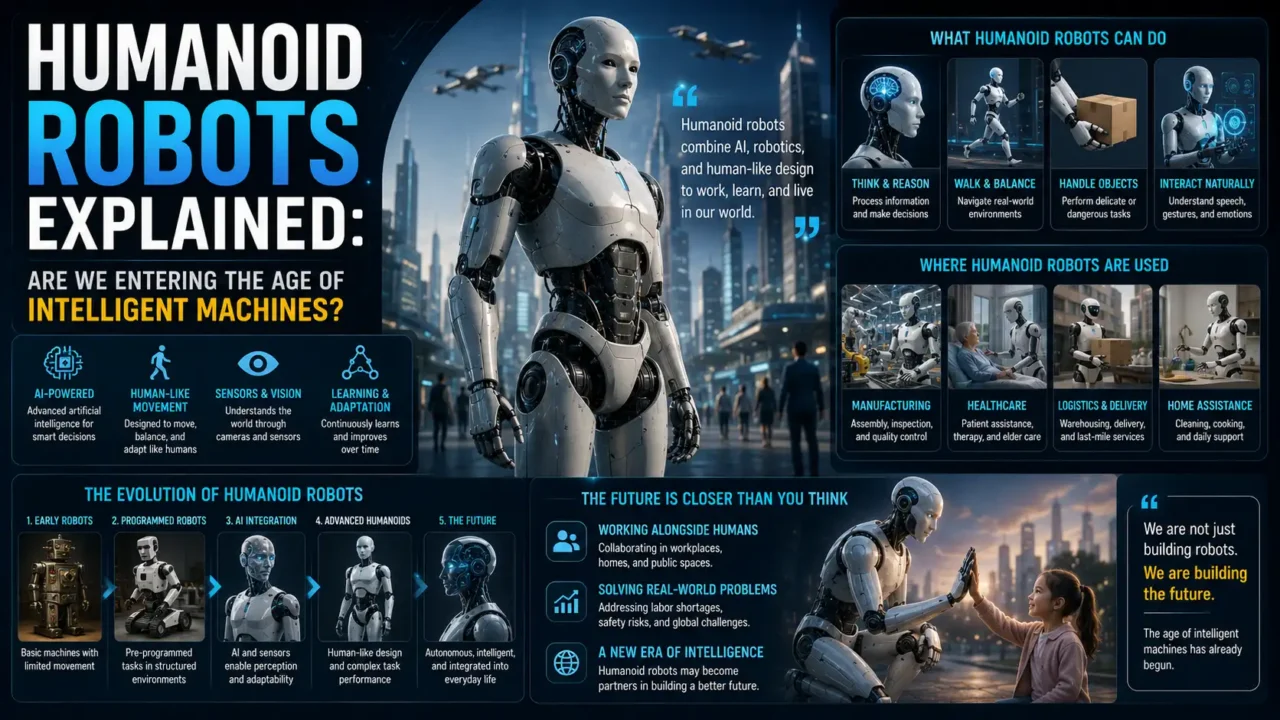
Not long ago, humanoid robots belonged almost exclusively to science fiction. They appeared in novels, movies, and futuristic predictions as machines capable of walking, talking, thinking, and working alongside humans. Today, that vision is steadily moving into reality. Advances in artificial intelligence, robotics, computer vision, powerful sensors, and battery technology have accelerated the development of robots that increasingly resemble human workers—not merely in appearance, but in their ability to perform useful tasks in real-world environments.
Governments and technology companies are investing billions of dollars into humanoid robotics because they believe these machines could help address some of society’s biggest challenges, including labor shortages, aging populations, hazardous industrial work, and rising demand for automation. At the same time, many people wonder whether intelligent robots will replace human jobs, reshape economies, or fundamentally change daily life.
Understanding humanoid robots has therefore become important not only for engineers but for anyone interested in the future of technology. While the field is still developing, the progress made over the past few years suggests that intelligent machines may become a familiar part of workplaces and households sooner than many expected.
What Is a Humanoid Robot?
A humanoid robot is a machine designed to resemble the basic physical structure of a human being. Most humanoid robots have a head, torso, two arms, and two legs, allowing them to operate within environments originally designed for people. Unlike industrial robotic arms that perform repetitive tasks in fixed locations, humanoid robots are built to move through human spaces, manipulate everyday objects, climb stairs, carry equipment, and interact naturally with people.
Appearance alone does not make a robot intelligent. What distinguishes modern humanoid robots is the combination of advanced hardware with artificial intelligence. Cameras act as eyes, microphones function as ears, force sensors provide touch, while onboard computers process information continuously. AI models interpret the surrounding environment, recognize objects, understand spoken instructions, and plan actions based on changing conditions.
In essence, a humanoid robot combines mechanical engineering, electrical systems, artificial intelligence, and real-time decision-making into one integrated machine.
Why Build Robots That Look Like Humans?
A common question is why engineers invest so much effort in creating robots with human-like bodies instead of designing machines optimized for specific tasks.
The answer lies in our environment. Nearly every building, factory, warehouse, office, hospital, and home has been designed for human movement and human-sized tools. Doors, stairs, elevators, shelves, vehicles, and machinery all assume a person with two hands and two legs will operate them.
A humanoid robot can theoretically enter these environments without requiring expensive redesigns. Instead of rebuilding the world for robots, engineers are building robots that can function within the world humans have already created.
This flexibility could allow a single robot to perform many different jobs rather than being limited to one specialized function.
The Technologies That Make Humanoid Robots Possible
Several technological breakthroughs have converged to make today’s humanoid robots significantly more capable than previous generations.
Artificial intelligence provides the robot’s decision-making ability. Large AI models help interpret language, recognize objects, and understand complex instructions. Computer vision enables robots to identify people, obstacles, tools, and changing environments using multiple cameras and depth sensors. Advanced electric motors and actuators reproduce human-like movement, allowing robots to balance, walk, bend, lift, and manipulate delicate objects.
Modern batteries supply greater operating time, while powerful processors perform billions of calculations every second to coordinate movement, maintain balance, and respond instantly to unexpected changes.
Cloud computing further extends capability by allowing robots to learn from shared experiences. A task mastered by one robot can potentially improve the performance of thousands of others through software updates.
Rather than relying on a single breakthrough, humanoid robotics has advanced because multiple technologies have matured simultaneously.
Where Humanoid Robots Are Already Being Used
Although fully autonomous household robots remain uncommon, humanoid robots are already being tested in industries where repetitive physical work creates labor shortages or safety concerns.
Manufacturing facilities are exploring robots that transport components, inspect equipment, and assist assembly lines. Warehouses use humanoid robots to move packages, organize inventory, and perform physically demanding logistics tasks. Hospitals are investigating robotic assistants capable of delivering supplies, transporting medical equipment, and supporting healthcare workers with routine operations.
Emergency response represents another promising application. Robots can enter environments containing toxic chemicals, radiation, extreme heat, or unstable structures where sending human workers would be dangerous.
Researchers also envision future roles in elder care, hospitality, retail, construction, agriculture, and household assistance as hardware becomes more affordable and capable.
Will Humanoid Robots Replace Human Workers?
Perhaps the greatest public concern is whether intelligent robots will eliminate large numbers of jobs.
History suggests that automation rarely removes work entirely. Instead, it changes the nature of work. During previous industrial revolutions, machines replaced many repetitive physical tasks while creating demand for new technical, managerial, and creative occupations.
Humanoid robots are likely to follow a similar pattern. They will probably assume physically demanding, repetitive, hazardous, or labor-intensive responsibilities while humans continue performing tasks requiring empathy, complex judgment, creativity, negotiation, leadership, and strategic thinking.
Many experts believe the most common future workplace will involve collaboration rather than replacement, where human workers supervise, coordinate, and work alongside intelligent machines that increase overall productivity.
This transition will nevertheless require significant workforce adaptation through education and continuous skill development.
Artificial General Intelligence (AGI): How Close Are We to Human-Level AI?
The Challenges That Still Remain
Despite impressive demonstrations, humanoid robots remain far from matching human versatility.
Walking across uneven terrain, manipulating unfamiliar objects, understanding subtle social interactions, and making reliable decisions in unpredictable environments remain difficult engineering challenges. Human beings perform these tasks effortlessly because millions of years of evolution shaped our balance, perception, coordination, and reasoning.
Energy efficiency also presents a major obstacle. Humans can work for many hours using remarkably little energy compared with today’s robotic systems, whose batteries remain a limiting factor for extended operation.
Cost represents another challenge. Advanced humanoid robots currently require expensive hardware, sophisticated sensors, high-performance computing, and extensive software development. Widespread adoption will depend upon continued reductions in manufacturing costs.
Safety, cybersecurity, privacy, and ethical governance must also evolve alongside technical capability to ensure intelligent machines remain trustworthy and beneficial.
CRISPR Gene Editing Explained: Can We Rewrite Human DNA?
Are We Entering the Age of Intelligent Machines?
The evidence increasingly suggests that society is approaching a significant technological transition. Artificial intelligence has already transformed digital work through language models and generative AI. Humanoid robotics extends that intelligence into the physical world.
Instead of merely generating text or analyzing information, future AI systems will increasingly perceive environments, manipulate objects, collaborate with people, and perform useful physical work. This convergence of AI and robotics represents one of the most important developments in modern technology.
The transition will likely occur gradually rather than overnight. Early adoption will concentrate in industries facing labor shortages and repetitive work before expanding into broader commercial and consumer applications as costs decline and reliability improves.
Conclusion
Humanoid robots represent far more than sophisticated machines that resemble humans. They embody the convergence of artificial intelligence, robotics, computer vision, mechanical engineering, and advanced computing into systems capable of interacting with the physical world in increasingly useful ways.
While significant technical and ethical challenges remain, the trajectory is clear. Intelligent machines are moving from research laboratories into factories, hospitals, warehouses, and eventually many aspects of everyday life. Their greatest impact may not come from replacing people but from augmenting human capabilities, improving safety, addressing labor shortages, and allowing individuals to focus on work that requires uniquely human creativity and judgment.
Understanding humanoid robots today is therefore not simply about following technological trends. It is about preparing for a future in which humans and intelligent machines increasingly work together to solve problems that neither could address as effectively alone.
Call to Action
The future of intelligent machines is unfolding rapidly, with new breakthroughs in robotics and artificial intelligence emerging every year. Explore the Aziz Publishing Knowledge Library for in-depth, practical guides on AI, emerging technologies, global innovation, and the scientific developments shaping the next generation of human progress.