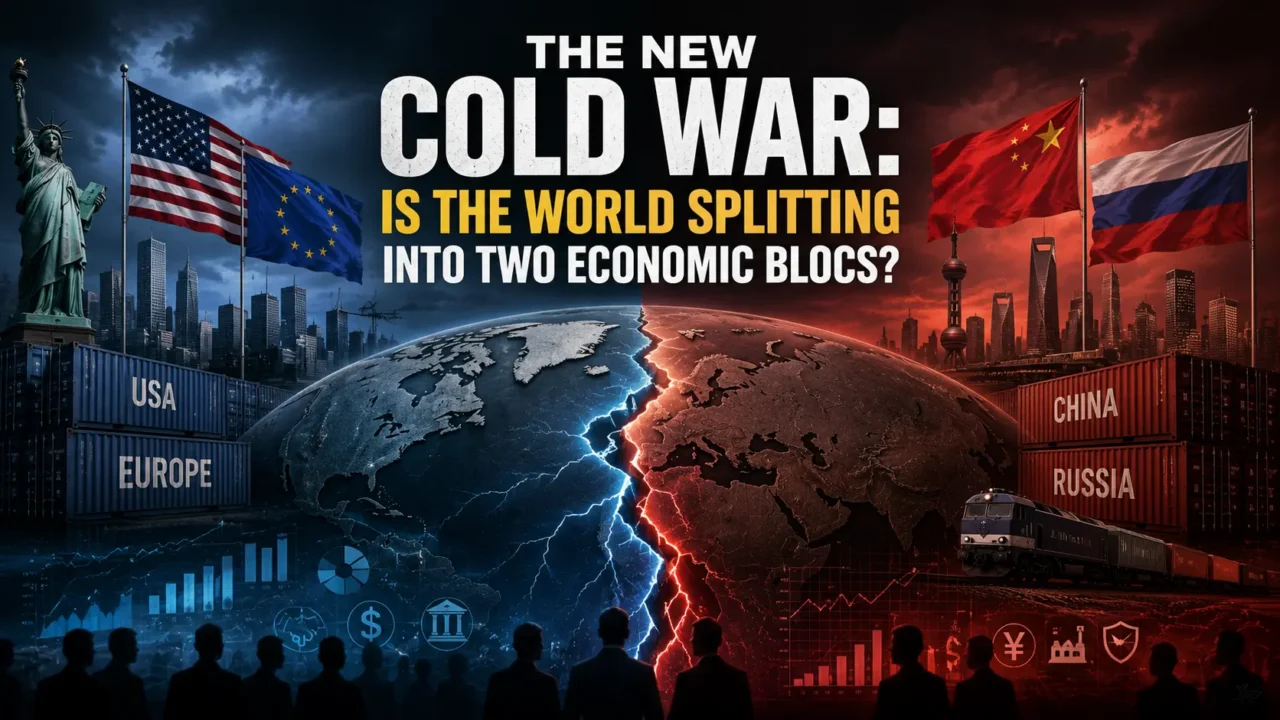
For decades after the Cold War ended, globalization was built on a powerful assumption: nations could compete politically while remaining economically interconnected. Countries traded across ideological lines, multinational companies built global supply chains, and economic cooperation was widely viewed as a force for stability. Today, that assumption is being questioned. Rising geopolitical tensions, trade restrictions, technology sanctions, and growing concerns over national security have prompted governments to rethink how—and with whom—they conduct business.
This shift has given rise to an important debate in international relations. Is the world entering a new Cold War, one defined not primarily by military confrontation but by economic competition? More specifically, are global markets gradually separating into two competing economic blocs led by the United States and its allies on one side and China with its expanding network of partners on the other?
The answer is more complex than a simple yes or no. The global economy is changing, but it is not dividing into two completely isolated systems. Instead, the world appears to be moving toward selective economic fragmentation, where cooperation continues in some areas while strategic competition intensifies in others. Understanding this transition is essential because it will influence trade, technology, investment, energy, and economic growth for decades to come.
Why Governments Are Rethinking Globalization
The globalization model that emerged during the 1990s emphasized efficiency above all else. Companies located factories wherever production costs were lowest, supply chains stretched across continents, and consumers benefited from cheaper goods. This approach helped lift millions out of poverty and accelerated global economic growth.
Recent events, however, exposed the vulnerabilities of extreme economic interdependence. The COVID-19 pandemic disrupted international supply chains, creating shortages of medical equipment, semiconductors, and essential industrial components. The war in Ukraine highlighted Europe’s dependence on imported energy, while increasing geopolitical tensions between the United States and China raised concerns about reliance on strategic technologies manufactured abroad.
These experiences encouraged governments to place greater emphasis on economic security alongside economic efficiency. Instead of asking only where products can be manufactured most cheaply, policymakers increasingly ask whether critical industries can remain resilient during future crises.
Technology Has Become the New Battleground
Unlike the original Cold War, today’s competition is driven as much by technology as by military power. Advanced semiconductors, artificial intelligence, quantum computing, biotechnology, and telecommunications have become strategic assets because they influence both economic competitiveness and national security.
Governments now recognize that technological leadership shapes future economic strength. As a result, export controls, investment restrictions, and domestic industrial policies have become increasingly common. Several countries are investing heavily in domestic semiconductor manufacturing while limiting exports of certain advanced technologies to geopolitical rivals.
Technology companies therefore operate in an environment where commercial decisions increasingly intersect with foreign policy. A product designed for global markets may also become part of broader strategic competition between major powers.
Iran–US War Escalation Explained: Why the Strait of Hormuz Could Reshape the Global Economy
Are Two Economic Blocs Really Emerging?
The phrase “two economic blocs” suggests that countries must choose one side while ending trade with the other. Current evidence suggests reality is more nuanced.
Trade between major economies remains substantial despite rising tensions. Businesses continue operating internationally because global supply chains remain deeply interconnected. At the same time, governments are encouraging friend-shoring, near-shoring, and supply chain diversification to reduce dependence on a single country for strategically important products.
Many middle powers—including India, Vietnam, Indonesia, Saudi Arabia, Brazil, and several ASEAN members—are pursuing pragmatic strategies that allow them to maintain economic relationships with multiple major powers simultaneously. Rather than choosing permanent sides, these countries seek investment, technology, and trade opportunities from a diverse range of partners.
The emerging global economy therefore appears less like two sealed blocs and more like overlapping networks connected by selective cooperation and strategic competition.
The Economic Consequences
A more fragmented global economy carries both opportunities and costs.
On one hand, diversified supply chains improve resilience. Manufacturing spread across multiple countries reduces the risk that one geopolitical crisis or natural disaster will disrupt entire industries. New manufacturing investment has also created opportunities for emerging economies seeking to attract international businesses relocating production.
On the other hand, fragmentation can reduce efficiency. Duplicating supply chains, restricting technology transfers, and imposing tariffs often increase production costs. Consumers may ultimately face higher prices, while companies encounter greater regulatory complexity when operating across multiple jurisdictions.
Innovation could also become more expensive if scientific collaboration and technology exchange become increasingly constrained. Historically, many technological breakthroughs have benefited from international cooperation among researchers, universities, and private companies.
The long-term challenge will be balancing national security with the economic benefits of global openness.
What This Means for Businesses and Individuals
Businesses are already adapting to this changing environment. Many multinational firms now evaluate geopolitical risk alongside traditional financial considerations when making investment decisions. Supply chain resilience, cybersecurity, regulatory compliance, and political stability have become central components of corporate strategy.
For workers and students, this transformation increases the importance of skills connected to advanced manufacturing, artificial intelligence, cybersecurity, international business, logistics, semiconductor technology, and geopolitical analysis. Understanding global affairs is no longer relevant only for diplomats and economists. Increasingly, it shapes career opportunities across technology, finance, engineering, and business.
Consumers may also notice gradual changes through higher prices for certain products, increased emphasis on locally manufactured goods, and growing public discussions surrounding economic resilience and strategic industries.
How Artificial Intelligence Is Reshaping Global Power
A More Competitive—but Still Connected—World
It is tempting to compare today’s geopolitical tensions directly with the Cold War of the twentieth century. While certain similarities exist, important differences remain.
The United States and China remain deeply connected through trade, investment, financial markets, and global supply chains. Unlike the largely separate economic systems of the previous Cold War, today’s major economies remain significantly interdependent. Complete economic separation would impose enormous costs on businesses and consumers worldwide.
Instead of absolute decoupling, many experts describe the current trend as “de-risking”—reducing dependence in strategically sensitive sectors while preserving cooperation where mutual economic benefits remain substantial.
This distinction matters because it suggests competition and cooperation will continue existing simultaneously rather than replacing one another entirely.
Conclusion
The world is undoubtedly entering a period of profound economic transformation. Geopolitical competition, technological rivalry, and national security concerns are reshaping the foundations of globalization. Governments are placing greater emphasis on resilience, strategic industries, and supply chain security, while businesses adjust to an increasingly complex international environment.
Yet describing this transformation as a simple division into two opposing economic blocs overlooks the complexity of today’s interconnected world. Global trade continues, international investment persists, and many nations actively seek balanced relationships with multiple partners rather than exclusive alliances.
The future global economy is therefore unlikely to be defined by complete separation.
It will be defined by selective integration.
Countries will cooperate where interests align, compete where strategic advantages matter, and continuously adjust to an international system that is becoming more multipolar, technologically driven, and economically interconnected in new ways.
Understanding this shift is essential because the decisions being made today will shape global prosperity, innovation, and international relations for decades to come.
Call to Action
Global affairs are evolving rapidly, and understanding the forces behind these changes is becoming an essential skill for professionals, investors, students, and informed citizens alike. Explore the Aziz Publishing Knowledge Library for thoughtful, evidence-based analysis of geopolitics, technology, world affairs, economics, and the emerging trends shaping the future of our interconnected world.