Updated July 16, 2026
This article explains the latest developments based on publicly available information as of July 16, 2026. Because the situation is evolving, some events may change after publication.
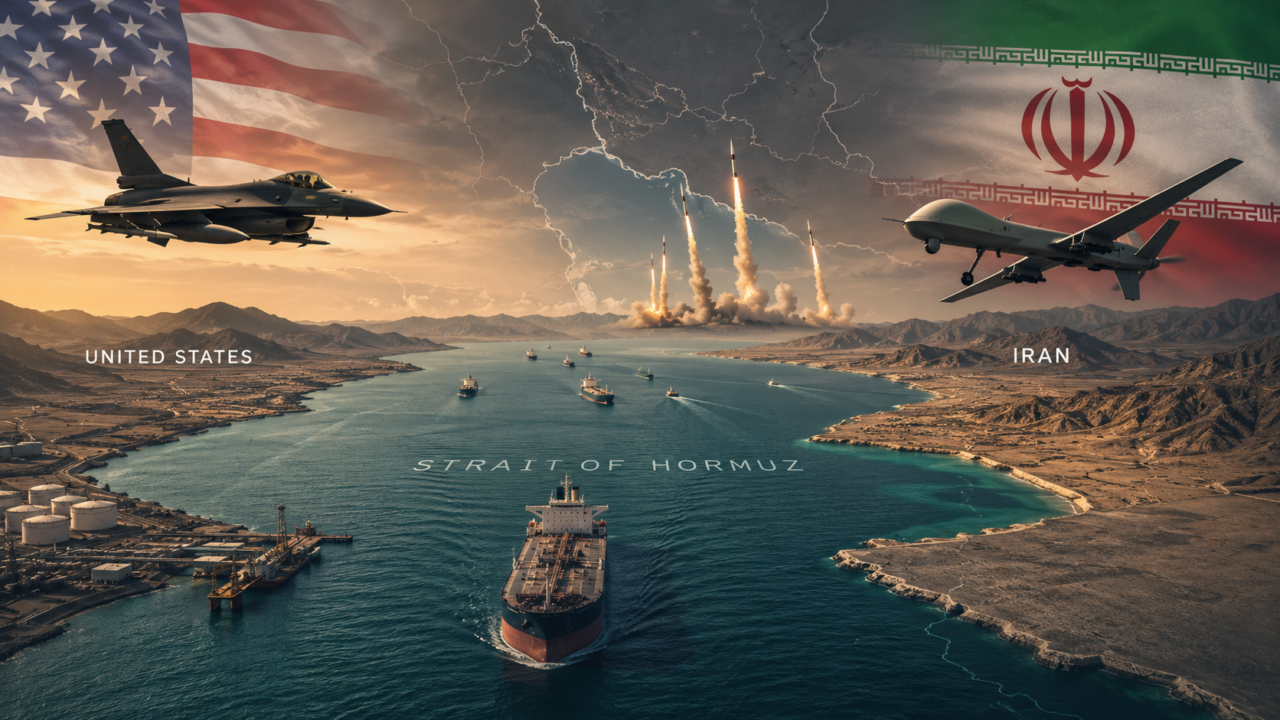
The escalating confrontation between Iran and the United States is no longer a distant diplomatic dispute conducted through sanctions, warnings, and proxy forces. It has become a direct military conflict involving American airstrikes, Iranian missile and drone attacks, threats against regional infrastructure, and a struggle over one of the world’s most important maritime routes.
Recent American operations have expanded beyond targets near southern Iran and the Strait of Hormuz. US forces have reportedly struck missile positions, air-defence systems, maritime assets, and military sites farther north, while also enforcing pressure around Iranian ports and oil-export infrastructure. Iran has continued retaliatory attacks against locations across the Gulf, including countries that host American military forces.
The conflict matters far beyond Washington and Tehran. The Strait of Hormuz carries a significant share of internationally traded oil and liquefied natural gas. Disruption there can raise fuel prices, increase transportation costs, unsettle financial markets, and affect households thousands of miles away.
To understand why this crisis is so dangerous, it is necessary to look beyond the daily exchange of strikes. The real contest is about military deterrence, freedom of navigation, Iran’s regional influence, nuclear uncertainty, domestic political survival, and control over the economic pressure points of the Gulf.
What Is Happening Between Iran and the United States?
The latest escalation centres on renewed American military operations against Iranian assets and Tehran’s retaliation across the Middle East.
The United States says its strikes are intended to reduce Iran’s ability to attack commercial shipping and threaten American forces and partners. Recent targets have reportedly included radar systems, missile facilities, drones, small naval vessels, coastal defences, and other military infrastructure around the Strait of Hormuz. American operations have also expanded into northern parts of Iran, increasing the geographical scope of the conflict.
Iran, meanwhile, has used missiles, drones, naval pressure, and threats against Gulf infrastructure to demonstrate that it can impose costs on both the United States and countries supporting American operations. Attacks have affected or threatened states hosting US military facilities, including Bahrain, Kuwait, Qatar, Jordan, and other regional partners.
The conflict has repeatedly shifted between military escalation and incomplete diplomatic pauses. An interim arrangement created hope that strikes might stop and negotiations could resume, but the ceasefire deteriorated. President Donald Trump later informed Congress that hostilities had resumed, presenting the renewed operations as necessary to protect American interests and personnel.
This creates a dangerous pattern: military force is being used to improve negotiating leverage, but every strike also makes negotiation politically harder.
Why the Strait of Hormuz Matters So Much
The Strait of Hormuz is a narrow waterway connecting the Persian Gulf with the Gulf of Oman and the Arabian Sea. It is one of the most strategically important energy routes in the world.
Oil and gas exports from Saudi Arabia, the United Arab Emirates, Kuwait, Iraq, Qatar, and Iran depend heavily on access through or near this passage. Even when physical supplies continue moving, the possibility of disruption can sharply increase insurance costs, shipping charges, and energy prices.
Iran cannot easily defeat the United States in a conventional military contest. But geography gives Tehran an important form of leverage. Iran can threaten ships using coastal missiles, drones, mines, submarines, fast boats, and surveillance systems positioned around the Gulf.
The United States, by contrast, wants to demonstrate that no country can unilaterally close or control an international shipping route. Washington therefore faces pressure to restore reliable navigation without becoming trapped in an expensive, open-ended regional war.
This is the central strategic dilemma. Iran does not need to permanently close the strait to influence the global economy. It only needs to make shipping uncertain, dangerous, and expensive.
Why Oil Prices and Consumer Costs Are at Risk
The economic consequences of the conflict are already visible. Reports of new attacks and tighter maritime restrictions have caused oil prices to rise, although prices have moved below and above earlier peaks as traders respond to changing military and diplomatic signals.
A prolonged disruption could affect much more than petrol prices.
Higher energy costs increase the expense of manufacturing, aviation, shipping, agriculture, electricity generation, and road transportation. Businesses often pass those costs on to consumers. As a result, a conflict in the Gulf can raise the price of food, imported goods, airline tickets, and everyday services in the United States, Canada, Britain, Europe, and Asia.
How the crisis could affect ordinary households
Consumers may experience:
- Higher petrol and diesel prices
- More expensive flights and freight
- Increased food-production costs
- Renewed inflationary pressure
- Higher electricity costs in energy-importing countries
- Greater volatility in pensions and investment markets
The economic damage would depend on the duration of the conflict, the amount of shipping interrupted, and whether regional oil facilities become direct targets.
So far, the United States has reportedly avoided a broad campaign against Iran’s oil infrastructure, but threats involving Kharg Island and other strategically important sites have increased concern that energy facilities could become part of the battlefield.
The Nuclear Issue Has Not Disappeared
Although the current fighting is heavily focused on shipping and regional security, Iran’s nuclear programme remains one of the deepest causes of confrontation.
The United States and its allies fear that Iran could move closer to acquiring a nuclear weapon. Iran has long maintained that its programme serves peaceful purposes, while arguing that Western pressure and Israeli military threats justify stronger deterrent capabilities.
The International Atomic Energy Agency has faced serious limitations in monitoring Iranian nuclear activity. Recent assessments indicated continuing uncertainty over access, verification, and parts of Iran’s enriched uranium stockpile. An interim peace arrangement was expected to restore some access for UN inspectors, but disputes remained over which facilities would be opened and under what conditions.
This uncertainty increases the danger of miscalculation. If American or Israeli leaders believe Iran is using the conflict to conceal nuclear progress, they may consider additional strikes. If Iran believes its government or strategic facilities face an existential threat, it may conclude that only a stronger deterrent can protect it.
Military action can damage physical infrastructure. It cannot automatically eliminate scientific knowledge, political motivation, or the security fears that drive nuclear development.
Why Neither Side Can Easily Back Down
The conflict is difficult to stop because both governments have framed it as a test of national strength.
For the United States, allowing Iran to threaten shipping and attack regional partners could appear to weaken American deterrence. Washington also wants to reassure allies that American military power can protect trade routes and US personnel.
For Iran, reopening the strait or ending retaliation without major concessions could look like surrender after sustaining extensive military damage. Iranian leaders also depend on a narrative of resistance against foreign pressure.
This produces a classic escalation trap:
- One side uses force to compel restraint.
- The other side interprets restraint as weakness.
- Retaliation follows to restore credibility.
- Each government expands its demands.
- Political space for compromise becomes smaller.
Even when leaders privately want negotiations, they may fear that publicly offering concessions will weaken them at home or encourage further attacks.
Could the Conflict Become a Wider Regional War?
A wider war is not inevitable, but the pathways toward one are clear.
Iran may target military installations, shipping facilities, or energy infrastructure in Gulf states that assist American operations. The United States may respond with increasingly broad attacks on Iranian military, government, or economic targets. Israel could intensify its own operations if it believes Iran’s nuclear or missile capabilities remain a threat.
Armed groups aligned with Iran could also increase activity in Iraq, Syria, Lebanon, Yemen, or elsewhere. A single attack causing large numbers of American or civilian deaths could rapidly change political calculations.
The greatest danger may not be a deliberate decision to begin a larger war. It may be an accident, a misidentified target, an uncontrolled proxy attack, or a strike whose consequences are more severe than expected.
Modern conflicts can escalate faster than diplomatic channels can contain them.
What Would De-Escalation Require?
A durable solution would require more than a temporary pause in airstrikes.
The United States would want reliable freedom of navigation, protection for its regional forces, limits on missile and drone threats, and verifiable restrictions on Iran’s nuclear programme.
Iran would likely demand sanctions relief, security guarantees, an end to attacks on its territory, recognition of its right to peaceful nuclear activity, and restrictions on American or Israeli military pressure.
Regional mediation is therefore essential. Countries such as Pakistan, Qatar, Egypt, Oman, and other states with diplomatic access to both sides can help transmit proposals when direct trust is absent. Diplomatic efforts have continued despite the collapse of earlier pauses, but they face enormous pressure from events on the battlefield.
An effective agreement may require phased steps:
- A verified halt to attacks on commercial shipping
- Suspension of American and Iranian offensive operations
- Safe maritime corridors through the Strait of Hormuz
- Renewed access for international nuclear inspectors
- Prisoner releases or humanitarian measures
- Gradual sanctions relief tied to compliance
- A continuing regional-security negotiation
The most realistic path may not begin with a grand peace agreement. It may begin with small, verifiable actions that reduce the immediate risk of catastrophe.
What Should the World Watch Next?
Several developments will reveal whether the crisis is moving toward containment or a wider war.
Expansion of US target selection
If the United States moves from military sites to electricity networks, bridges, oil terminals, leadership compounds, or deeply buried nuclear facilities, the conflict would enter a more dangerous phase.
Iranian attacks on Gulf infrastructure
Major strikes against energy facilities, desalination plants, airports, or populated areas could trigger broader retaliation and draw more governments into the war.
Shipping activity in the Strait of Hormuz
The volume and safety of tanker traffic will remain one of the clearest measures of the crisis. Even partial recovery could ease oil prices; renewed attacks could send them sharply higher.
Nuclear-inspection access
Progress or obstruction involving the IAEA will affect whether diplomacy can address the underlying nuclear dispute.
The survival of diplomatic channels
Public threats may dominate headlines, but private communications through mediators could determine whether both governments can find an exit.
Final Thoughts
The Iran–US conflict is not only a military confrontation. It is a struggle over credibility, economic leverage, nuclear uncertainty, regional power, and control of a waterway that connects Middle Eastern energy producers with the global economy.
The United States possesses overwhelming conventional military power. Iran possesses geography, missiles, drones, regional networks, and the ability to create uncertainty around global energy supplies. Each side can hurt the other, but neither can easily force a stable political outcome through military action alone.
That is why the Strait of Hormuz has become more than a shipping route. It is now the central pressure point in a conflict whose effects could reach fuel stations, supermarkets, factories, airports, and financial markets around the world.
The most important question is no longer whether both countries can escalate. They clearly can.
The question is whether they can create a path toward de-escalation before the economic and human costs become impossible to control.
References
- Associated Press reporting on expanded US strikes and Iranian retaliation, July 2026.
- Reuters reporting on US military strategy, congressional notification, diplomacy, and the Strait of Hormuz, July 2026.
- International Atomic Energy Agency reporting and monitoring information concerning Iran’s nuclear programme.
- US Central Command public statements regarding military operations around the Strait of Hormuz.