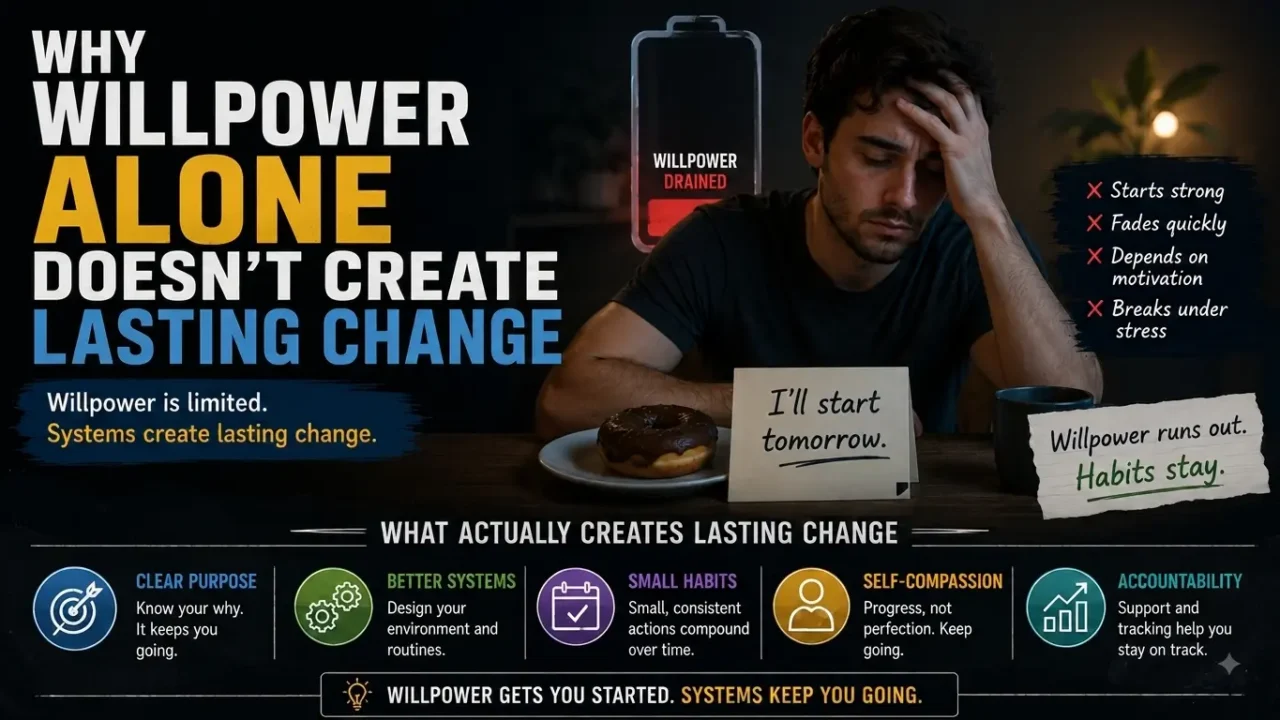
You white-knuckled your way through week one. Maybe even week two. Then, predictably, the old pattern crept back in, and you concluded you just don’t have enough discipline. The problem was never your discipline, it was relying on willpower alone in the first place.
Willpower Behaves Like a Limited Resource, Not a Fixed Trait
Research on self-control consistently shows that willpower functions more like a fluctuating resource than a stable personality trait, meaning it genuinely depletes throughout the day based on stress, decision fatigue, and even simple hunger. This explains why the same person can resist temptation easily in the morning but crumble by evening, it’s not a character flaw, it’s a predictable pattern of a finite resource running low. Building a strategy that requires maximum willpower at your most depleted moments, like resisting snacks at 9 p.m. after a draining day, sets you up to fail regardless of how genuinely committed you are. Understanding this mechanism reframes repeated “failures” as a structural problem, not a personal weakness.
Why Relying on Motivation Creates an Unstable Foundation
Willpower and motivation are closely linked, and both share the same core weakness, they’re emotional and physiological states that fluctuate constantly rather than staying reliably available. Motivation spikes around fresh starts, a new year, a dramatic wake-up call, and then predictably fades as the initial novelty wears off and the real, repetitive work begins. Building lasting change on top of this inherently unstable foundation means your success becomes contingent on catching yourself in a motivated mood often enough to follow through, which is a genuinely unreliable strategy over months and years. Sustainable change requires a foundation that doesn’t depend on feeling inspired in any given moment.
Growth Mindset vs Fixed Mindset: The Difference That Changes Everything
The Environment You’re In Matters More Than You Think
A significant amount of what looks like willpower failure is actually a poorly designed environment quietly working against the change you’re trying to make. Keeping tempting snacks in plain sight, having your phone within arm’s reach during focused work, or living in a chaotic space all increase the willpower required to make the desired choice, regardless of how motivated you feel. Behavioral researchers consistently find that reducing friction toward the desired behavior, and increasing friction toward the competing one, produces more reliable results than trying to summon more discipline. People who appear highly disciplined have often simply engineered their surroundings to require far less discipline in the first place.
Habits Run on Autopilot, Willpower Doesn’t
Behavioral science describes habits as running on a loop, a cue triggers a routine, followed by a reward, and repeated pairing of these elements gradually shifts the behavior from requiring conscious effort to running largely automatically. Early on, a new habit genuinely requires willpower and motivation to get started, since the loop hasn’t been established yet. But as the cue and routine get paired together through repetition, the behavior increasingly requires far less conscious effort to execute, which is the real mechanism behind consistency that lasts. This means the actual goal isn’t summoning more willpower indefinitely, it’s building habits reliable enough that willpower becomes less necessary over time.
Why Identity-Based Change Outlasts Goal-Based Change
Change driven purely by an external goal, “I want to lose twenty pounds,” tends to create a natural stopping point once the goal is achieved, removing the very thing that was driving the behavior in the first place. Change driven by identity, “I’m becoming someone who prioritizes their health,” doesn’t have a built-in finish line, since you don’t complete an identity, you simply continue living in alignment with it. This distinction matters enormously for sustainability, identity-based change survives an occasional missed day far better than goal-based change does, since a single lapse doesn’t threaten your underlying self-concept the way it threatens progress toward a fixed target. Framing change around who you’re becoming, rather than purely what you’re trying to achieve, creates a far more durable foundation.
The Role of Systems Over Isolated Decisions
Relying on willpower means making the same difficult decision repeatedly, resisting the same temptation, choosing the harder option, every single day, which is exhausting and unreliable by design. Building a system, meal prepping in advance, automating savings transfers, scheduling workouts as fixed calendar appointments, removes the need to make that difficult decision fresh each time. This shift from decision to system matters because systems don’t require daily willpower to maintain once they’re established, they simply need to be set up correctly and occasionally maintained. People who sustain long-term change consistently describe relying on systems and structure far more than on daily bursts of discipline.
The Hidden Psychology of Self-Sabotage: Why You Keep Getting in Your Own Way
How Social Support Reduces the Willpower Burden
Attempting significant change in isolation places the entire burden of consistency on your individual willpower, with no external structure to catch you during a weak moment. Social accountability, a workout partner, a support group, simply telling a friend about your goal, distributes some of that burden externally, since showing up for someone else often feels different than showing up purely for your own internal motivation. Research on behavior change consistently shows that social support and accountability structures improve follow-through rates significantly compared to purely solo efforts relying on internal discipline alone. Building genuine support into your change process isn’t a sign of weakness, it’s a well-documented strategy that actually works better than isolated willpower.
What Actually Creates Lasting Change
Lasting change comes from combining several specific elements, environment design that reduces friction, habit loops that automate behavior over time, identity-based framing rather than purely goal-based thinking, systems that remove daily decision-making, and social support that distributes the burden of consistency. None of these elements require you to become a fundamentally more disciplined person, they simply require you to structure your approach more intelligently than relying on willpower alone ever could. This is genuinely good news, since it means past “failures” weren’t a character flaw, they were often just missing structural support that had nothing to do with how much you wanted the change. Building even two or three of these elements into your next attempt at change dramatically improves your odds compared to willpower alone.
Final Thoughts
Willpower alone fails to create lasting change because it’s a fluctuating, limited resource, not a stable trait you either have enough of or don’t, and building change entirely on top of it sets you up for a predictable pattern of temporary progress followed by relapse. Real, lasting change comes from environment design, habit loops, identity shifts, systems, and social support working together, not from gritting your teeth harder than last time.
Call to Action
Pick one part of your current change effort that’s relying purely on willpower, and redesign it this week using one of these strategies. If this helped you understand why past attempts didn’t stick, share it with someone still blaming a lack of discipline that was never really the problem. Continue exploring the Aziz Publishing Knowledge Library for evidence-based articles on psychology, mindset, habits, productivity, and emotional well-being. The more you understand how your mind works, the more intentionally you can shape the way you think, decide, and live.