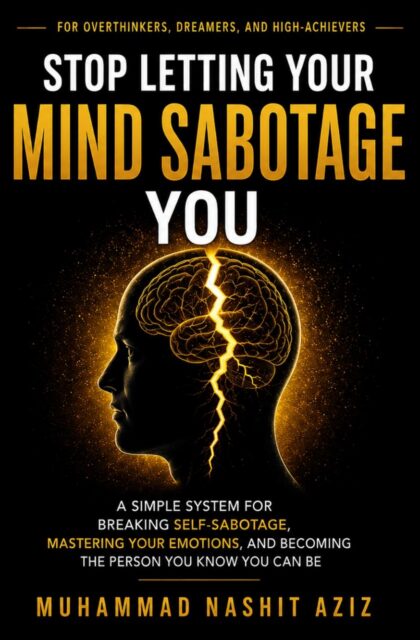
Self-sabotage is one of the most frustrating psychological patterns because it often happens without us realizing it. We set meaningful goals, feel genuinely motivated, and then somehow find ourselves procrastinating, making excuses, or abandoning the very things we want most. This hidden conflict is rarely about laziness or a lack of willpower—it is often the result of unconscious beliefs, emotional conditioning, and protective mental habits. Understanding the psychology behind self-sabotage is the first step toward breaking free from these invisible patterns and creating lasting, meaningful change.
We Often Become the Biggest Obstacle in Our Own Lives
There is a frustrating experience almost everyone shares, although few people understand it. You make a promise to yourself that this time will be different. You decide that tomorrow you will wake up earlier, begin exercising, finish the project you’ve been avoiding, finally apply for that opportunity, or start building the life you’ve imagined for years. The motivation feels genuine. The excitement feels real. For a brief moment, you believe that change has finally arrived.
Then something unexpected happens.
Tomorrow arrives, but the enthusiasm quietly fades. You find reasons to delay. Small distractions become urgent priorities. Minor inconveniences suddenly feel overwhelming. Before long, the commitment you made to yourself disappears beneath another excuse, another delay, another promise that you will begin “next Monday.”
The painful part is not that you failed.
The painful part is that you genuinely wanted to succeed.
This contradiction confuses millions of people. They begin asking questions that slowly damage their confidence. Why can’t I stay consistent? Why do I keep making the same mistakes? Why do I keep destroying opportunities that I worked so hard to create? Eventually, many people reach a dangerous conclusion: perhaps something is fundamentally wrong with me.
But psychology offers a very different explanation.
What feels like laziness is often emotional protection.
What feels like procrastination is frequently unconscious avoidance.
What feels like a lack of discipline is often a deeply learned survival strategy that once served an important purpose.
Self-sabotage is rarely a conscious decision. Very few people wake up wanting to ruin their own progress. Instead, it operates quietly beneath awareness, influencing decisions long before logic has the chance to intervene. It disguises itself as caution, perfectionism, overthinking, or waiting for the “right moment.” Because it wears so many different masks, most people spend years fighting the symptoms without ever recognizing the psychological system creating them.
Understanding that system changes everything.
Because once you understand why your mind keeps working against you, you stop fighting yourself blindly. Instead, you begin working with your psychology rather than against it.
That is where lasting change truly begins.
Self-Sabotage Is Not a Character Flaw—It’s a Psychological Pattern
One of the greatest misconceptions surrounding self-sabotage is the belief that it reflects weak character. Society often praises discipline while criticizing inconsistency, creating the impression that successful people simply possess more willpower than everyone else.
Human psychology tells a far more complex story.
Our brains evolved primarily for survival, not achievement. Long before people worried about careers, businesses, or personal development, the human nervous system focused on one objective above all else: avoiding danger. Every decision your brain makes still passes through ancient emotional systems designed to keep you safe.
The problem is that your brain often struggles to distinguish between physical danger and psychological discomfort.
Standing in front of a large audience may trigger the same stress response that ancient humans experienced when facing a predator. Starting a business can activate the same uncertainty circuits that once protected our ancestors from entering unfamiliar territory. Falling in love, changing careers, asking for a promotion, publishing your creative work, or taking a significant risk can all produce feelings that your nervous system interprets as threats.
When your brain senses danger, its priority immediately changes.
Instead of helping you grow, it focuses on helping you survive.
This is why self-sabotage often appears precisely when your goals become meaningful. The closer you move toward something that could transform your identity, the louder your internal resistance becomes. You mistake that resistance for evidence that you are incapable, when in reality it may simply be evidence that your brain has entered protective mode.
This perspective changes the conversation completely.
Instead of asking, “Why am I so lazy?” you begin asking, “What is my mind trying to protect me from?”
That single question opens the door to genuine self-awareness.
The Invisible Conflict Between Your Present Identity and Your Future Self
Every meaningful change asks you to become someone you have never been before.
That sentence sounds simple, but psychologically it explains why personal growth often feels so uncomfortable.
People usually focus on changing behaviors while ignoring the identities behind those behaviors. They attempt to exercise without becoming someone who values movement. They try to save money without developing the mindset of a financially responsible person. They attempt to become confident while continuing to see themselves as insecure.
The result is constant internal conflict.
Imagine pulling a rubber band. One side represents the person you have been for years. The other side represents the person you hope to become. Every action that supports your future stretches the tension between those two identities. At first, the discomfort feels manageable. But as the gap widens, your mind naturally searches for relief.
Unfortunately, returning to familiar habits provides immediate psychological comfort.
This is why people often abandon progress immediately after experiencing success.
Someone loses weight and gradually returns to unhealthy eating.
A new entrepreneur begins gaining momentum but suddenly stops marketing their business.
A writer makes significant progress on a book, then spends weeks doing everything except writing.
Outsiders see inconsistency.
Psychologists often see identity protection.
The old identity fights for survival because it has become familiar. Familiarity creates safety, even when that familiarity is limiting or painful. Remaining stuck may be uncomfortable, but it is predictable. Growth introduces uncertainty, and uncertainty activates fear.
Until your internal identity changes, your external behavior will constantly struggle to remain consistent.
Real transformation does not happen when your habits change.
It happens when your self-image changes.
Why Your Mind Prefers Familiar Pain Over Unfamiliar Success
This may sound strange at first, but human beings often choose familiar suffering instead of unfamiliar happiness.
Not consciously.
Psychologically.
Think about people who remain in unhealthy relationships long after they recognize the damage. Consider employees who stay in jobs they dislike for decades despite dreaming about something different. Reflect on individuals who repeatedly postpone opportunities even though they desperately want their lives to improve.
From the outside, these decisions appear irrational.
From the inside, they feel safe.
The human brain is remarkably efficient at predicting familiar environments. It knows what to expect. It understands the emotional rules. It recognizes the risks. Even if those circumstances are unpleasant, they remain psychologically manageable because they are known.
Success, however, creates uncertainty.
What if I fail after everyone expects more from me?
What if people judge me?
What if I can’t maintain this progress?
What if success changes my relationships?
What if I discover I’m not actually capable?
These questions rarely appear in full sentences. Instead, they emerge as hesitation, procrastination, overthinking, perfectionism, or endless preparation without meaningful action.
People believe they are waiting until they feel ready.
In reality, they are waiting for uncertainty to disappear.
That day never arrives.
Confidence is not what comes before courageous action.
Confidence is what gradually grows because of courageous action.
The Four Hidden Psychological Drivers of Self-Sabotage
Although self-sabotage can take countless forms, most destructive behaviors are driven by a small number of psychological mechanisms operating beneath conscious awareness. They influence the stories we tell ourselves, the decisions we make, and the opportunities we either embrace or avoid. Understanding these hidden drivers is like turning on the lights in a dark room. Suddenly, behaviors that once felt random begin to make perfect sense.
The first driver is the fear of failure, but not in the way most people imagine it. Failure itself is rarely the greatest concern. What people truly fear is what failure might say about who they are. If your identity becomes attached to being intelligent, capable, or talented, then failing at something meaningful feels less like an event and more like a verdict. Rather than risking that emotional pain, the mind quietly encourages avoidance. It whispers that now isn’t the right time, that more preparation is necessary, or that waiting another week won’t make much difference. These excuses feel logical because they protect the ego from immediate disappointment.
The second driver is the fear of success, which often surprises people. Success sounds universally desirable until we recognize that every success changes expectations. Achieving one goal usually creates another. Greater responsibility follows greater achievement. Success can alter relationships, challenge long-held beliefs, and force people to leave environments where they once felt comfortable. For someone whose nervous system values predictability above growth, success can feel almost as threatening as failure. The mind begins slowing progress, not because it dislikes achievement, but because it fears everything achievement might require afterward.
The third driver is perfectionism, one of the most socially accepted forms of self-sabotage. Perfectionists rarely see themselves as afraid. They simply believe they have high standards. Yet beneath those standards often lies an impossible expectation: if everything can be made perfect, then criticism, rejection, and disappointment can be avoided. Since perfection never arrives, action keeps getting postponed. Projects remain unfinished. Ideas stay trapped inside notebooks. Dreams become permanent plans instead of lived experiences.
The final driver is emotional avoidance. Every meaningful goal demands emotional discomfort somewhere along the journey. There will be uncertainty before confidence, rejection before acceptance, mistakes before mastery, and frustration before progress. People who have never learned to tolerate uncomfortable emotions often organize their entire lives around avoiding them. They postpone difficult conversations, delay important decisions, abandon challenging goals, and convince themselves that comfort is wisdom. In reality, comfort has quietly become their prison.
These four psychological forces rarely operate alone. More often, they reinforce one another until self-sabotage becomes a deeply established pattern that feels almost automatic.
The Habit Loop That Keeps You Stuck
One reason self-sabotage feels so difficult to overcome is that it eventually becomes habitual. Habits are not simply repeated actions. They are neurological shortcuts designed to conserve mental energy. Once the brain identifies a familiar pattern, it begins executing it automatically, often before conscious awareness has a chance to intervene.
Imagine someone who feels anxious whenever they face an important task. Instead of beginning the work, they instinctively open social media, check email, organize their desk, or watch another motivational video. The anxiety temporarily decreases. The brain immediately registers an important lesson: distraction successfully reduced discomfort.
The next time anxiety appears, the same behavior becomes even more likely.
Eventually, procrastination is no longer a decision.
It becomes a conditioned emotional response.
The tragedy is that temporary relief creates long-term suffering. Every avoided task quietly strengthens self-doubt. Every postponed opportunity reinforces the belief that action is difficult. Every broken promise weakens self-trust. Over months and years, the individual begins believing they simply lack discipline, never realizing they have been training their brain to avoid discomfort all along.
Breaking this cycle requires more than motivation.
Awareness Is the Beginning of Freedom
Perhaps the greatest misconception in personal development is the belief that awareness alone is not enough.
In truth, awareness changes far more than people realize.
You cannot interrupt a pattern you cannot recognize.
The moment you notice yourself inventing excuses, delaying meaningful work, or seeking unnecessary comfort, you create a tiny space between the automatic habit and the conscious decision. That space may last only a few seconds, but within those seconds lies the possibility of choosing differently.
Psychologists often refer to this as moving from automatic behavior to intentional behavior.
Most self-sabotage occurs on autopilot.
Growth begins the moment awareness takes the steering wheel.
This is why journaling, reflection, mindfulness, and honest self-observation remain such powerful practices. They are not magical solutions. They simply help reveal psychological patterns that previously operated in silence.
Once those patterns become visible, they begin losing their power.
Breaking the Cycle: Small Decisions That Rewrite Your Psychology
One of the biggest myths surrounding personal transformation is the belief that dramatic change requires dramatic action. Popular culture celebrates overnight success stories, life-changing breakthroughs, and moments of extraordinary inspiration. While these stories are exciting, they rarely reflect how the human mind actually changes.
Psychology operates through repetition.
Your brain does not build beliefs based on your intentions. It builds beliefs based on your evidence.
Every time you keep a promise to yourself, no matter how small, you provide your brain with new evidence about who you are. Every workout you complete despite not feeling motivated, every difficult conversation you choose not to avoid, every page you write when inspiration is absent, and every uncomfortable decision you make in alignment with your values becomes another vote for a new identity.
This is why consistency is more psychologically powerful than intensity.
Conclusion: Your Mind Is Not Your Enemy
Perhaps the most important lesson about self-sabotage is that your mind is not trying to destroy your future. It is trying to protect you using strategies that were developed long before your current goals existed.
The problem is not that your brain works against you.
The problem is that it often relies on outdated patterns that no longer serve the life you want to build.
Once you understand this, your relationship with yourself begins to change. Instead of responding to procrastination with self-criticism, you become curious about what your mind is attempting to avoid. Instead of labeling yourself lazy, you investigate the emotional discomfort hidden beneath the behavior. Instead of believing that discipline belongs only to naturally successful people, you recognize it as a skill developed through repeated acts of self-trust.
This perspective replaces shame with understanding.
It replaces frustration with awareness.
Most importantly, it replaces helplessness with responsibility.
You may not have chosen the beliefs that shaped your early life. You may not be responsible for every fear, insecurity, or emotional pattern you carry today. But you are responsible for deciding whether those patterns continue directing the rest of your life.
Every meaningful change begins long before visible results appear. It begins the moment you recognize an old pattern and consciously choose a different response. That choice may feel small. It may seem insignificant. Yet history is filled with extraordinary lives that were not transformed by one giant decision but by thousands of quiet decisions made consistently over time.
The next time you find yourself procrastinating, doubting your abilities, or standing at the edge of an important opportunity, pause before assuming something is wrong with you.
Ask a different question.
“What is my mind trying to protect me from?”
Then ask an even more important one.
“Does this protection still serve the person I want to become?”
The answer to those two questions may be the beginning of a completely different future.
Why Smart People Still Sabotage Their Own Progress – Aziz Publishing: The Hidden Psychology of Self-Sabotage: Why You Keep Getting in Your Own Way