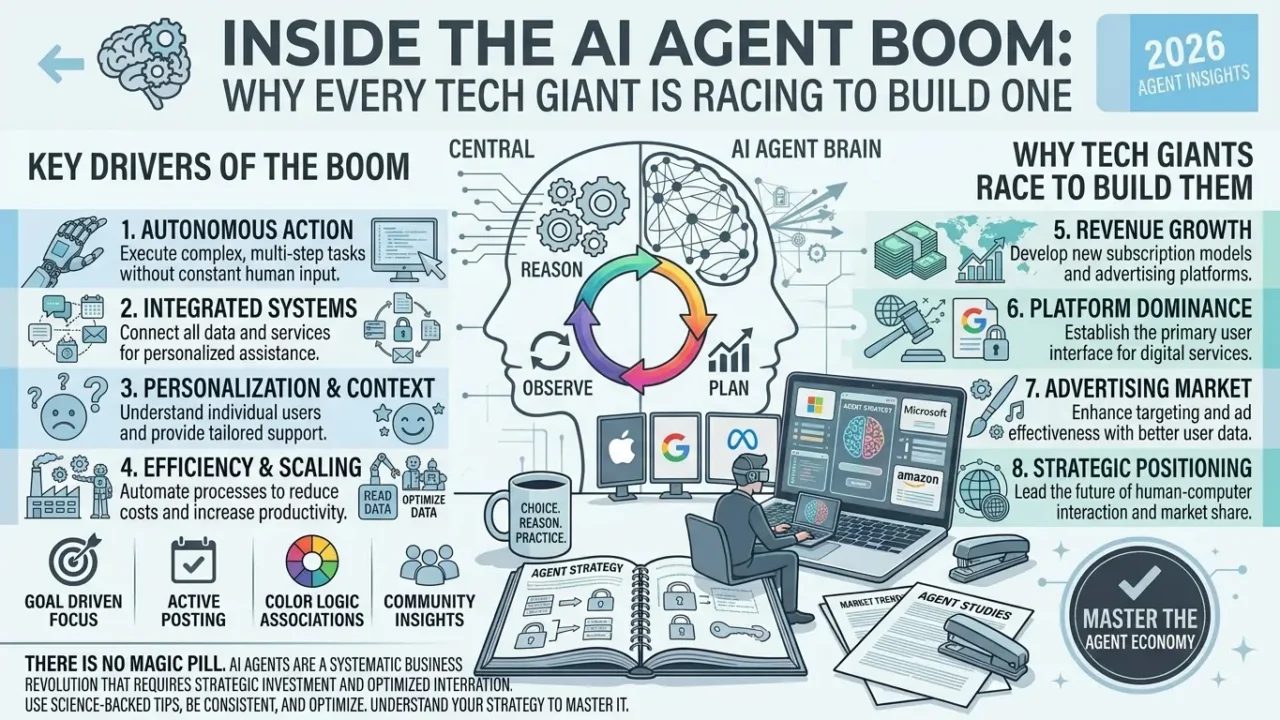
Every major tech company is chasing the same goal in 2026: building AI that doesn’t just answer questions, but actually gets things done. Google, OpenAI, Microsoft, Amazon, and Meta have all launched competing platforms in the past few months, turning AI agents into the industry’s biggest battleground.
From Chatbots to Digital Workers
For years, AI meant a chatbot you talked to, something that answered a question or drafted an email when prompted. AI agents are different. Give one a goal, like booking a flight or managing a multi-step workflow, and it plans the steps, makes decisions, and carries out the task with minimal human oversight. That shift from responding to acting is what’s driving the current race.
How Google, Microsoft, and OpenAI Are Competing
In April, Google renamed its Vertex AI developer platform to the Gemini Enterprise Agent Platform and introduced industry-specific agents built for large organizations. Microsoft countered with its Microsoft 365 “Frontier Suite,” centered on Microsoft Agent 365, alongside multi-agent orchestration tools in Copilot Studio that let businesses build networks of agents working together across different systems. OpenAI, Amazon, and Salesforce have each rolled out competing agent frameworks of their own, all within the same few months.
Super Intelligence (SI): The Science Behind the Buzzword
The Money Behind the Race
The competition isn’t just about features, it’s about enormous spending. Alphabet, Amazon, Meta, and Microsoft together are projected to invest around $650 billion in AI infrastructure in 2026 alone, up sharply from the previous year. Analysts expect the broader agentic AI market to grow from roughly $11 billion in 2026 to well over $180 billion by 2033, which explains why no major tech company can afford to sit this one out.
Why Businesses Are Driving the Shift
Enterprise demand, not consumer hype, is fueling most of this growth. Companies want systems that can handle scheduling, customer service, data entry, and internal workflows without constant human input. That’s pushed tech giants to position agents as productivity infrastructure rather than novelty features, embedding them directly into tools businesses already use, like Microsoft 365, Google Workspace, and Salesforce.
Quantum Computing Explained: Will It Change Everything?
The Risks Nobody’s Fully Solved Yet
Giving software more autonomy raises real concerns. Agents that can take actions, not just generate text, introduce new risks around errors, security, and accountability when something goes wrong. Most companies are still working out how much oversight these systems actually need before they’re trusted with sensitive tasks.
What Comes Next
Analysts widely expect 2026 to be the year agentic AI moves from pilot programs to everyday use inside large organizations. Whether that translates into real productivity gains, or simply more automated busywork, is the question the entire industry is racing to answer first.
Final Thoughts
The AI agent boom marks a real shift in what artificial intelligence is built to do, moving from answering questions to completing tasks. With hundreds of billions of dollars now riding on the outcome, the race between Google, Microsoft, OpenAI, and Amazon is likely to define the next phase of the AI industry.
Call to Action
If this breakdown helped you understand why every tech giant is betting big on AI agents, share it with someone following the AI race. Explore the Aziz Publishing Knowledge Library for more guides on artificial intelligence and science & technology.