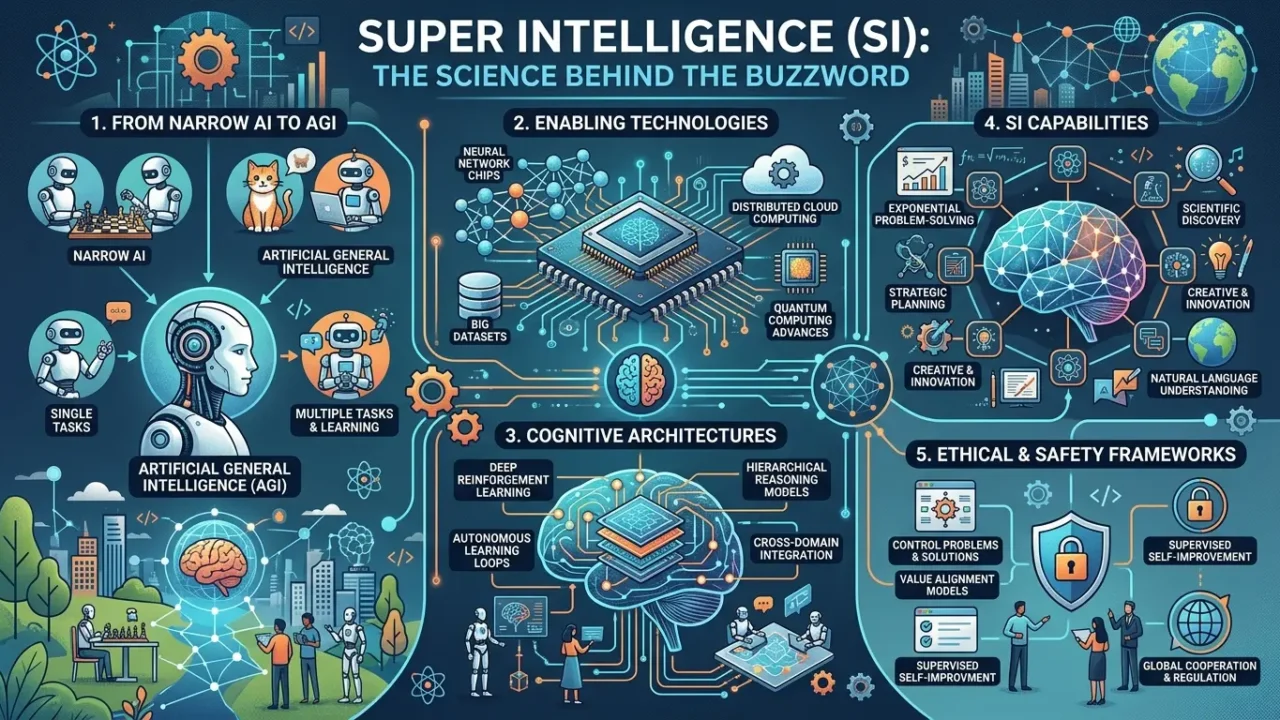
Trump’s announcement that “artificial intelligence” would be renamed “super intelligence” in U.S. government use sparked confusion online. But long before it became a political talking point, “superintelligence” was already a real term in computer science and philosophy, describing something very specific, and very different from the AI most people use every day.
Where the Term Actually Comes From
The concept of superintelligence didn’t originate in a press conference. It traces back to AI researchers and philosophers, most notably Oxford philosopher Nick Bostrom, who used it to describe a hypothetical intellect that dramatically outperforms the best human minds across every domain, not just narrow tasks like chess or language.
Artificial Intelligence Explained: How AI Is Changing the World
Three Tiers of AI, Explained Simply
Researchers generally separate AI into three tiers:
- Narrow AI (what exists today): systems like chatbots, recommendation engines, and image generators, each built to excel at specific tasks.
- Artificial General Intelligence (AGI): a still-theoretical system that could match human-level reasoning across any task, not yet achieved.
- Superintelligence (ASI): a system that would exceed human intelligence broadly, including in creativity, judgment, and problem-solving.
Today’s most advanced AI models are still firmly in the first category.
Why Calling Current AI “Super Intelligence” Is Misleading
Renaming today’s AI tools “super intelligence” collapses a distinction that took decades to establish. A chatbot that writes emails or summarizes documents is not exceeding human intelligence in any general sense, it’s performing narrow pattern-matching extremely well. Experts have pushed back on the rebrand precisely because it blurs a technical boundary that matters for public understanding, regulation, and research funding.
What Is Artificial General Intelligence, and How Close Are We?
What Actual Superintelligence Would Require
Researchers point to several unresolved technical hurdles before anything resembling true superintelligence could exist:
- Generalized reasoning across unfamiliar domains, not just trained patterns
- Long-term planning and goal-setting without human specification
- Self-improvement capabilities that compound over time
- Robust common-sense understanding of the physical and social world
None of today’s systems reliably demonstrate these traits together.
Why the Terminology Debate Matters
This isn’t just semantics. How AI is labeled affects public perception, government policy, and how seriously safety research gets taken. Mislabeling narrow AI as “super intelligence” risks either alarming the public unnecessarily or, alternatively, numbing people to what real superintelligence risk discussions actually mean.
Final Thoughts
The science behind “super intelligence” is well-established, it’s a meaningful term researchers have used for years to describe a future capability, not a marketing label for today’s chatbots. Understanding the real distinction helps cut through the noise every time a new AI headline breaks.
Call to Action
If this breakdown helped you understand what “super intelligence” actually means, share it with someone still picturing today’s AI as something out of science fiction. Explore the Aziz Publishing Knowledge Library for more guides on artificial intelligence, science & technology, and the ideas shaping the future.