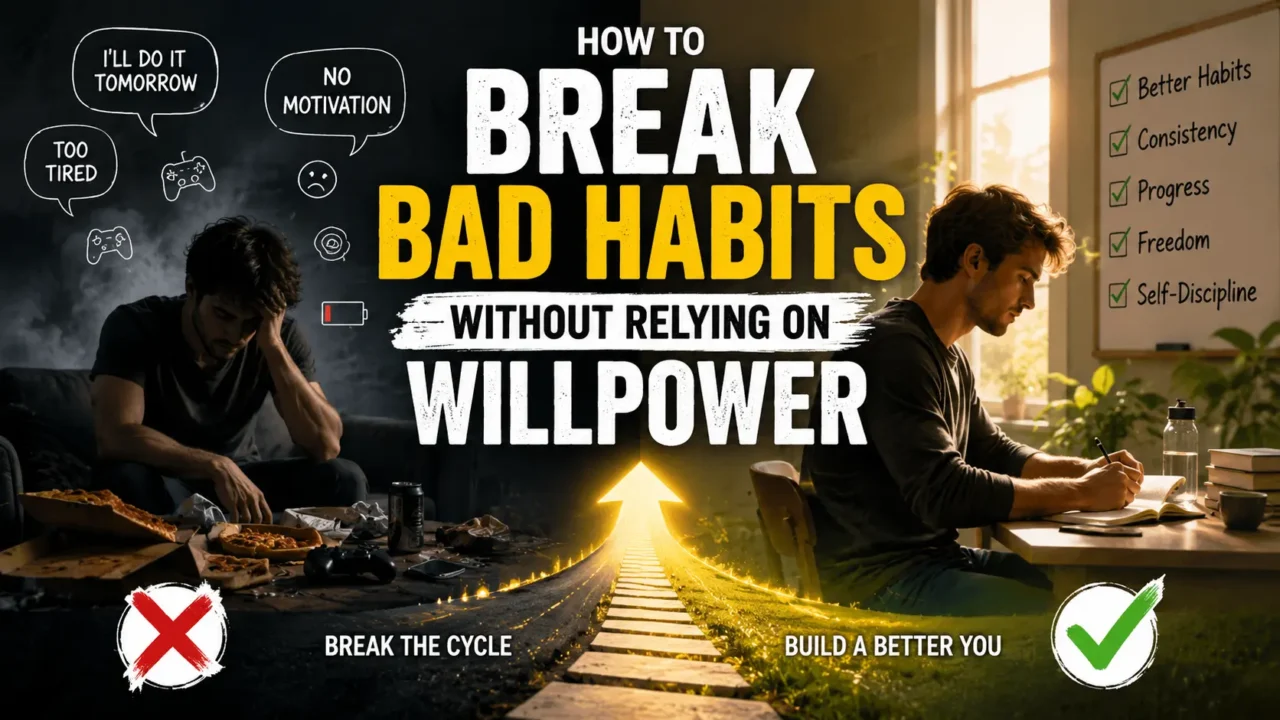
Most people believe breaking a bad habit is a test of willpower. They assume that if they could simply become more disciplined, they would stop procrastinating, eat healthier, spend less time on social media, or quit smoking. When they inevitably slip back into old patterns, they often reach a painful conclusion: I just don’t have enough self-control.
Psychology tells a different story.
Bad habits rarely persist because people lack willpower. They persist because habits are designed to operate automatically. Once a behavior becomes deeply ingrained, the brain shifts control from deliberate decision-making to efficient, unconscious routines. This conserves mental energy but also makes unwanted behaviors surprisingly resistant to change.
Understanding this changes the entire approach to habit change. Instead of fighting your brain every day, you begin designing an environment and a system that makes good choices easier and bad habits harder. Lasting change comes not from constantly resisting temptation but from reducing the need to resist it in the first place.
Why Willpower Is an Unreliable Strategy
Willpower feels powerful because it is noticeable. Resisting a craving requires conscious effort, so we assume effort is the primary ingredient of self-control. In reality, willpower is a limited mental resource that fluctuates throughout the day. Stress, fatigue, emotional pressure, poor sleep, and decision overload all reduce our ability to regulate impulses.
Imagine someone trying to avoid unhealthy snacks. In the morning, after a good night’s sleep, saying no may feel easy. After a demanding workday filled with meetings, deadlines, and unexpected problems, the same person walks into the kitchen mentally exhausted. The snack that seemed easy to ignore now feels almost impossible to resist.
The habit did not become stronger.
The brain simply had fewer mental resources available to override it.
This explains why relying exclusively on motivation often produces inconsistent results. Motivation rises and falls. Effective habit systems are designed to work even when motivation disappears.
The Science of Limiting Beliefs: How They Secretly Control Your Life
The Habit Loop That Keeps You Stuck
Researchers studying behavior have shown that most habits follow a predictable cycle consisting of a cue, a routine, and a reward. The cue triggers the behavior, the routine is the habit itself, and the reward reinforces the cycle by providing something the brain values, such as pleasure, comfort, distraction, or relief.
For example, boredom during work may trigger checking social media. The routine is scrolling through endless posts, while the reward is temporary stimulation and escape from mental effort. Over time, the brain learns that boredom predicts scrolling, making the response increasingly automatic.
Many people try to eliminate the routine while ignoring the cue and the reward. This rarely succeeds because the underlying psychological need remains. Sustainable habit change begins by identifying what the habit is actually providing. Once the reward is understood, healthier routines can satisfy the same need without producing harmful consequences.
Design Your Environment Instead of Testing Your Discipline
One of the strongest influences on behavior is not personality but environment. People often underestimate how much their surroundings shape daily decisions.
If unhealthy food sits on the kitchen counter, it requires constant self-control to avoid it. If your phone remains beside your bed, checking notifications becomes almost automatic. If television dominates your living room while books remain hidden in a drawer, entertainment will usually win over reading.
Behavioral scientists refer to this as choice architecture—the idea that small environmental changes influence decisions before conscious thought even begins.
Instead of asking, “How can I become stronger?” ask, “How can I make this habit harder to perform?”
Remove tempting apps from your phone’s home screen. Keep healthy foods visible and unhealthy foods out of immediate reach. Prepare tomorrow’s workout clothes the night before. Create physical barriers that interrupt automatic behavior.
The fewer decisions required, the easier positive habits become.
Replace Habits Instead of Eliminating Them
The brain dislikes behavioral gaps. Removing a habit without replacing it often leaves the original trigger unresolved.
Someone trying to stop emotional eating still experiences stress. A person quitting excessive gaming still seeks relaxation after work. Eliminating the old routine without introducing a healthier alternative usually creates frustration rather than lasting change.
Successful habit change focuses on substitution rather than suppression.
Replace evening television with reading. Replace mindless scrolling with a short walk. Replace sugary snacks with healthier alternatives that remain satisfying. Replace procrastination with committing to just five minutes of focused work.
The goal is not to eliminate the need.
The goal is to change how that need is met.
Over time, the brain begins associating familiar cues with healthier responses.
Focus on Identity Rather Than Outcomes
Many habit changes fail because they are driven by temporary goals instead of lasting identity.
A person says, “I want to lose weight.”
Another says, “I want to become someone who takes care of their health.”
The difference appears subtle but has profound psychological consequences.
Goals focus attention on achieving a specific result. Identity focuses attention on becoming a particular type of person. Every small action then becomes evidence supporting that identity.
Each workout reinforces, “I am someone who exercises.”
Each completed writing session reinforces, “I am someone who writes consistently.”
Each healthy meal strengthens, “I make choices that support my well-being.”
This approach aligns with research on self-perception, which suggests that people gradually form beliefs about themselves by observing their own repeated actions. Consistency becomes easier because behavior now supports identity rather than chasing motivation.
Why Fear of Failure Is Keeping You Stuck
Expect Imperfection Without Abandoning Progress
One missed workout does not destroy a fitness habit. One unhealthy meal does not erase months of good nutrition. One unproductive afternoon does not define a person’s work ethic.
What damages habits is not occasional failure but the belief that failure means starting over.
Psychologists call this the what-the-hell effect—the tendency to abandon long-term goals after a small lapse because perfection has already been broken. Someone eats one unhealthy dessert and concludes the entire day is ruined. One missed study session becomes an excuse to stop studying altogether.
Sustainable change requires a different perspective.
Treat lapses as temporary interruptions rather than permanent defeats. Analyze what triggered the setback, adjust the environment if necessary, and return to the routine as quickly as possible.
Progress depends far more on recovery than on perfection.
Conclusion
Breaking bad habits is often portrayed as a battle between discipline and temptation. In reality, it is usually a matter of understanding how the brain builds automatic behavior and then redesigning the systems that support it.
Willpower has its place, but it is an unreliable foundation for lasting change because it fluctuates with stress, fatigue, and emotion. Strong habits emerge when cues are understood, environments are intentionally designed, healthier routines replace unhealthy ones, and identity gradually shifts through consistent action.
The most effective people are not those with extraordinary self-control. They are those who have built lives in which good decisions happen more naturally and bad decisions require greater effort.
Real transformation begins when you stop asking, “How can I force myself to change?” and start asking, “How can I make the right choice the easiest choice?”
That question turns habit change from a daily struggle into a sustainable way of living.
Call to Action
The habits you repeat each day shape the person you become. Continue exploring the Aziz Publishing Knowledge Library for evidence-based articles on psychology, habits, productivity, and mindset to build systems that support lasting personal growth instead of depending on temporary motivation.