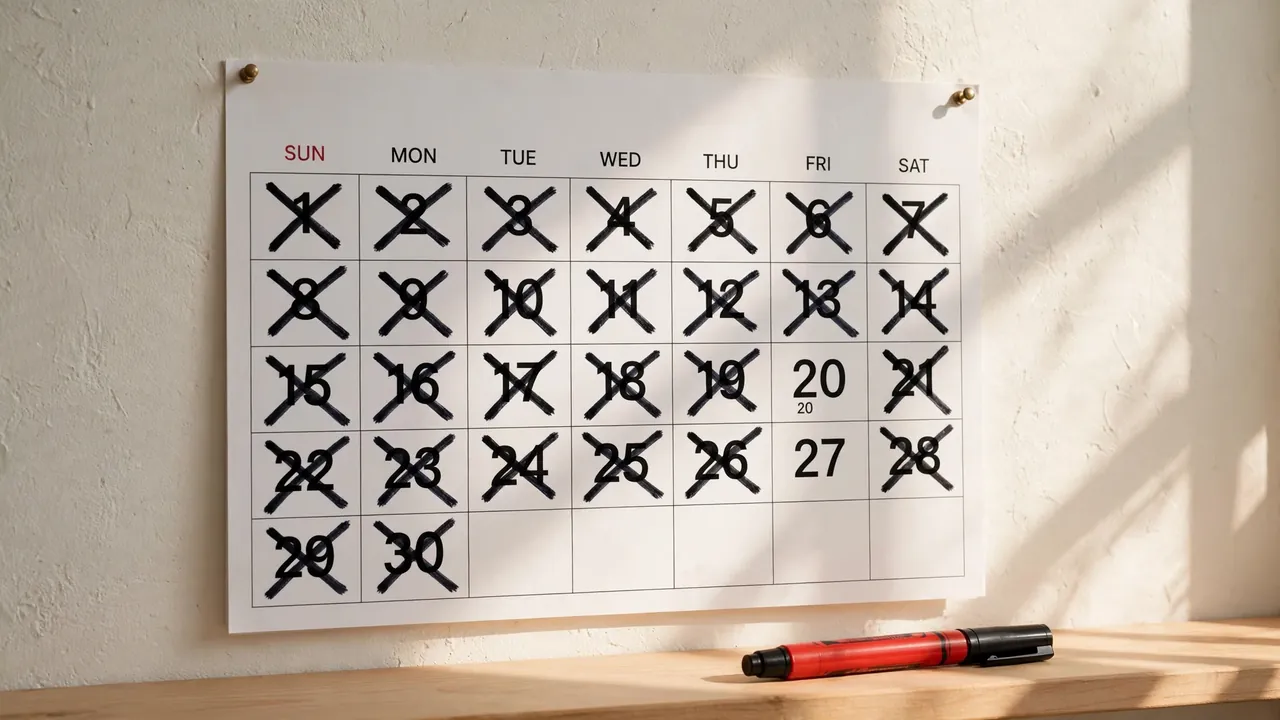
Almost every habit dies the same way. Not on the day you miss it, but on the day after, when you miss it again. The first miss barely registers. The second is where the streak resets, guilt arrives, and the habit quietly becomes a memory. There is a simple rule that stops that collapse, and it fits in four words: never miss twice. Here is what the two-day rule really is, what the science says about it, and how to use it to keep a habit alive.

What the Two-Day Rule Is
The two-day rule is simple: never miss a habit two days in a row. One missed day is allowed, even expected. Two consecutive missed days is the boundary you do not cross. The rule was popularized by James Clear in Atomic Habits, where he puts it like this: “The first mistake is never the one that ruins you. It is the spiral of repeated mistakes that follows. Missing once is an accident. Missing twice is the start of a new habit.” Filmmaker and creator Matt D’Avella also popularized a two-day version, using it to maintain exercise, meditation and creative habits over years of practice.
The rule works because it replaces a perfectionistic standard with a sustainable one. “Never miss” is a standard almost nobody can keep, and the first miss under that standard feels like failure, which is exactly when most people quit. “Never miss twice” keeps a clear, enforceable boundary while admitting that life happens. A missed day is not a failure. It is scheduled flexibility inside a consistent system, as explained in a November 2026 guide to the two-day rule.
The rule also has a clear trigger. After every missed day, you have a mandate: do the habit tomorrow. There is no decision to make, no negotiation with yourself, and no debate about whether you feel like it. The rule decides for you, and that is the point. The hardest part of consistency is not the habit itself. It is the decision to restart after a slip, and the two-day rule makes that decision in advance.
Why One Miss Is Harmless and Two Are Not
The science underneath the rule comes from the best habit formation data we have. In the landmark field study by Lally and colleagues in 2010, 96 participants repeated a new daily behavior for 12 weeks while researchers tracked how automatic it became. The study produced the famous 66-day habit figure, and it also produced a quieter finding: missing a single day had no significant effect on the long-term automaticity curve. Participants who missed single days formed habits on the same trajectory as those who did not. One miss is noise in a long signal.
Two consecutive misses are different. The second miss begins a measurable slide, because it starts to reset the cue-action pairing that makes a habit automatic. The brain begins to treat the behavior as optional again rather than automatic, and by three misses the habit loop has often weakened enough that resuming takes deliberate effort. You are back near the beginning of the automaticity curve, and the habit feels like a new effort instead of a routine.
The psychology of the second miss has a name from the relapse literature: the abstinence violation effect, described by Marlatt and Gordon in 1985. After a slip, guilt, shame and self-criticism are among the strongest predictors of continued failure, not recovery. The person thinks the habit is ruined, so they stop trying, which ruins the habit. The two-day rule interrupts that spiral at the earliest possible point, before the shame has time to do its work.
The Honest Limits of the Rule
It is worth saying plainly what the evidence does and does not support. The miss-tolerance finding is well replicated: a single missed day does not damage habit formation. But the two-day rule itself has not been tested head to head against other recovery rules in controlled trials. The exact cutoff of one miss versus two has not been calibrated in a controlled experiment. The rule synthesizes the Lally data and the relapse research into a practical design choice. It is a heuristic built on good evidence, not a directly tested intervention, as noted in a 2026 evidence review of the never-miss-twice principle.
That does not make the rule useless. It makes it honest. Most habit advice pretends to be more proven than it is, and the two-day rule is unusually well grounded for a habit heuristic. But it is not a law of nature. It is a tool, and like any tool it works best when you understand what it is for: protecting the chain, not guaranteeing perfection.
There is one more limit to know. The rule budgets for exceptions, but it does not license intentions to skip. Planning to miss tomorrow because the rule allows one miss is not the rule. That is a loophole, and loopholes are how the rule dies. The miss the rule forgives is the one life forces on you, not the one you schedule.
How to Run the Two-Day Rule
The rule needs three things to work: a clear definition of a miss, a minimum version of the habit, and a way to see the chain. Without those, the rule collapses into self-debate about whether today counts. Set them up once, and the rule runs itself.
- Define a miss clearly: A miss is a day with zero engagement with the habit. Not a short session, not a bad session, but no session at all. If you did the smallest version, it counts. That clarity stops the argument in your head before it starts.
- Set a minimum version: This is the smallest version of the habit that still touches the cue: the two-minute starter, or a five-minute floor for physical habits. One push-up, two minutes of meditation, one glass of water. On the day after a miss, you do the minimum version. It is not a workout or a deep session. It is a touch of the cue, and that touch is what keeps the chain alive.
- Track the days visibly: Use a calendar, a habit tracker app, or a simple notebook, and mark each day you perform the habit. The visible chain is the point. You can see at a glance whether yesterday was a miss, and the rule tells you exactly what today has to be, as described in a 2026 guide to staying consistent with the rule.
- Recover the next morning: Do not wait for the perfect moment. Do the habit first thing, or as early as you can, in its minimum version. The longer the day goes on, the more reasons you will find to skip again, and the second miss is the one the rule exists to prevent.
- Forgive the single miss: When you miss once, say so plainly and move on. No guilt-driven restart, no punishment session to make up for it, no doubling the habit tomorrow. The research is clear that shame predicts continued failure, not recovery, and the rule works because it removes the shame.
The numbers make the case for the rule. With realistic adherence, the two-day rule lands around 85 percent completion, about 310 days of practice in a year. That beats a perfect-then-nothing pattern by a wide margin. Even the worst case is strong: if you miss every other day, the worst the rule allows, you still practice half the days in the year. Half a year of practice beats a perfect month followed by eleven months of nothing. A habit loop needs its cue to fire regularly to become automatic, and the two-day rule is what keeps the cue firing when life gets in the way.
Two-Day Rule vs Streaks and Perfection
The two-day rule is often confused with streak keeping, but it is the opposite of a streak. A streak says every day counts the same, and one miss ends the run. The two-day rule says one miss is free, and the only thing that matters is the second day. A streak punishes the slip. The rule absorbs it. That is why streaks break people and the two-day rule keeps them going.
The rule also pairs well with other habits systems. Keystone habits are the habits that trigger other good habits, and the two-day rule is a good way to protect them, because a keystone habit that dies takes the others with it. If you protect the one habit that matters most with a never-miss-twice rule, the rest of the system stays standing. The rule is small, but it guards the load-bearing habit.
There is a deeper lesson here too. Consistency is not the absence of misses. It is the presence of a recovery plan. People who keep habits for years are not people who never miss. They are people who miss once and come back the next day, every time. The two-day rule is simply that recovery plan, written down in four words, and it works because it asks for the smallest possible promise: not perfection, just never twice.
- The two-day rule is simple: never miss a habit two days in a row. One missed day is allowed, even expected. Two consecutive missed days is the boundary you do not cross.
- In Lally’s 2010 field study, missing a single day had no significant effect on how automatic a habit became. One miss is noise. Two consecutive misses begin a measurable slide and start to reset the cue-action pairing.
- The psychology of the second miss is the abstinence violation effect: after a slip, guilt and shame predict continued failure, not recovery. The rule interrupts that spiral before it starts.
- The rule itself has not been tested head to head against other recovery rules, and the exact two-day cutoff is a practical design choice built on the evidence, not a separately measured optimum.
- Run it with a clear definition of a miss, a minimum version of the habit for the day after a miss, and a visible tracker. With realistic adherence it lands around 85 percent completion, about 310 days of practice a year.
Frequently Asked Questions
What is the two-day rule?
The two-day rule is simple: never miss a habit two days in a row. One missed day is allowed, even expected, but two consecutive missed days is the boundary you do not cross. The rule was popularized by James Clear in Atomic Habits: “The first mistake is never the one that ruins you. It is the spiral of repeated mistakes that follows. Missing once is an accident. Missing twice is the start of a new habit.” Filmmaker Matt D’Avella also popularized a two-day version for exercise, meditation and creative habits.
Why is one missed day harmless?
In the landmark field study by Lally and colleagues in 2010, 96 participants repeated a new daily behavior for 12 weeks while researchers tracked how automatic it became. Missing a single day had no significant effect on the long-term automaticity curve. Participants who missed single days formed habits on the same trajectory as those who did not. One miss is noise in a long signal.
What counts as a miss?
A miss is a day with zero engagement with the habit. Not a short session and not a bad session, but no session at all. If you did the smallest version of the habit, the two-minute starter or the five-minute floor, it counts. That clear definition stops the argument in your head about whether today counts, and it is what makes the rule enforceable.
What should I do the day after a miss?
Do the habit in its minimum version, as early as you can. One push-up, two minutes of meditation, one glass of water. It is not a full session and it is not a punishment. It is a touch of the cue, and that touch is what keeps the chain alive. Do not try to make up for the miss by doubling the habit, and do not wait for the perfect moment, because the second miss is the one the rule exists to prevent.
Final Thoughts
The two-day rule is the most forgiving rule in habit building, and that is why it works. It does not ask for perfection. It asks for one promise: never twice. A single miss is life happening, and the research says it costs you nothing. The second miss is a new pattern forming, and the rule exists to stop it there. Keep the chain alive one day at a time, and the habit will take care of itself.
Call to Action
If this guide gave you a kinder way to stay consistent, share it with someone who quit a habit after one bad day. Explore the Aziz Publishing Knowledge Library for more guides on habits, including how to plan exactly when and where you will act and how a daily writing habit clears your mind.

