The average knowledge worker now uses dozens of digital tools every day, yet many people still feel overwhelmed, distracted, and unproductive. The problem is rarely a lack of technology. Instead, it is choosing the right tools for the right tasks. Productivity apps should simplify work, reduce mental clutter, and help you focus on meaningful progress rather than keeping you busy. The best productivity app is not necessarily the one with the most features—it is the one that fits your workflow. Whether you are a student, professional, entrepreneur, or writer, understanding the strengths and weaknesses of today’s leading productivity apps can help you build a more efficient system that supports your goals.
Productivity Begins With Systems, Not Apps
Before comparing specific tools, it is important to recognize that no application can compensate for poor habits or unclear priorities. Productivity experts consistently emphasize that systems outperform motivation. Apps simply support those systems. If you constantly switch between tasks, ignore priorities, or overload your schedule, even the most advanced software will not improve your performance.
The most effective productivity stack usually combines four functions: task management, note-taking, calendar scheduling, and focused work. Different apps excel in different areas, making it worthwhile to choose tools based on your needs rather than popularity.
Notion: The All-in-One Workspace
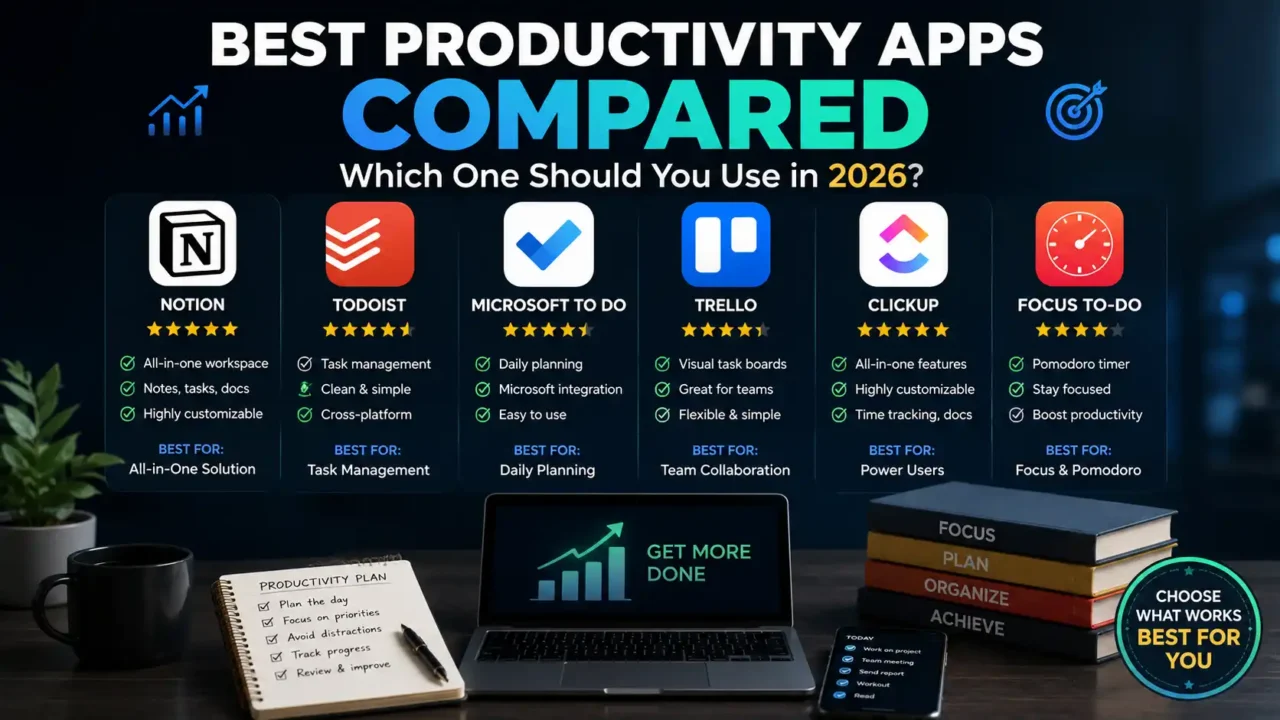
Notion has become one of the most popular productivity platforms because it combines notes, databases, project management, documents, and collaboration into a single workspace. Writers can organize research, students can manage study materials, and businesses can coordinate projects without constantly switching between applications.
Its flexibility is both its greatest strength and its biggest challenge. New users may feel overwhelmed by the number of customization options, but once a workflow is established, Notion becomes a powerful personal knowledge management system.
Todoist: Simplicity That Encourages Consistency
Todoist focuses on one thing exceptionally well: managing tasks. Its clean interface, recurring reminders, priority levels, and cross-platform synchronization make it ideal for people who want a straightforward task manager without unnecessary complexity.
Because it requires very little setup, Todoist encourages consistent daily use, which is often more valuable than using an advanced system inconsistently.
Trello: Visual Project Management
Trello organizes work using visual boards based on the Kanban method. Tasks move from one stage to another as projects progress, making it particularly useful for teams, freelancers, and content creators managing multiple assignments simultaneously.
Its visual approach helps users immediately understand project status while reducing the mental effort required to track ongoing work.
Microsoft OneNote and Evernote: Digital Note-Taking
For users who primarily capture ideas, research, meeting notes, and study materials, digital notebooks remain essential. OneNote offers flexible organization with seamless integration into the Microsoft ecosystem, while Evernote provides powerful search capabilities and document management features.
Both applications reduce information overload by creating searchable repositories instead of scattered files and paper notes.
How to Remember More of What You Read: 7 Science-Backed Strategies
Google Calendar: Mastering Time
Task lists answer what needs to be done, but calendars determine when work actually happens. Google Calendar helps users schedule focused work sessions, meetings, deadlines, and recurring routines. Time-blocking—assigning specific periods to important tasks—has become one of the most effective productivity techniques because it transforms intentions into commitments.
Combining a task manager with a well-maintained calendar creates a more realistic daily workflow.
AI-Powered Productivity Tools
Artificial intelligence is rapidly changing productivity software. Modern AI assistants help summarize meetings, generate first drafts, organize notes, automate repetitive work, and prioritize information. Rather than replacing human decision-making, AI reduces administrative tasks that consume valuable attention.
Used thoughtfully, AI allows professionals to spend more time solving problems, creating ideas, and making strategic decisions instead of performing repetitive work.
AI Productivity Systems Anyone Can Build: Work Smarter With Artificial Intelligence
Choosing the Right App for Your Needs
There is no universally perfect productivity app. Students often benefit from note-taking platforms, project managers may prefer visual task boards, writers frequently need distraction-free workspaces, while entrepreneurs usually combine several specialized tools into one integrated system.
The most productive people rarely chase every new application. Instead, they choose a small number of reliable tools and develop consistent habits around them. Simplicity almost always outperforms complexity.
Conclusion
The best productivity apps are those that support your thinking instead of competing for your attention. Whether you choose Notion for organization, Todoist for task management, Trello for projects, OneNote for knowledge, Google Calendar for scheduling, or AI-powered assistants for automation, remember that tools amplify existing habits rather than creating them. Lasting productivity comes from clear priorities, focused work, and consistent systems. Select the apps that align with your workflow, avoid unnecessary complexity, and allow technology to become a quiet partner in achieving your goals rather than another source of distraction.
Call to Action
Productivity is only one part of becoming a more effective thinker. Explore more evidence-based articles in the Aziz Publishing Knowledge Library to learn how psychology, habits, mindset, and decision-making shape the way we work, learn, and live.