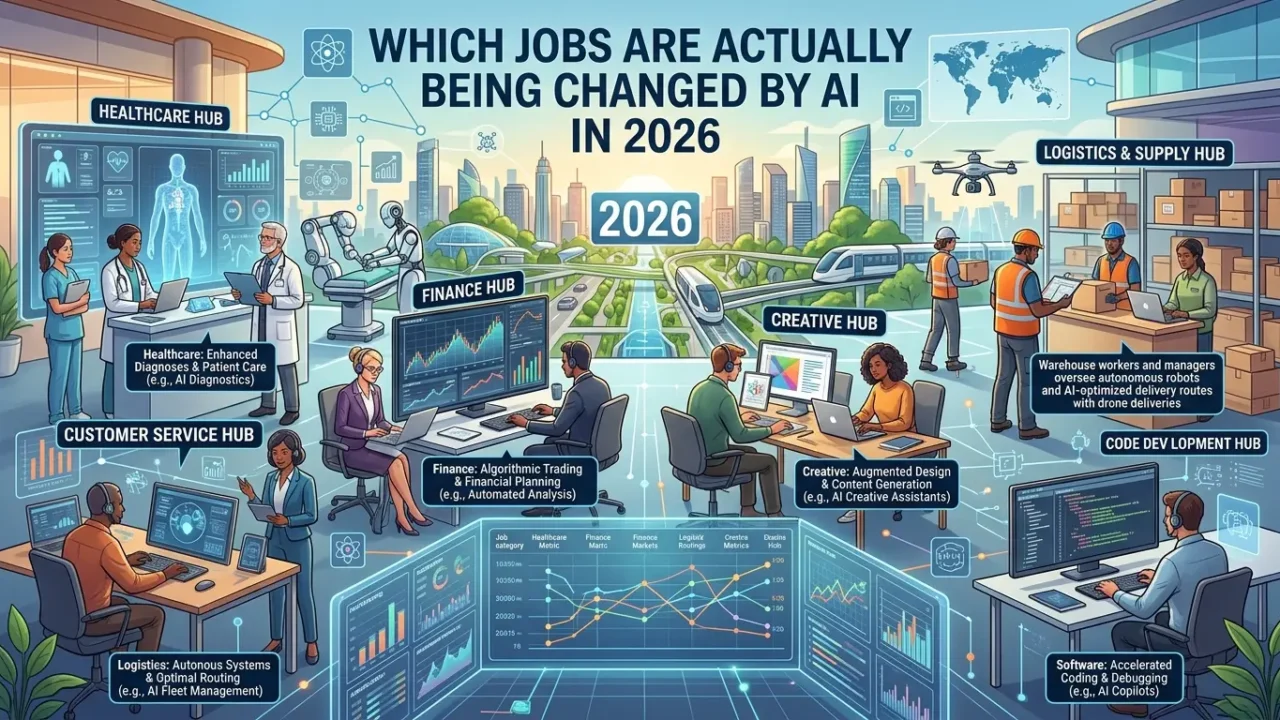
Forget the vague predictions about robots taking over someday, AI is already reshaping specific jobs right now, and the data shows exactly where. Some fields are seeing dramatic task automation, others barely at all. Here’s what’s actually happening, industry by industry.
Office and Administrative Work Is Changing Fastest
Office and administrative support has the highest task-automation share of any category, at 46%, according to Goldman Sachs Research. Scheduling, data entry, document processing, and routine correspondence are being handled increasingly by AI tools rather than administrative staff. This doesn’t mean every administrative role disappears, but the routine, repetitive core of the job is shrinking fast. Workers in this field are increasingly shifting toward oversight, coordination, and judgment calls AI still can’t reliably handle.
What Is Agentic AI? A Clear, Simple Explanation
Legal Work Is Being Reshaped From the Inside
Legal work shows a striking 44% task-automation share, driven by AI tools that can review documents, research case law, and draft routine contracts far faster than manual processes. This is changing what junior legal roles actually look like, less time on exhaustive document review, more time on strategy, client interaction, and judgment-heavy tasks. Law firms are already restructuring how they staff certain case types as a direct result. The underlying legal expertise still matters enormously, but the busywork surrounding it is shrinking quickly.
Architecture and Engineering Are Seeing Real Task Shifts
Architecture and engineering show a 37% task-automation share, with AI tools now handling preliminary design generation, structural calculations, and drafting work that used to consume significant hours. This is freeing up professionals to focus more on client collaboration, creative problem-solving, and final design judgment. The shift is task-level, not job-level, most roles are being reshaped rather than eliminated outright. Firms adopting these tools report faster project turnaround without necessarily cutting headcount.
Customer Service Has Already Transformed Significantly
Customer service shows a 45% automation exposure, with AI chatbots and call center automation already handling a substantial share of routine inquiries. This is one of the most visible, already-completed shifts, most people have already interacted with an AI-driven support system without necessarily realizing it. Human agents increasingly handle only escalated, complex, or emotionally sensitive cases the AI can’t resolve. This reshaping happened faster than almost any other white-collar field over the past two years.
The Future of AI Jobs: Which Careers Will Grow in the Age of Artificial Intelligence?
Manufacturing and Retail Show High but Uneven Impact
Manufacturing shows roughly 58% automation exposure and retail around 40%, reflecting AI’s growing role in quality control, inventory management, and demand forecasting. These industries were already automating physical tasks with robotics for decades, AI now adds a layer of predictive and analytical automation on top of that existing foundation. Retail specifically has seen AI reshape pricing, personalized recommendations, and inventory decisions significantly. The physical, hands-on tasks in these fields remain considerably harder to automate than the analytical and planning work surrounding them.
Which Fields Remain Largely Untouched So Far
Construction sits at just 6% task-automation exposure, and installation, maintenance, and repair roles sit even lower at 4%, according to the same Goldman Sachs analysis. These fields depend heavily on physical dexterity, unpredictable real-world conditions, and hands-on problem-solving that current AI systems simply can’t replicate. This pattern holds broadly, industries rooted in physical skill, trust, and hands-on judgment remain considerably harder to automate fully. Workers in these fields face meaningfully less immediate disruption than office-based, data-heavy roles.
The Surprising Gap Between Exposure and Actual Layoffs
Almost 40% of global employment is technically exposed to AI according to the IMF, yet only about 13% of US job-cut plans in early 2026 actually cited AI as the reason, per Challenger, Gray & Christmas. This gap matters enormously, exposure to AI capability doesn’t automatically translate into immediate job loss. Most companies are still in a task-reshaping phase, redistributing work rather than eliminating roles outright. The technology sector remains the clearest exception, where AI is already directly replacing certain coding and technical functions.
10 AI Agents Building Billion-Dollar Businesses in 2026
What This Actually Means for Your Own Role
The clearest pattern across every affected industry is task reshaping, not wholesale job elimination, workers are spending less time on repetitive duties and more time on oversight, judgment, and communication. This shift is happening regardless of whether your specific job title appears on any “at risk” list, since even resilient fields are seeing their day-to-day task mix change. The practical response isn’t panic, it’s paying attention to which specific tasks in your role are shifting and building skills adjacent to that change. Workers who adapt their skill set alongside these shifting tasks tend to fare considerably better than those who wait for clarity before adjusting.
Final Thoughts
AI is already reshaping specific tasks across office work, legal services, engineering, customer service, and manufacturing right now, not as a future hypothetical but as a measurable, ongoing shift. The gap between technical exposure and actual job loss shows this is currently more about changing roles than eliminating them wholesale.
Call to Action
Take an honest look at which specific tasks in your own role are shifting toward AI assistance, then start building skills in the areas AI still can’t handle. If this breakdown helped clarify what’s actually happening in your industry, share it with a colleague still working from vague, outdated assumptions about AI and jobs. Explore the Aziz Publishing Knowledge Library for practical guides on artificial intelligence, productivity, psychology, writing, and emerging technologies that help you work smarter, think more clearly, and make better decisions in an AI-powered world.