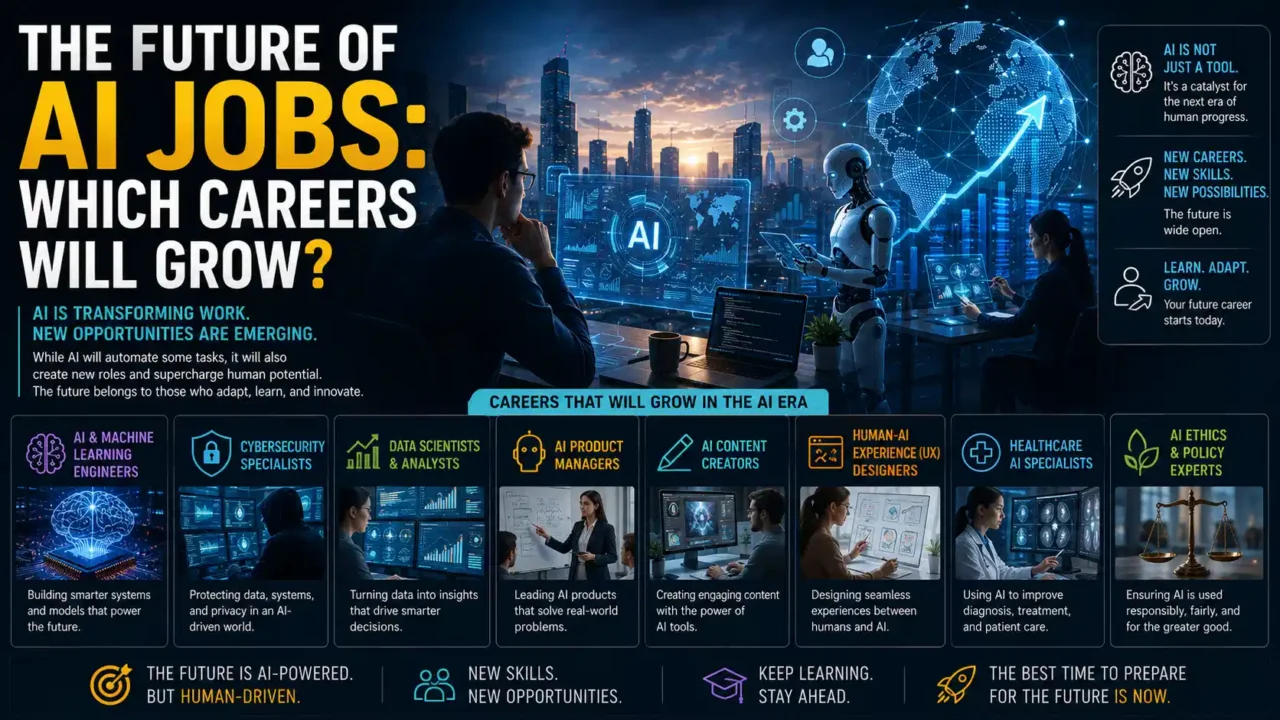
Every other headline seems to warn that AI is coming for your job, but the actual data tells a more nuanced story. Real job numbers, real growth rates, and real hiring trends paint a picture that’s less about mass unemployment and more about a massive reshuffling. Here’s what’s actually growing, and why.
The Big Picture: Growth, Not Just Displacement
The World Economic Forum’s Future of Jobs Report 2026 projects that by 2030, AI and related technologies will displace roughly 92 million existing roles while creating approximately 170 million new ones, a net gain of 78 million jobs globally. This isn’t a small statistical footnote, it represents a genuine structural shift rather than the mass unemployment scenario many headlines predicted just a couple of years ago. The catch is that the people losing roles aren’t automatically the ones filling the new ones, meaning the transition itself creates real disruption even as the overall numbers stay positive. Understanding which specific careers are actually growing matters far more than the aggregate statistic alone.
Technology and AI-Specific Roles Are Expanding Fast
Unsurprisingly, roles directly tied to building and maintaining AI systems are among the fastest-growing categories in the current job market. The World Economic Forum reports AI has already created more than 1.3 million new jobs globally, including roles like AI engineers, forward-deployed engineers, and data annotators that barely existed before 2023. US job postings requiring AI skills grew 144% year over year as of April 2026, reflecting just how quickly employer demand has accelerated. Data scientists specifically are projected to grow around 34%, and software developers around 17%, according to Bureau of Labor Statistics projections covering the current decade.
AI and National Security: How Artificial Intelligence Is Reshaping Global Power
Healthcare Careers Are Booming Alongside AI Adoption
Healthcare consistently ranks among the strongest growth sectors even as AI reshapes clinical workflows, largely because the work itself relies heavily on human judgment and hands-on care. Nurse practitioners are projected to grow by an impressive 45.7% by 2032, one of the strongest growth rates of any occupation tracked. The sector overall is expected to add roughly 20.5 million new jobs in the US alone, driven partly by persistent physician shortages that AI tools can support but not fully solve. This growth reflects a broader pattern, roles requiring empathy, physical presence, and complex human judgment remain resilient even as AI capabilities expand elsewhere.
Cybersecurity Is Becoming Non-Negotiable
As AI systems get embedded deeper into business infrastructure, the need to secure those systems has turned cybersecurity into one of the most consistently in-demand fields. Networks and cybersecurity rank as the second-fastest-growing skill family in recent World Economic Forum surveys, right behind AI and big data itself. Projections show cybersecurity roles growing around 12%, with hundreds of thousands of postings recorded in recent years as companies scramble to secure increasingly complex, AI-integrated systems. This growth makes sense given the stakes, more automation and more AI integration inevitably creates more potential attack surface that skilled professionals need to defend.
The Rise of AI Oversight and Governance Roles
A genuinely new category of jobs has emerged specifically to manage and oversee AI systems responsibly, rather than just build them. AI trainers and evaluators, who improve model outputs through techniques like reinforcement learning from human feedback, represent one fast-growing niche within this space. AI ethics and governance officers, who set guardrails, audit outputs, and ensure regulatory compliance, represent another emerging role that essentially didn’t exist as a defined job title a few years ago. These positions reflect a broader recognition that deploying AI responsibly requires dedicated human oversight, not just technical development.
Prompt Engineering Explained: How to Get Better Results From AI
Frontline and Care Economy Jobs Are Growing Too
Contrary to the assumption that AI mainly threatens lower-skill work, frontline and care roles are actually projected to see some of the largest growth in absolute numbers by 2030. Farmworkers, delivery drivers, construction workers, and personal care aides are all expected to expand significantly, since these roles depend on physical presence and adaptability that current AI systems can’t replicate. Clean-energy installer roles are also growing rapidly, reflecting a parallel green-transition trend running alongside the AI-driven shift. This pattern reinforces a consistent theme across the data, jobs requiring hands-on physical work or direct human care tend to hold up well against automation pressure.
Which Jobs Are Actually Shrinking
Not every role is growing, and the data is fairly clear about where decline is concentrated. Roles like cashiers, bank tellers, and administrative assistants are expected to see the largest declines in absolute numbers by 2030, largely due to straightforward, repeatable tasks that automation handles efficiently. Early 2026 already saw tech layoffs surpass 59,000 globally, with major cuts at companies like Amazon and Meta, showing that even the tech sector isn’t immune to disruption despite its overall growth. This creates what researchers describe as a genuine paradox, simultaneous mass layoffs and mass hiring happening within the same broader labor market at the same time.
How to Actually Position Yourself for This Shift
Given that 39% of workers’ core skills are expected to change by 2030, staying static in your current skill set carries real career risk regardless of your specific industry. Workers with AI skills already command wage premiums up to 56% higher than their peers without those skills, according to PwC’s Global AI Jobs Barometer, making AI literacy a genuinely measurable career advantage right now. Analytical thinking remains the single most sought-after skill across surveyed companies, followed closely by resilience, flexibility, and leadership, none of which are purely technical skills. The clearest path forward isn’t necessarily becoming an AI specialist, it’s building genuine AI fluency into whatever field you’re already in, since that combination is increasingly what employers are paying a premium for.
Final Thoughts
The future of work in the AI era isn’t simply “AI takes jobs,” it’s a genuine structural shift creating millions of new roles in tech, healthcare, cybersecurity, and frontline work, even as certain repetitive roles decline. The workers who come out ahead won’t necessarily be the most technical, they’ll be the ones who adapted their existing skills to work alongside AI rather than in competition with it.
Take a honest look at your own field and ask which specific tasks are likely to change most over the next few years, then start building the adjacent skills now rather than waiting. If this breakdown helped clarify where the real opportunities are, share it with someone still worried AI is simply coming for every job.
Call to Action
Take an honest look at your own field and ask which tasks are likely to change most in the coming years, then start building adjacent skills now. If this helped clarify where the real opportunities are, share it with someone still worried AI is coming for every job. Explore the Aziz Publishing Knowledge Library for in-depth, evidence-based articles on artificial intelligence, emerging technologies, productivity, and the future of work to stay informed in an increasingly AI-driven world.