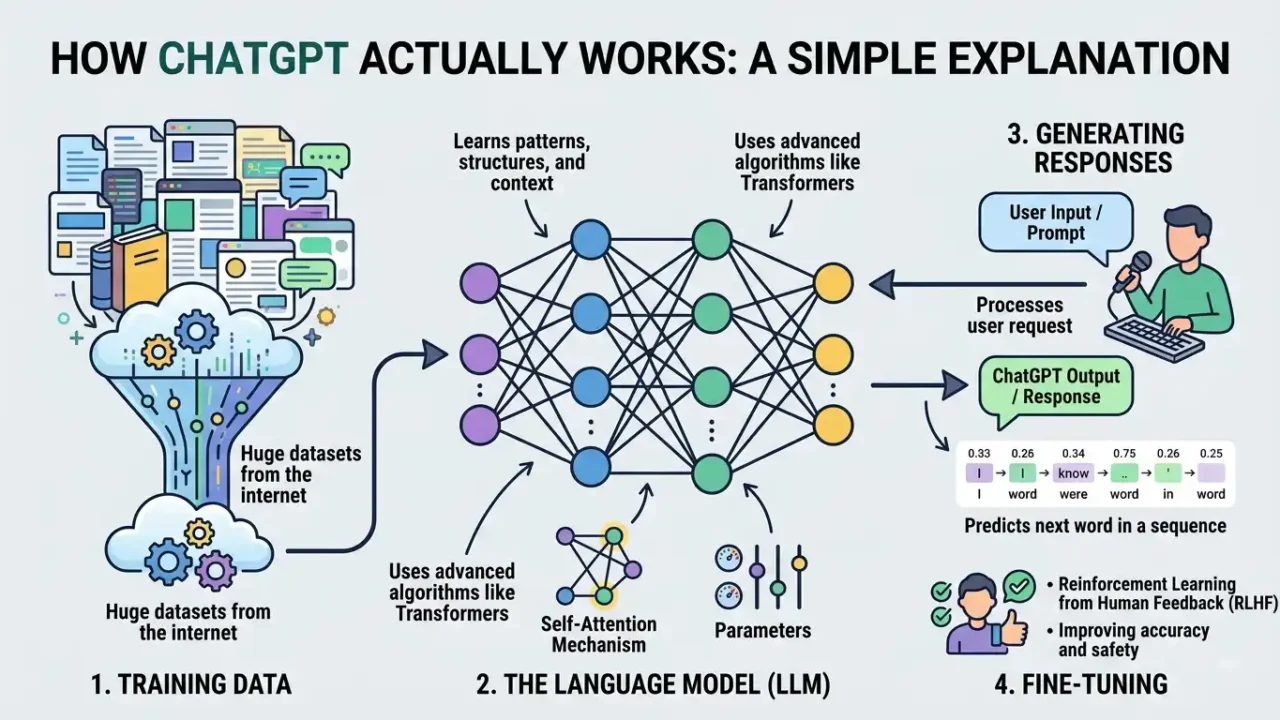
You type a question, and within seconds, a coherent, often genuinely helpful answer appears. It feels like magic, but underneath, it’s actually a fairly explainable process built on pattern recognition at a massive scale. Here’s what’s really happening behind the scenes, no computer science degree required.
It Starts With Breaking Text Into Tokens
Before ChatGPT can process anything you type, it first breaks your text into smaller pieces called tokens, which can be whole words, parts of words, or even punctuation marks. This tokenization step is necessary because the underlying model doesn’t actually understand language the way humans do, it works with numbers, so each token gets converted into a numerical representation the model can process. A single sentence might break down into a dozen or more tokens depending on the words used, with common words often becoming single tokens and unusual or technical words sometimes splitting into several. This tokenized, numerical version of your input is what actually gets fed into the model, not the raw text itself.
The Transformer Architecture Underneath It All
ChatGPT is built on what’s called a transformer architecture, a type of neural network design introduced in a 2017 research paper that revolutionized how AI models process language. The key innovation in transformers is something called “attention,” which allows the model to weigh how relevant every other word in a sentence is to understanding any given word, rather than processing text strictly in order like older models did. This means the model can understand that in the sentence “the bank raised its rates,” the word “bank” relates to finance rather than a riverbank, by weighing the surrounding context. This attention mechanism, repeated across many layers of the network, is what gives the model its ability to grasp nuance, context, and meaning across long passages of text.
How the Model Actually Learned Language in the First Place
Before ChatGPT could generate anything useful, it went through a training process involving enormous amounts of text data, books, articles, websites, and other written material. During this training, the model wasn’t given explicit grammar rules or dictionaries, instead it learned statistical patterns, which words tend to follow other words, how sentences are typically structured, and how ideas connect within a paragraph. This process involved adjusting billions of internal parameters, essentially numerical values that determine how the model weighs different pieces of information, through repeated exposure to text and a whole lot of mathematical optimization. The result is a model that has absorbed patterns of human language without ever being explicitly told a single grammar rule.
The Future of AI Jobs: Which Careers Will Grow in the Age of Artificial Intelligence?
Predicting the Next Word, One Token at a Time
At its core, ChatGPT generates responses by predicting the most likely next token, one at a time, based on everything that came before it in the conversation. When you ask a question, the model calculates probabilities for what token should come next, picks one, adds it to the growing response, and then repeats this process, recalculating probabilities each time based on the newly expanded text. This happens incredibly fast, generating what feels like a fluid, complete response, even though it’s technically being built one small piece at a time. This is also why the same question can sometimes generate slightly different answers, since there’s often some randomness built into which likely token gets selected at each step.
Why It Doesn’t Just Copy and Paste Answers
A common misconception is that ChatGPT searches a database and retrieves a stored answer, but that’s not actually how it works at all. The model doesn’t store specific documents or exact answers, it learned generalized patterns from its training data and generates new text based on those patterns, similar to how a person who’s read thousands of books can write an original sentence without quoting any of them directly. This is exactly why the model can answer questions about topics phrased in ways it never saw during training, it’s generating a plausible response based on learned patterns, not searching for a pre-written match. It also explains why the model can occasionally produce confidently incorrect information, since it’s generating statistically plausible text, not verifying facts against a database in real time.
The Human Feedback That Shaped Its Behavior
Raw language prediction alone would produce a model that’s technically fluent but not necessarily helpful, safe, or aligned with what people actually want from an assistant. This is where a process called reinforcement learning from human feedback comes in, where human reviewers rate different possible responses, and the model gets further trained to produce outputs more like the ones humans rated highly. This step is what shapes ChatGPT’s tendency to be helpful, avoid harmful content, and format responses in genuinely useful ways, rather than just generating grammatically correct but unhelpful text. Without this additional layer of training, the raw underlying model would behave quite differently, and often far less usefully, than the polished assistant people actually interact with.
Why It Sometimes Gets Things Wrong
Understanding the prediction-based mechanism explains why ChatGPT can sometimes confidently state incorrect information, a phenomenon commonly called hallucination. Since the model generates statistically likely text rather than retrieving verified facts, it can produce plausible-sounding but factually wrong answers, especially on obscure topics, very recent events, or highly specific details it wasn’t trained on. This isn’t the model “lying,” it’s a natural consequence of how prediction-based generation works, the model is optimizing for what sounds like a coherent, helpful answer, not cross-checking against a verified fact database in real time. Understanding this limitation is exactly why double-checking important factual claims remains a genuinely good habit when using any AI assistant.
What Happens During an Actual Conversation
When you’re having a back-and-forth conversation with ChatGPT, the model isn’t just processing your latest message in isolation, it’s considering the entire conversation history up to that point, within certain length limits. This is why it can reference something you mentioned several messages earlier, maintaining context throughout a conversation rather than treating each message as a completely fresh, unconnected request. However, this context window has real limits, and very long conversations can eventually push earlier details out of what the model actively considers when generating a response. Understanding this helps explain why occasionally restating important context partway through a long conversation can genuinely improve the quality of the responses you get.
Final Thoughts
ChatGPT’s apparent intelligence comes down to a genuinely explainable process, breaking text into tokens, using attention mechanisms to understand context, and predicting one likely next word at a time, all shaped by massive training data and human feedback. Understanding this mechanism doesn’t make the technology any less impressive, it just makes it less mysterious.
Next time ChatGPT gives you a genuinely helpful answer, you’ll actually understand the process happening behind that response instead of treating it as an unexplainable black box. If this breakdown helped demystify how it actually works, share it with someone who’s still convinced there’s a person typing on the other end.
Call to Action
Next time ChatGPT gives you a genuinely helpful answer, you’ll understand the process behind it instead of treating it like a black box. If this breakdown helped demystify it, share it with someone still convinced there’s a person typing on the other end. Explore the Aziz Publishing Knowledge Library for practical, evidence-based guides on artificial intelligence, emerging technologies, productivity, and digital innovation to stay informed and build the skills needed in the AI era.

