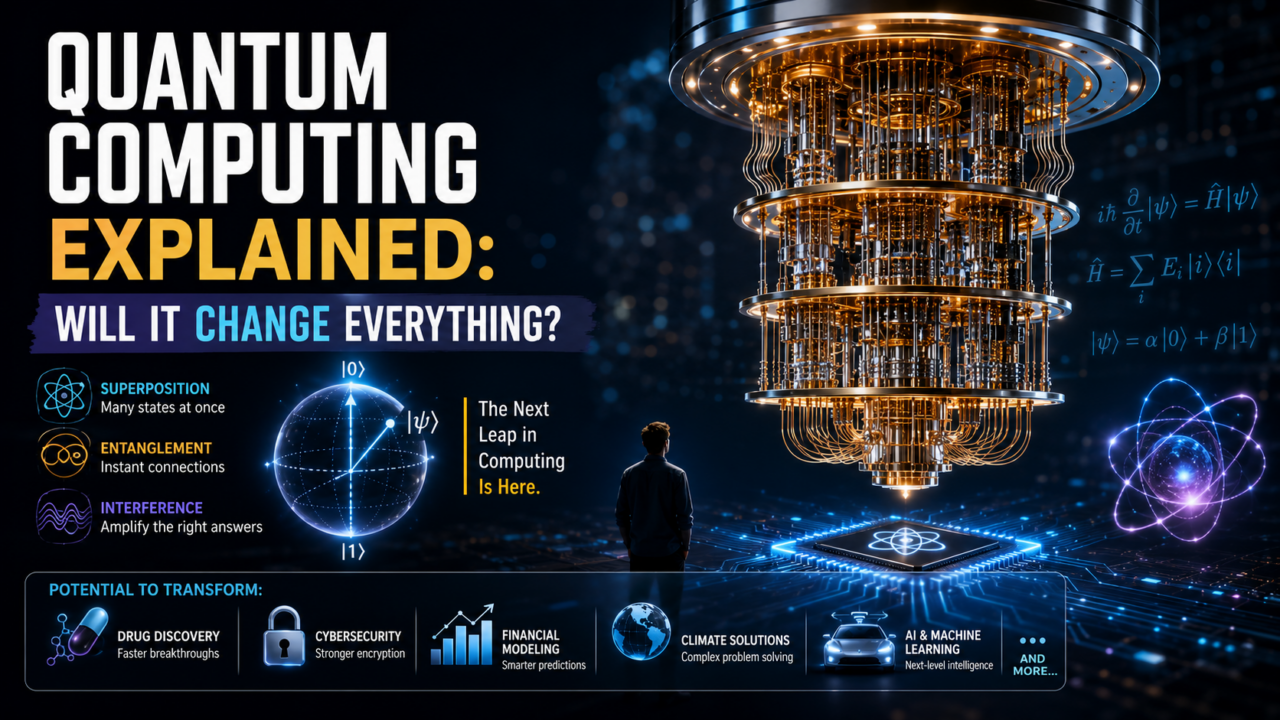
Quantum computing has become one of the most talked-about technologies of the decade. Headlines often describe it as the next revolution after artificial intelligence, while others suggest it could break internet security, accelerate scientific discovery, and solve problems beyond the reach of today’s most powerful supercomputers. These claims sound extraordinary, but they also raise an important question: How much of this is realistic, and how much is speculation?
The answer lies somewhere in between.
Quantum computing is not simply a faster version of the laptop on your desk. It represents a fundamentally different way of processing information, built on the unusual principles of quantum mechanics rather than the classical physics that powers today’s computers. Although practical, large-scale quantum computers are still under development, researchers believe they could transform fields such as medicine, cybersecurity, logistics, finance, chemistry, and artificial intelligence.
Understanding quantum computing does not require advanced mathematics. It requires understanding why some problems become unimaginably difficult for classical computers—and why quantum computers approach those problems in an entirely different way.
How Quantum Computing Differs from Classical Computing
Every smartphone, laptop, and data center in the world relies on bits, the smallest unit of digital information. A bit can hold one of two values: 0 or 1. Even the most advanced supercomputers perform calculations by processing enormous numbers of these binary bits at incredible speeds.
Quantum computers use something different.
Instead of bits, they use qubits.
Unlike classical bits, qubits can exist in a quantum state known as superposition, allowing them to represent multiple possible values until they are measured. Another quantum property, called entanglement, enables qubits to become strongly connected so that changing one can instantly influence the behavior of another within the quantum system.
These properties do not mean quantum computers try every possible answer simultaneously—a common misconception. Instead, they allow certain algorithms to explore complex mathematical problems far more efficiently than classical approaches. For specific types of calculations, this creates an enormous computational advantage.
Why Quantum Computing Matters
The significance of quantum computing is not that it will replace everyday computers. It is that it may solve problems that are effectively impossible for classical machines.
Imagine trying to simulate every interaction inside a complex protein molecule while designing a new medicine. The number of possible interactions becomes so enormous that even powerful supercomputers struggle to model them accurately.
Quantum computers could dramatically improve these simulations because quantum systems naturally model other quantum systems.
The same principle applies to optimizing airline routes, managing global supply chains, discovering advanced materials, improving battery technology, and solving certain mathematical optimization problems that currently require enormous computational resources.
In each case, the advantage is not speed alone.
It is the ability to solve problems that scale beyond classical computing methods.
Industries Most Likely to Benefit
Healthcare is widely expected to become one of the biggest beneficiaries of quantum computing. Pharmaceutical companies spend years testing molecular interactions before developing new drugs. More accurate simulations could reduce research time while improving the precision of drug discovery.
The financial industry also has significant interest. Banks and investment firms constantly analyze enormous numbers of variables when assessing financial risk, optimizing investment portfolios, and detecting fraud. Quantum algorithms may eventually improve these calculations for highly specialized applications.
Logistics companies face similar challenges. Every delivery network involves countless combinations of routes, fuel costs, weather conditions, warehouse locations, and customer demand. Even small improvements in optimization can save millions of dollars annually.
Artificial intelligence may also benefit. While today’s AI systems already rely on powerful classical computers, researchers continue exploring whether quantum computing can improve machine learning algorithms, particularly for complex optimization and pattern recognition tasks.
Although many of these applications remain experimental, they demonstrate why governments and technology companies continue investing billions of dollars in quantum research.
The Challenges Holding Quantum Computing Back
Despite the excitement, quantum computing remains one of the most technically challenging fields in science and engineering.
Qubits are extremely fragile.
Even tiny environmental disturbances such as heat, electromagnetic interference, or vibration can introduce errors into calculations. To minimize these effects, many quantum computers operate at temperatures colder than outer space using highly specialized refrigeration systems.
Another major challenge is error correction. Quantum calculations require extraordinary precision, and maintaining reliable qubits over long periods remains difficult. Researchers continue developing techniques that allow many physical qubits to function together as one stable logical qubit.
These engineering challenges explain why today’s quantum computers are not replacing classical computers anytime soon.
Most experts believe the technology will mature gradually rather than through a single dramatic breakthrough.
The Future of Work in an AI-Driven Economy
Will Quantum Computing Break Internet Security?
Perhaps the most widely discussed concern involves cybersecurity.
Many modern encryption systems rely on mathematical problems that classical computers would need an impractical amount of time to solve. Certain quantum algorithms, most notably Shor’s algorithm, suggest that sufficiently advanced quantum computers could solve some of these problems much faster.
This does not mean internet security will suddenly collapse.
Cryptographers have anticipated this possibility for years. Governments, universities, and technology companies are already developing post-quantum cryptography—new encryption methods designed to remain secure even against future quantum attacks.
The transition has already begun because replacing global encryption standards requires years of preparation before large-scale quantum computers become practical.
Should Ordinary People Care Today?
For most people, quantum computing will not change daily life tomorrow.
Its influence will initially appear behind the scenes through better medicines, improved logistics, stronger cybersecurity, more efficient manufacturing, scientific discoveries, and advances in artificial intelligence.
Just as few people understand how cloud computing or semiconductor manufacturing works, most individuals will benefit from quantum computing without interacting directly with it.
However, understanding its potential remains valuable.
Like artificial intelligence, quantum computing represents a foundational technology capable of influencing many industries simultaneously. Students, professionals, business leaders, and policymakers who understand its possibilities today will be better prepared for the opportunities it creates tomorrow.
Conclusion
Quantum computing is often surrounded by exaggerated promises and unnecessary fear. The reality is both more measured and more fascinating. It is not a replacement for classical computing but a complementary technology designed to solve a narrow set of exceptionally difficult problems that conventional computers struggle to handle.
Its greatest impact is likely to emerge in scientific research, medicine, optimization, cybersecurity, materials science, and artificial intelligence. At the same time, significant engineering challenges remain before quantum computers become practical on a global scale.
The future of quantum computing should therefore be viewed with cautious optimism rather than unrealistic expectations.
History shows that transformative technologies rarely change the world overnight. They evolve through decades of research, experimentation, and gradual adoption before quietly becoming part of everyday life.
Quantum computing appears to be following that same path.
The question is not whether it will change everything.
It is which industries will change first—and who will be ready when they do.
Call to Action
Emerging technologies are reshaping industries faster than ever before. Continue exploring the Aziz Publishing Knowledge Library for practical, evidence-based articles on artificial intelligence, science, productivity, psychology, and global trends to better understand the innovations shaping the future.