
You can read a chapter twice and still forget it by tomorrow. Or you can close the book, try to produce the answer yourself, and remember it for weeks. That gap is not about effort or intelligence. It is the generation effect, one of the most reliable findings in the psychology of learning. Here is what the generation effect really is, what the research shows, and how to use it every time you study.
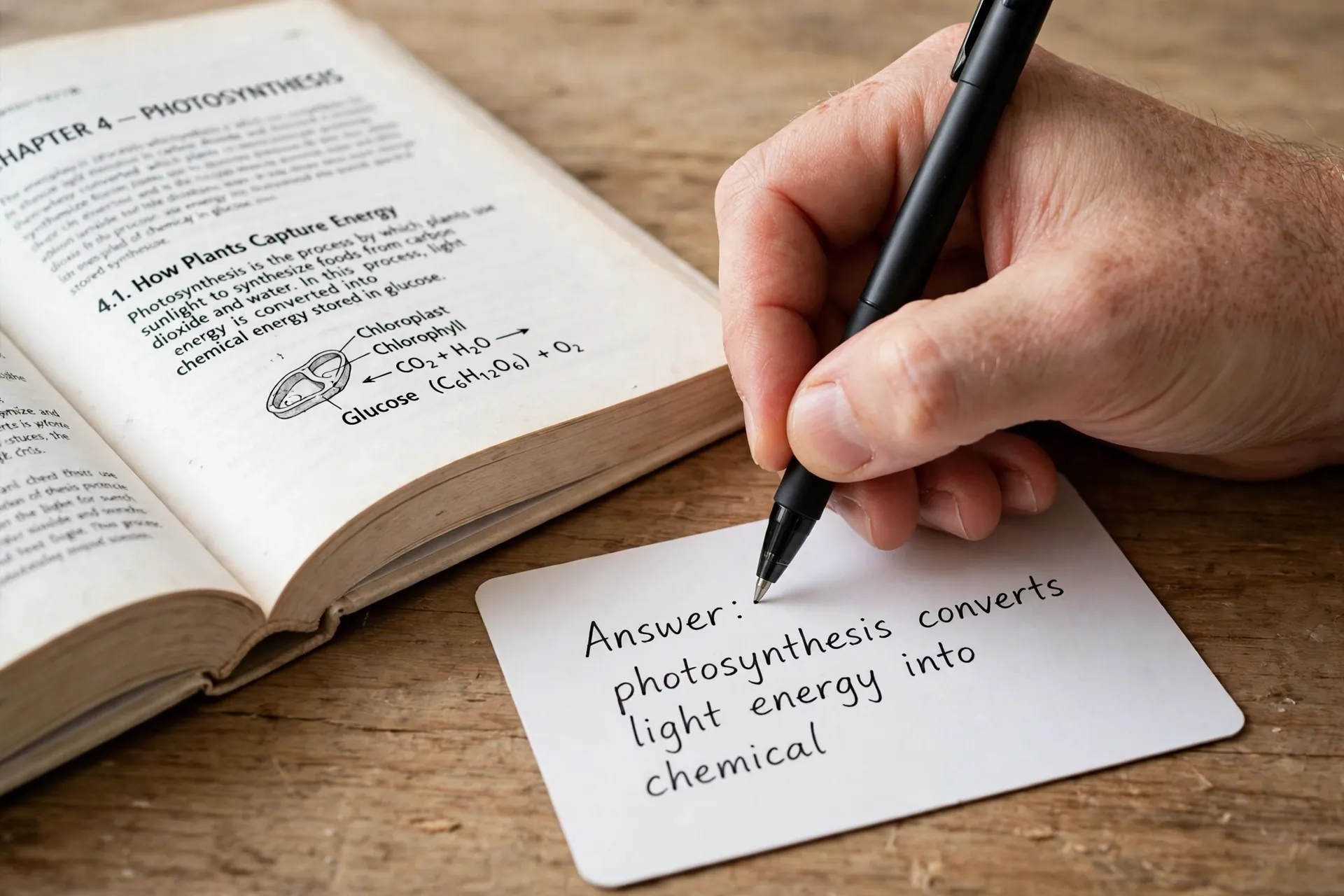
What the Generation Effect Is
The generation effect is the finding that information you produce yourself is remembered better than the same information you only read. When you fill in a blank, work out a problem before looking at the solution, or say the answer out loud before checking it, you remember more than when you passively read the same words off the page. The effect was isolated by Norman Slamecka and Peter Graf in 1978 in a paper called “The generation effect: Delineation of a phenomenon”, published in the Journal of Experimental Psychology: Human Learning and Memory.
In their five experiments, participants saw word pairs and had to remember the second word. In the read condition they simply read the complete pair. In the generate condition they produced the target word themselves from a rule and a fragment, such as an initial letter. The generated words were remembered better on every measure the researchers used: cued and uncued recognition, free recall and cued recall. The two groups spent the same amount of time on the material. The only difference was whether the learner produced the answer or received it, as explained in a 2026 guide to the generation effect.
The idea is simple, but it cuts against how most people study. Rereading feels productive because the words look familiar. That familiarity is a trap. It tells you that you recognize the material, not that you can recall it when it matters. Generation replaces recognition with production, and production is what builds memory you can actually use.
Why Producing an Answer Works
When you generate something, your brain has to do several things at once. It searches your memory for the relevant information, organizes that information, decides what matters, and puts it into words. Reading skips all of that work. The answer arrives already assembled, so your brain never has to build the path to it. Later, when you need the answer, that path is what you are looking for, and if you never built it, you cannot find it.
The leading explanation is the mental effort theory. Generating demands more mental effort than reading, and that effort strengthens the memory. A 2026 study tested this directly with pupillometry, a measure of effort based on pupil size. In four experiments, Grudzien and Unsworth found that more mental effort was allocated to generated information than to read information, and that the extra effort partly accounts for the memory boost. The study was published in Memory and Cognition in April 2026, and it is the freshest evidence that effort is part of the mechanism, not just a side effect.
There is also a second mechanism at work. Generating forces you to connect the new material to what you already know. You cannot produce an answer from a cue unless you search through related knowledge to find it. That search activates a web of associations, and the answer gets stored inside that web. A read answer is stored alone, with few connections, which is why it fades so fast.
How Big the Effect Really Is
The generation effect is real, but it is not magic, and the honest numbers matter. Bertsch, Pesta, Wiscott and McDaniel pooled 445 effect sizes from 86 studies in 2007 and reported an average advantage of about four tenths of a standard deviation. That is a solid, meaningful gain, roughly the difference between an average score and a clearly above average one, but it is not a doubling of memory. Claims that generation doubles or triples retention overstate what the data shows.
A 2020 meta-analysis of 126 articles and 310 experiments found that the size of the effect depends on how tightly the generation task constrains the answer. When the cue points clearly to one correct answer, the effect is strong. When the task is open ended and the learner can generate almost anything, the benefit shrinks. The practical lesson is clear: generation works best when the question has a right answer and you have to work to reach it.
The effect also has a hard limit. It only works when the generation succeeds. A target you cannot produce and never see is a target you have not learned, which is why generation works best with feedback. Trying to answer, failing, and then seeing the correct answer still helps, because the attempt primes your brain to absorb the answer. But trying, failing, and never checking the answer helps no one. The check is part of the method.
The Generation Effect in 2026 Classrooms
The effect is getting fresh attention in 2026, because two new classroom studies show it working in real courses, not just in the lab. A 2026 study in The International Journal of Management Education examined student-generated questions in an undergraduate international business course. Students who created their own multiple-choice questions performed better on the final exam than students who did not, even after controlling for prior academic performance. They learned more by writing the questions than by answering someone else’s.
A separate 2026 randomized crossover trial in BMC Medical Education looked at dental students creating multiple-choice questions. The results were striking: 87.1 percent of students said the act of generating questions enhanced their understanding of the material, 82.3 percent said it increased their engagement, and 79 percent said it improved their ability to identify key concepts and relationships. The students did not just score better. They understood the material differently, as described in a 2026 look at the creator’s advantage in studying.
The timing matters, because 2026 is also the year AI answers became effortless. A 2026 paper on the generation effect and AI-assisted writing puts it well: self-generated material is remembered and understood significantly better than passively received material. When an AI hands you the finished answer, you get the product without the process, and the process is where the learning lives. The generation effect is the reason that shortcut costs you more than it saves.
How to Use the Generation Effect
You do not need a new app or a new system to use the generation effect. You need to change the order of your study: try first, then check. The attempt comes before the answer, every time. Start with the smallest version of the method and build from there.
- Cover the answer, then try: Read the question or the cue, cover the answer, and try to produce it before you look. Even a wrong attempt helps, because it primes your brain to absorb the correct answer when you see it.
- Write your own questions: After reading a section, close the book and write three questions about it, with answers. You are not just reviewing the material. You are generating it, which is exactly what the 2026 classroom studies show works.
- Fill in the blanks: Turn your notes into cloze deletions, sentences with a key word blanked out. Filling in the blank is the original 1978 experiment, and it still works.
- Solve before you look: When a textbook gives a worked example, cover the solution and work it yourself first. Looking at a finished solution feels like understanding. Producing the solution is understanding.
- Explain it before you reread: Try to explain the idea in your own words, out loud, before you go back to the text. A Feynman technique session is generation in its purest form, because you cannot explain what you have not produced yourself.
One warning matters. Generation is not the same as grinding. If you cannot produce the answer after a genuine attempt, look it up, study it, and try again later. The goal is successful generation with feedback, not frustration. Deliberate practice works the same way: focused attempts, immediate feedback, and another try. Generation is the study version of that loop.
- The generation effect is the finding that information you produce yourself is remembered better than the same information you only read. Slamecka and Graf isolated it in 1978, and generated words won on every measure they used.
- Producing an answer forces your brain to search memory, organize material, and put it into words. A 2026 pupillometry study confirmed that generation demands more mental effort, and that effort partly accounts for the memory boost.
- The average advantage across 86 studies is about four tenths of a standard deviation, a solid gain, not a doubling. The effect is strongest when the cue points to one clear answer.
- Two 2026 classroom studies show it working in real courses: students who wrote their own exam questions scored better, and 87.1 percent of dental students said generating questions improved their understanding.
- Use it by trying first and checking second: cover the answer, write your own questions, fill in the blanks, solve before you look, and explain the idea before you reread.
Frequently Asked Questions
What is the generation effect?
The generation effect is the finding that information you produce yourself is remembered better than the same information you only read. It was isolated by Norman Slamecka and Peter Graf in 1978. In their five experiments, words participants produced from a rule and a fragment were remembered better than words they only read, on every measure the researchers used: cued and uncued recognition, free recall and cued recall.
Why does generating an answer help memory?
Generating forces your brain to search memory, organize the material, decide what matters, and put it into words, work that reading skips. The mental effort theory says this extra effort strengthens the memory, and a 2026 pupillometry study confirmed that more effort is allocated to generated information and that the effort partly accounts for the memory boost. Generating also connects the answer to what you already know, which gives it more paths back when you need it.
Does the generation effect work if I get the answer wrong?
Yes, as long as you check the correct answer afterward. A failed attempt primes your brain to absorb the right answer when you see it, so trying and then checking still helps. What does not help is trying, failing, and never seeing the correct answer. The feedback is part of the method, not an optional extra.
How is the generation effect different from active recall?
Active recall is testing yourself on material you have already learned, such as quizzing yourself with flashcards. The generation effect is producing the material itself from a cue, such as filling in a blank or writing your own question, often the first time you meet it. They overlap and they work well together: generate the answer first, then use active recall to test whether you can still produce it later.
Final Thoughts
The generation effect is a small change with a large payoff: try before you look. Reading feels like learning because the words are familiar, but familiarity is not memory. The answer you produce yourself, even imperfectly, is the one you will still have tomorrow. In a year when AI can hand you every answer instantly, the most useful study skill is the willingness to reach for the answer yourself first.
Call to Action
If this guide changed how you study, share it with someone who is still rereading the same chapter. Explore the Aziz Publishing Knowledge Library for more guides on psychology, including how to reach deep focus while you work and how to find purpose in what you do every day.

