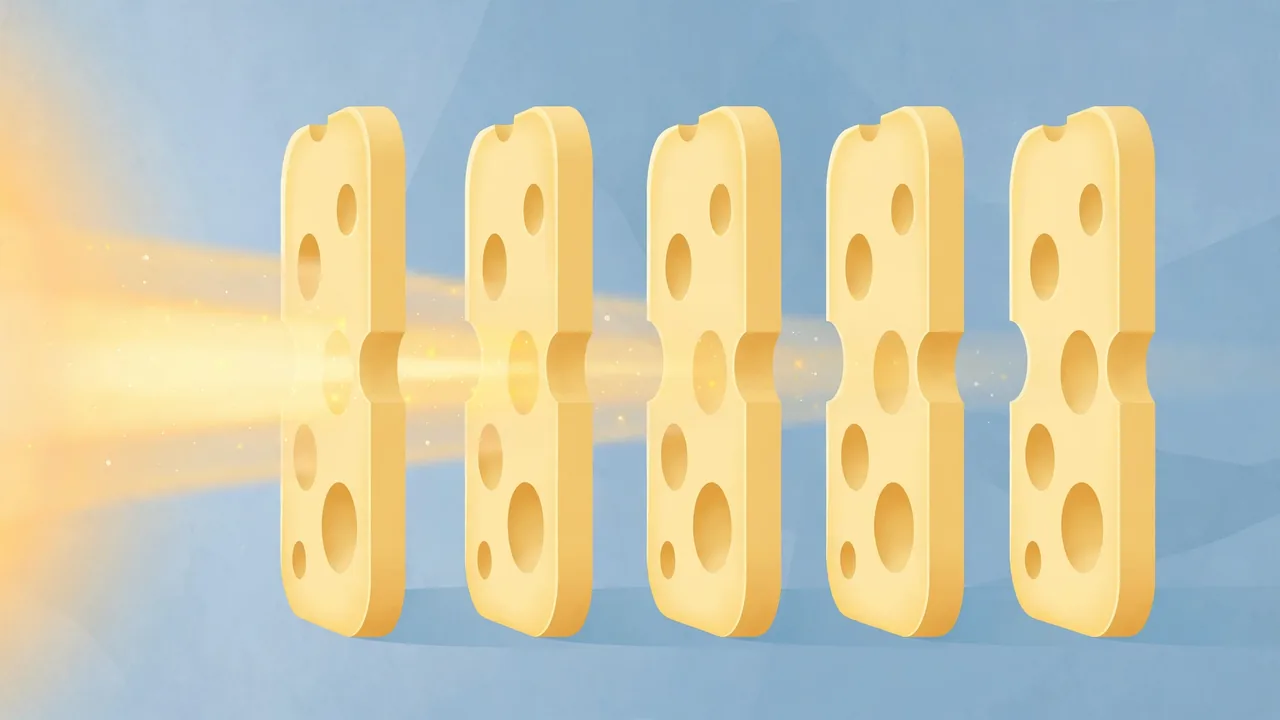
In 1990, psychologist James Reason offered a simple picture of how disasters happen: each layer of protection is a slice of Swiss cheese, full of holes, and an accident happens only when the holes in every slice line up at once. Here is what the model really says, why one mistake is never the whole story, and how to build layers that catch your own errors before they reach the end of the line.

What the Swiss Cheese Model Is
The Swiss cheese model is a way of picturing how accidents happen in complex systems. Imagine a stack of Swiss cheese slices standing between a hazard and a disaster. Each slice is a layer of defence: a procedure, a piece of equipment, a trained person, a supervisor checking the work. No slice is solid. Every one has holes, which are the weaknesses, gaps, and edge cases in that layer.
Most of the time, a hazard hits a hole in one slice and stops at the solid part of the next. Nothing bad happens, and nobody notices. The dangerous moment is the rare one when the holes in several slices happen to line up at the same time, letting the hazard pass through every layer. That alignment is the accident. It is why the model is sometimes drawn with an arrow running straight through the whole stack.
The model changed how aviation and healthcare think about safety. Before Reason, an investigation usually ended with the person who made the last mistake. After Reason, the question became which layers failed and why. The person at the sharp end still matters, but blaming one person misses the system that let the mistake through, as explained in a 2026 guide to the model in aviation safety.
The Four Layers of Defence
Reason described high technology systems as having many defensive layers. Some are engineered, such as alarms, physical barriers, and automatic shutdowns. Others rely on people, such as a trained operator watching a gauge. Others depend on procedures and administrative controls, such as a checklist or a rule that two people must sign off before a step goes ahead.
In aviation those layers include aircraft system design, maintenance procedures and independent inspections, training and licensing, crew procedures, and the oversight that sits above them. In healthcare the layers include prescribing software, a pharmacist checking the dose, a nurse reading the label, and a patient asking a question. The layers are different in each field, but the shape is the same: several defences in a row, each imperfect, each catching what the one before missed.
The Human Factors Analysis and Classification System, known as HFACS, turns the layers into four levels investigators can code: unsafe acts, preconditions for unsafe acts, unsafe supervision, and organisational influences. It was developed by Scott Shappell and Doug Wiegmann in the early 2000s and is heavily based on Reason’s model. It gives investigators a shared language for naming which layer failed, instead of stopping at the first person they find.
Active Failures and Latent Conditions
Reason made a distinction that sits at the heart of the model. Active failures are the unsafe acts committed by people in direct contact with the system: a pilot flips the wrong switch, a nurse gives the wrong dose, a programmer deploys the wrong file. They are visible, they happen close to the accident, and they are the easiest to blame.
Latent conditions are different. They are the organisational weaknesses that sit quietly for years: a budget cut that left training thin, a procedure nobody follows because it is out of date, a manager who rewards speed over care, a piece of equipment that has been unreliable for months. Latent conditions are the holes in the outer slices. They do not cause an accident by themselves, but they set the stage for one. When an active failure meets a latent condition, the holes start to line up.
This is why the fundamental attribution error matters here. Our first instinct is to explain a failure by pointing at a person’s character, and to ignore the situation around them. The Swiss cheese model forces the opposite move. It asks you to look past the person and into the system, because the system is where the holes were waiting.
Why the Holes Keep Moving
One detail of the model is easy to miss, and it is the one that explains why safe systems fail on ordinary days. The holes do not stay still. Reason described them as opening and closing at random, as people get tired, as procedures change, as equipment ages, as attention drifts. The same system can be safe for years and then fail on one bad day, because on that day the holes happened to line up.
That is also why a single accident rarely has a single cause. Investigators who study plane crashes and hospital errors keep finding the same pattern: a small mistake, plus a missed check, plus a tired team, plus a rule that was skipped because it felt unnecessary. Take away any one of those and the accident does not happen. The catastrophe needs the alignment, and the alignment needs several failures at once.
The model got a fresh audience in 2026, when AI developers started applying it to agent safety. A detailed post in April 2026 mapped five independent layers of tenant isolation in an AI agent system, and argued that for one customer to reach another customer’s data, all five layers would have to fail at the same time. The idea is the same one Reason had in 1990: no single layer is perfect, so stack enough of them that the odds of every hole lining up become vanishingly small, as described in an October 2026 guide to human factors and error.
How to Build Your Own Layers
The model is not only for airlines and hospitals. Your own life is a system with defences too, and most of your mistakes pass through because you trusted a single layer. A deadline you missed, a message you sent to the wrong person, a purchase you regretted: each one got through because one layer had a hole and there was nothing behind it. The fix is to add layers, cheap ones, in a row.
- Checklists: A short written list catches the step your tired brain skips. Pilots use them for every flight, surgeons use them for every operation, and you can use one for packing, publishing, or sending anything important. The checklist is a layer that does not get tired.
- A second pair of eyes: Ask someone else to read the email, check the numbers, or look at the plan before it goes out. A fresh pair of eyes sees the hole you have been staring straight through. This is the cheapest layer there is, and the one people skip most often.
- A cooling off period: For decisions that cannot be undone, add a delay between the impulse and the action. Wait a day before sending the angry reply, or an hour before buying the expensive thing. Time is a layer, and it closes holes that emotion opened.
- An automatic backup: Where a mistake would be costly, make the safe path the default one. Autosave, a second copy, a confirmation dialog, a calendar reminder the day before. Automation is a layer that works even when you are distracted.
- A review of the near miss: When something almost goes wrong, treat it as a free lesson. Ask which layer caught it and which layer had the hole. A near miss is the system telling you where the next accident will come from, and it costs nothing to listen.
None of these layers is perfect, and that is the point. A checklist can be skipped, a reviewer can be rushed, a delay can be ignored. But when the holes in your layers rarely line up, most mistakes get caught somewhere in the stack. That is also why the planning fallacy keeps biting: a plan with one layer, your own estimate, has a single hole that optimism walks straight through, as noted in EBSCO’s overview of the model.
The Honest Limits of the Model
It is worth saying plainly what the model does and does not do. The Swiss cheese model is a simplification. It shows that defences fail together, but it does not explain why a particular hole appeared, or how the layers influence each other. A hole in one layer can make a hole in the next one more likely, and the picture of neat slices does not capture that.
The model also does not tell you which layers to build or how strong each one needs to be. It is a way to think, not a formula that predicts accidents. Critics in safety research have made this point for years, and Reason himself presented the model as a framework for investigation, not as a complete theory of failure. The article says this plainly because the model is useful enough to survive the honesty.
There is one more limit. The model can tempt you to keep adding layers forever, until the system is so wrapped in checks that nothing gets done. Every layer costs time and attention, and a layer nobody uses is a hole, not a defence. The skill is choosing a few layers that actually get used, and keeping them in good shape, rather than building a wall of procedures nobody follows.
- The Swiss cheese model says accidents happen when the holes in several layers of defence line up at once. Each layer is a slice of cheese with holes, and a hazard has to pass through every slice to cause harm.
- James Reason, a psychologist at the University of Manchester, set out the model in his 1990 book Human Error, and his 2000 BMJ paper is the version most people cite.
- The holes come from two sources: active failures, the unsafe acts of people in direct contact with the system, and latent conditions, the organisational weaknesses that sit quietly for years.
- The holes open and close at random, which is why the same system can be safe for years and then fail on one bad day. A single hole is never enough. Catastrophe needs alignment.
- In your own life, build layers the same way: a checklist, a second pair of eyes, a cooling off period, an automatic backup, and a review of every near miss. No layer is perfect, so stack several.
- The model is a simplification, not a formula. It shows that defences fail together, but it does not explain why a particular hole appeared, and adding layers nobody uses only creates new holes.
Frequently Asked Questions
What is the Swiss cheese model?
The Swiss cheese model is James Reason’s picture of how accidents happen in complex systems. Each layer of defence is a slice of Swiss cheese with holes in it, and an accident happens only when the holes in several slices line up, letting a hazard pass through every layer. The holes come from active failures and latent conditions.
Who created the Swiss cheese model?
James Reason, a psychologist at the University of Manchester, created the model. He set out the ideas in his 1990 book Human Error and developed them in Managing the Risks of Organizational Accidents (1997). His short 2000 paper in the BMJ, Human error: models and management, is the version most people cite.
What are active failures and latent conditions?
Active failures are the unsafe acts committed by people in direct contact with the system, such as flipping the wrong switch or giving the wrong dose. Latent conditions are organisational weaknesses that sit quietly for years, such as thin training, out of date procedures, or a culture that rewards speed over care. An accident usually needs both to line up.
How can I use the Swiss cheese model in daily life?
Build several cheap layers in a row instead of trusting one. Use a checklist for important steps, ask a second person to check your work, add a cooling off period before irreversible decisions, automate backups and reminders, and review every near miss. No layer is perfect, so stack several and keep the ones you actually use in good shape.
Final Thoughts
The Swiss cheese model changes the question you ask after something goes wrong. Instead of asking who messed up, you ask which layers failed and why. That shift is the whole value of the model: it turns blame into a search for holes, and a search for holes into better layers. One mistake is never the whole story, and the next accident is already lining up its holes somewhere in your system.
Call to Action
If this guide helped you see mistakes differently, share it with someone who blames themselves for every slip. Explore the Aziz Publishing Knowledge Library for more guides on productivity, including how to plan your week with time blocking and how if-then plans carry you after you start.

