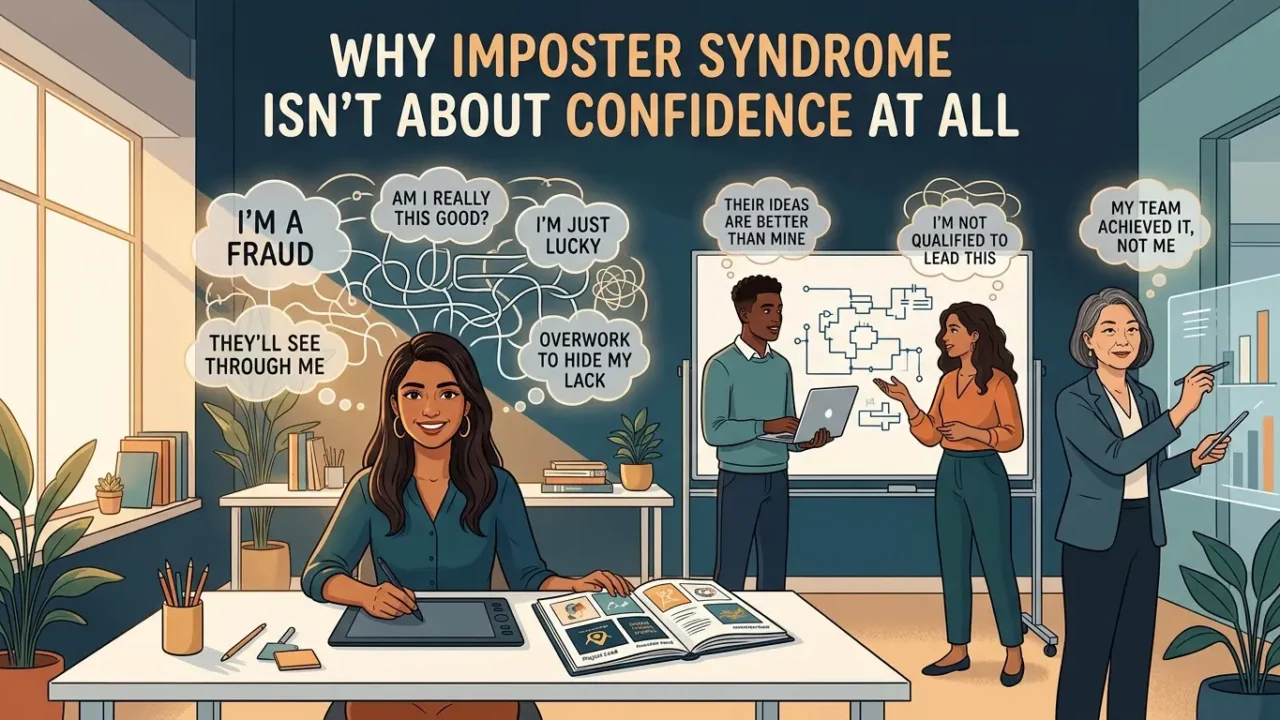
You’ve hit every milestone, gotten the promotion, earned the degree, landed the client, and somehow, you still feel like a fraud waiting to get caught. That’s not a confidence problem. It’s a specific, well-documented thinking pattern, and understanding it changes everything about how you fix it.
Where the Term Actually Came From
The concept was first identified in 1978 by psychologists Pauline Clance and Suzanne Imes, who studied high-achieving women who, despite clear external evidence of success, believed they weren’t actually intelligent and had somehow fooled everyone around them. Their original research called it the “imposter phenomenon,” and it was never framed as a confidence deficit, it was framed as a distorted way of interpreting one’s own achievements. This distinction matters enormously, because a confidence problem implies you simply need more self-belief, while a thinking pattern implies something specific and correctable is happening in how you process evidence about yourself. The original research already pointed toward cognition, not charisma, as the actual issue.
The Core Thinking Error at the Center of It
At its root, imposter syndrome involves a specific pattern of misattributing success while over-attributing failure. When something goes well, the brain credits luck, timing, or other people’s generosity, but when something goes poorly, the brain credits personal inadequacy directly. This isn’t random, it’s a consistent asymmetry in how evidence gets processed, meaning two people can have identical track records and interpret them in completely opposite ways. Recognizing this as a measurable cognitive bias, rather than an accurate read on your actual abilities, is the first real step toward interrupting it.
8 Signs of a Victim Mentality and How to Break Free
Why Competent People Are Especially Prone to It
Counterintuitively, imposter syndrome tends to intensify as competence increases, not decreases, which is exactly why it shows up so often among high achievers. As people take on more advanced work, they encounter more unfamiliar problems by definition, since growth constantly moves the goalposts into new territory. This creates a strange loop where becoming more skilled generates more moments of not-yet-knowing, which then gets misread as evidence of fraudulence rather than evidence of appropriate challenge. The very people most likely to be genuinely qualified are often the ones most likely to doubt it.
The Comparison Trap That Fuels the Pattern
Much of imposter syndrome runs on an unfair comparison, measuring your internal experience, doubts, uncertainty, and effort, against other people’s polished external output. You see a colleague’s finished presentation and assume they built it with total confidence, while you know exactly how much doubt went into your own version behind the scenes. This creates a systematic distortion where everyone else appears more certain than you, simply because you can’t see their internal process the way you see your own. The comparison was never fair to begin with, since you’re comparing your behind-the-scenes footage to everyone else’s highlight reel.
Why Fear of Failure Is Keeping You Stuck
Why “Just Be More Confident” Doesn’t Actually Work
Telling someone with imposter syndrome to simply feel more confident misses the mechanism entirely, since the problem isn’t a shortage of self-esteem, it’s a specific pattern of discounting evidence. Confidence-boosting advice, like affirmations or pep talks, tends to bounce off this pattern because it doesn’t address how success is actually being interpreted in the moment it happens. This is why traditional confidence-building strategies often provide only temporary relief before the same doubt resurfaces at the next challenge. Real change requires intervening at the level of interpretation, not just emotional reassurance.
The Specific Thought Patterns Worth Noticing
A few recurring thought patterns show up consistently in imposter syndrome, and naming them makes them easier to catch in real time. One is discounting, immediately explaining away a compliment or success with an external factor rather than accepting it as earned. Another is anticipatory catastrophizing, assuming the next challenge will finally be the one that exposes you as not good enough. A third is the “should already know this” pattern, treating any current gap in knowledge as proof of inadequacy rather than a normal part of ongoing growth.
How to Actually Interrupt the Pattern
Since imposter syndrome is a thinking pattern rather than a personality trait, it responds well to specific, evidence-based interruption techniques rather than general encouragement. Keeping a simple record of completed work and positive feedback creates a factual counterweight to the brain’s tendency to discount success in the moment. When you catch yourself attributing an outcome to luck, pause and ask what skill or decision actually contributed to that result, forcing a more accurate accounting. Talking openly with peers about these feelings also helps, since many people quietly assume they’re the only one experiencing this, when in reality the pattern is remarkably common even among visibly successful people.
Why Motivation Fades but Discipline Lasts: The Psychology of Consistency
When It’s Worth Getting Additional Support
For most people, imposter syndrome is a manageable pattern that responds to awareness and small behavioral shifts over time, but for some, it becomes persistent enough to affect decision-making, career growth, or daily wellbeing. If the pattern is causing significant distress or consistently holding you back from opportunities you’re genuinely qualified for, working with a therapist or coach trained in cognitive approaches can help identify and interrupt the specific thought patterns driving it. There’s no shame in needing structured support here, since this is a well-documented psychological pattern, not a personal weakness. Recognizing when self-directed strategies aren’t enough is itself a sign of clear thinking, not failure.
Final Thoughts
Imposter syndrome isn’t a sign that you lack confidence, it’s a specific, well-documented pattern of misreading your own evidence, discounting success while over-crediting failure to personal inadequacy. Understanding it this way, as a fixable thinking pattern rather than a fixed personality flaw, changes what kind of help actually works.
Next time you catch yourself explaining away a win as luck, pause and ask what skill actually got you there. If this reframe helped you see your own doubts a little differently, share it with someone who’s convinced they’re the only one who feels this way.
Call to Action
Next time you catch yourself explaining away a win as luck, pause and ask what skill actually got you there. If this reframe helped, share it with someone convinced they’re the only one who feels this way. Explore the Aziz Publishing Knowledge Library for more evidence-based articles on mindset, psychology, productivity, and habits that help you build a life driven by discipline rather than temporary motivation.