At concerts in 2026, crowds have started standing rigid instead of dancing, too self-conscious to move. That is the spotlight effect in real life: the belief that everyone is watching you, when almost nobody is. Here is what the research says about why it happens, and how to turn the spotlight down.
What the Spotlight Effect Actually Is
The spotlight effect is a cognitive bias that makes you overestimate how much other people notice your appearance, your behavior, and your mistakes. You walk out of a presentation replaying the one sentence you stumbled on. The audience, meanwhile, barely registered it.
The gap is enormous. You experience your own life from the inside, in high definition, so you assume everyone else sees it that clearly too. They do not. They are too busy standing in their own spotlight to study yours.
The Famous T-Shirt Experiment
The classic demonstration comes from psychologists Thomas Gilovich, Victoria Medvec, and Kenneth Savitsky. In their 2000 study published in the Journal of Personality and Social Psychology, students were asked to wear an embarrassing T-shirt (featuring singer Barry Manilow) and walk into a room full of peers.
Before entering, the wearers guessed that about half the room would notice the shirt. In reality, only about a quarter did. The wearers had overestimated the attention they received by roughly double. A good overview of the study and its follow-ups is available at FourWeekMBA’s spotlight effect explainer, which was updated in October 2026 with newer research.
The result has been replicated many times since. People consistently think their blunders, outfits, and nervous habits are far more visible than they are.
Why Your Brain Does This
Three mental habits drive the effect. The first is anchoring: you start from your own intense experience of the moment and fail to adjust for the fact that others experience it mildly, if at all.
The second is egocentrism, the quiet assumption that you are the main character in other people’s attention. The third is the illusion of transparency: you feel your nervousness so strongly that you assume it must be leaking out for everyone to see. It usually is not, a point that connects directly to The Psychology of Overthinking: Why Your Brain Won’t Let You Relax.
The Spotlight Effect on Social Media
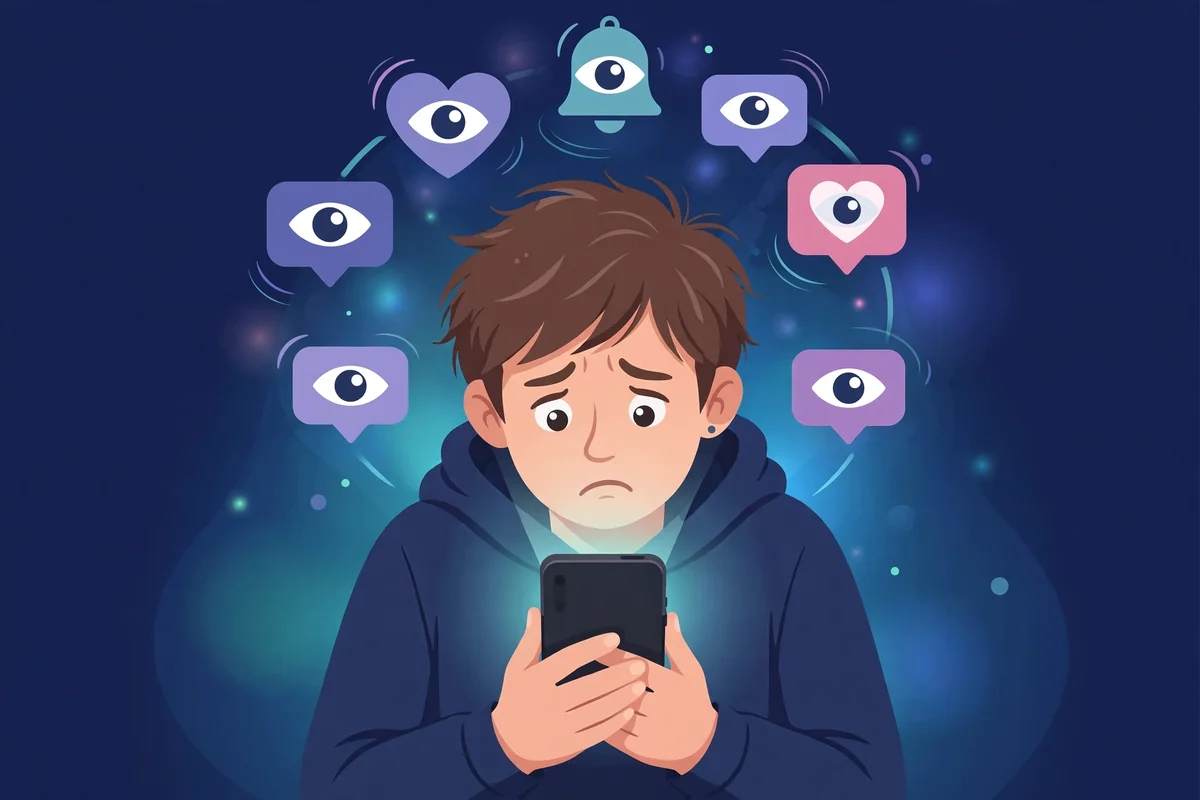
Social media has given this old bias a new stage. Every post feels like a performance under bright lights: you reread a caption five times, worry about who saw a story, and delete posts that get fewer likes than expected.
Researchers are now studying this directly. A recent peer-reviewed paper on the spotlight effect in the age of social media argues that platforms amplify the bias, because every interaction comes with visible metrics that feel like an audience scorecard. The irony is that your followers are scrolling past your post the same way you scroll past theirs: quickly, and without the judgment you fear.
7 Ways to Turn the Spotlight Down
You cannot switch the bias off, but you can shrink it with practice:
- Remember the 50-to-23 ratio: When you feel watched, recall the T-shirt experiment. You are probably overestimating attention by about double.
- Focus outward, not inward: In conversations, direct your attention to the other person. Ask questions and listen. The less you monitor yourself, the less the spotlight burns.
- Collect small exposures: Speak up once in a meeting. Wear the slightly bold outfit. Each uneventful outcome teaches your brain the audience is not there.
- Reframe mistakes as invisible: That stumble in your presentation? The audience forgot it within minutes. Treat your errors with the same generosity you give others.
- Prepare, then let go: For public speaking, preparation shrinks real risk. After that, accept imperfection instead of rehearsing disasters.
- Limit post-posting checking: Post and walk away. Refreshing likes every ten minutes feeds the bias with fake data.
- Use a self-compassion script: When the spiral starts, say what you would say to a friend: “Nobody is thinking about this as much as I am.” Because they are not.
For a fuller breakdown of the psychology and more coping strategies, Psychotricks’ guide to the spotlight effect covers eight mitigation techniques in depth. And if social comparison is part of your spiral, How to Stop Comparing Yourself to Others and Build Real Confidence tackles the other half of the problem.
Key Takeaways
- The spotlight effect is the bias of overestimating how much others notice you; in the classic study, people guessed double the real attention.
- It is driven by anchoring, egocentrism, and the illusion of transparency.
- Social media amplifies the bias with visible metrics that feel like an audience scorecard.
- Focusing outward, small exposures, and limiting post-checking all shrink the effect.
Final Thoughts
The spotlight you feel is mostly a trick of perspective. Everyone else is standing in their own spotlight, worrying about their own audience. Step out of yours, and the room gets a lot friendlier.
Call to Action
If this helped you feel a little less watched, share it with someone who overthinks every room they enter. Explore the Aziz Publishing Knowledge Library for more guides on psychology, including the thinking pattern behind imposter syndrome and why your brain expects something bad.
Frequently Asked Questions
What is the spotlight effect in simple terms?
It is the tendency to think people notice you far more than they do. You feel like you are on a stage, but the audience is mostly thinking about itself.
What causes the spotlight effect?
Three things: anchoring on your own intense experience, egocentrism (assuming you are the focus of others’ attention), and the illusion of transparency (believing your nervousness is obvious to everyone).
How do I stop feeling like everyone is watching me?
Focus your attention outward on other people, collect small low-stakes exposures, and remind yourself of the research: observers notice roughly half of what you think they do.
Is the spotlight effect related to social anxiety?
They feed each other. The spotlight effect makes social situations feel more scrutinized, which raises anxiety, which makes you monitor yourself more. Breaking the loop starts with recognizing the bias.