Every time you finish a nonfiction book, you walk away with more than a few new facts. You pick up new vocabulary, mental frameworks, and ways of organizing ideas that shape how you approach problems. Here’s what the research actually says about how nonfiction changes your thinking, and where the popular claims go too far.
What “Rewiring” Really Means
Your brain is constantly adapting to how you use it, a process scientists call neuroplasticity. Reading is a demanding mental activity that strengthens memory and language networks, and researchers note that this applies to reading of any type, not just nonfiction. So “rewiring” is best understood as gradual strengthening through repeated practice, not a dramatic overnight transformation.
Best AI Books for Non-Engineers: A Reading Guide
Nonfiction Builds Background Knowledge
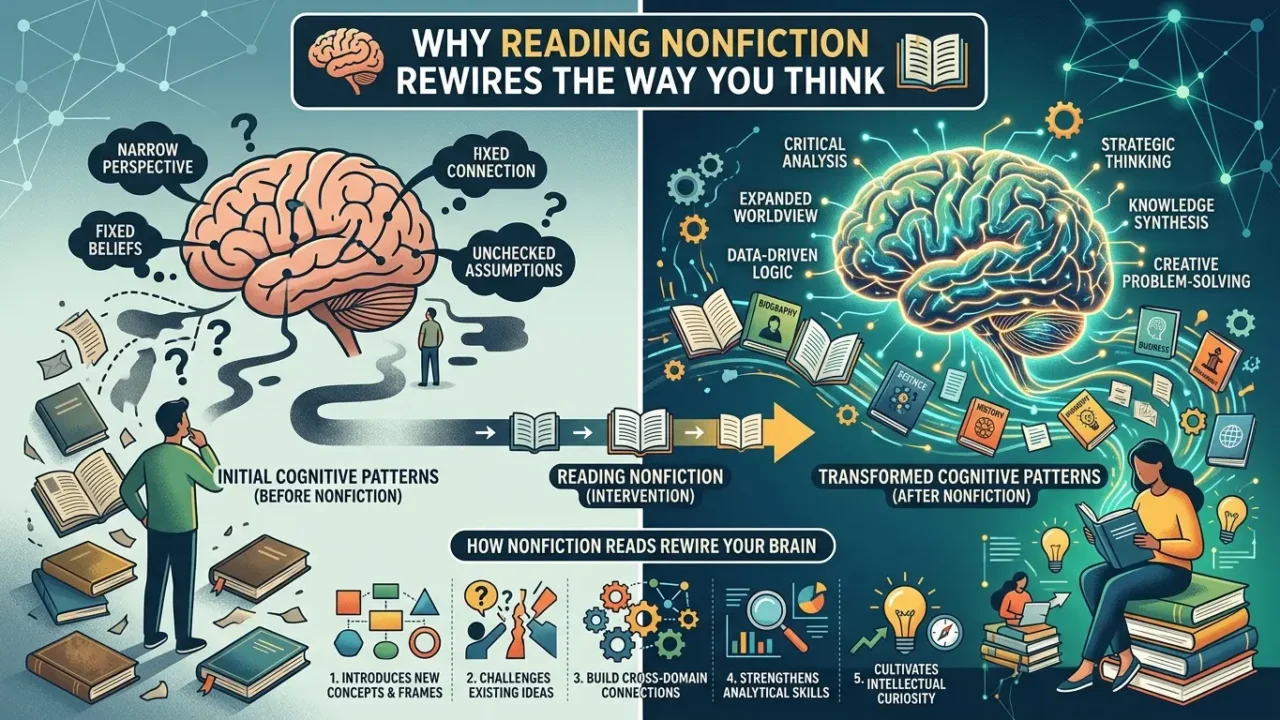
Education researchers have found that comprehension, deep thinking, and even creativity rely heavily on what you already know. Your brain can only juggle so much at once, so ideas stored in long-term memory free up mental space for higher-level thinking. Nonfiction feeds this cycle: the more you know, the more you understand, and the more you understand, the more each new book teaches you.
It Expands Your Vocabulary and Precision
Nonfiction introduces specialized terms and exact language you rarely encounter in everyday conversation. Learning words like “opportunity cost,” “confirmation bias,” or “compound interest” gives you sharper tools for describing situations. Better language often means clearer thinking, because you can name patterns you previously only sensed.
It Trains You to Follow an Argument
Most nonfiction is built around a claim, supporting evidence, and a conclusion. Reading it regularly teaches you to track how an argument is constructed, spot weak reasoning, and question where information comes from. Readers in one study valued nonfiction specifically for its directness and for authorship they could assess and question.
How Reading 20 Minutes a Day Can Change Your Brain
A Fair Note on What the Research Shows
The science here is more nuanced than headlines suggest. Some studies actually link fiction reading to stronger critical thinking dispositions, while finding weaker associations for nonfiction. That doesn’t make nonfiction less valuable. It means each type of reading builds different strengths: nonfiction tends to build knowledge and analytical skill, while fiction tends to build empathy and perspective-taking. A balanced reading diet likely works best.
How to Get More Out of Every Nonfiction Book
- Read actively: Underline key ideas and write a one-sentence summary after each chapter.
- Connect new ideas to old ones: Ask how a concept relates to something you already know.
- Question the author: Look for the evidence behind major claims.
- Apply one idea: Pick a single takeaway and use it within a week.
- Mix your sources: Read books that challenge your existing views.
Final Thoughts
Nonfiction doesn’t magically reprogram your brain, but consistent reading steadily builds the knowledge, vocabulary, and reasoning habits that shape how you think. The change happens gradually, one book at a time, and the benefits compound the longer you keep reading.
Call to Action
If this breakdown helped you see reading differently, share it with a fellow book lover. Explore the Aziz Publishing Knowledge Library for more guides on books and reading, psychology, and the habits that shape better thinking.