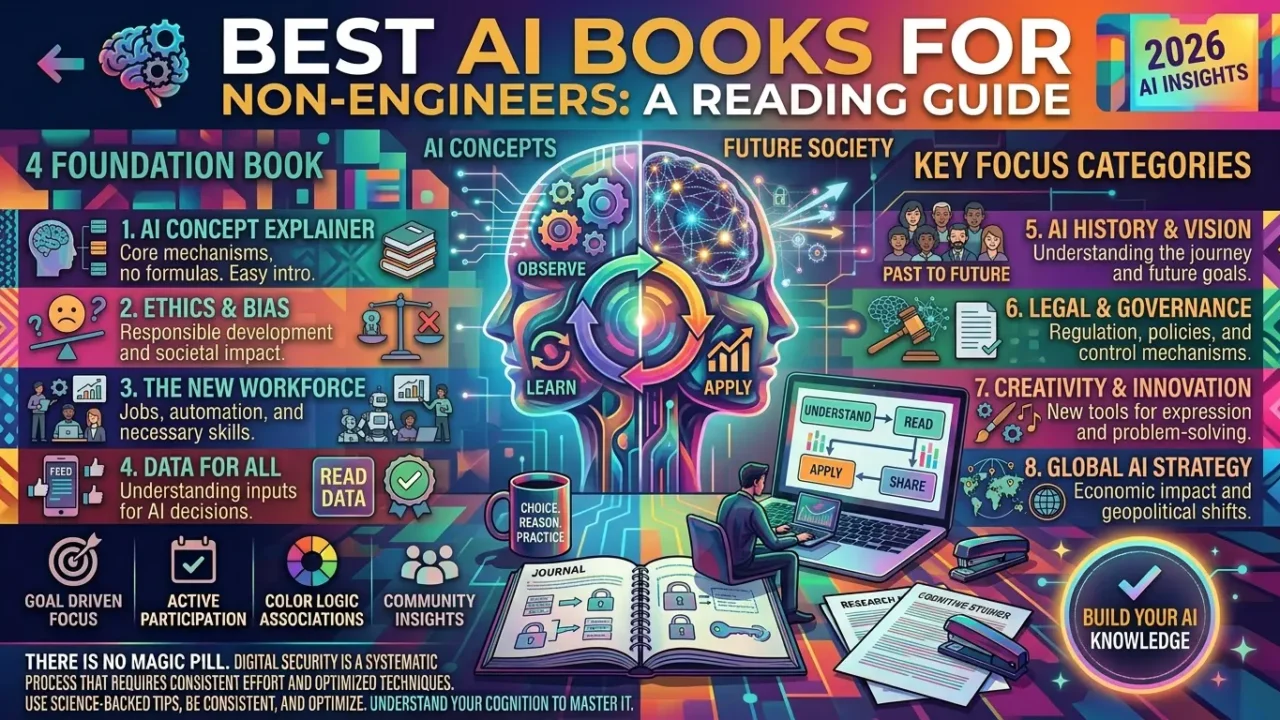
You don’t need to know how to code to understand what AI actually means for your work, your kids, or the next decade of your life. You just need the right books, ones written for genuinely curious readers rather than machine learning researchers. Here are the best starting points.
Start With “Co-Intelligence” by Ethan Mollick
If you want one practical, immediately useful book, Mollick’s “Co-Intelligence” is the strongest starting point for understanding how to actually work alongside AI tools rather than just theorizing about them. Mollick, a Wharton professor, writes in an accessible, experiment-driven style, sharing real examples of using AI for everyday tasks rather than abstract predictions about the future. The book’s core argument, treating AI as a genuine collaborator rather than either a magic solution or a threat, gives readers a grounded, usable framework. This is the book to hand someone who keeps asking “but what do I actually do with this.”
Understand the Big Picture With “Life 3.0” by Max Tegmark
For readers wanting the broader philosophical and societal stakes, physicist Max Tegmark’s “Life 3.0” explores what advanced AI could mean for humanity’s long-term future without requiring any technical background to follow. Tegmark uses accessible thought experiments and scenarios to explore questions about consciousness, control, and what a world with highly capable AI systems might actually look like. The book doesn’t shy away from difficult questions, but it presents multiple perspectives rather than pushing a single doomsday or utopian narrative. This is the book for readers who want to think seriously about where this technology could lead, not just how to use it today.
Does Reading Actually Help Your Career, or Is That a Myth?
Get the Business Angle From “AI Superpowers” by Kai-Fu Lee
Kai-Fu Lee, a veteran AI researcher and investor with deep experience in both the US and China, wrote “AI Superpowers” to explain the global competitive and economic dimensions of AI development. The book explains, in genuinely accessible terms, how AI is reshaping industries, labor markets, and international competition, drawing on Lee’s firsthand experience investing in AI companies across two major tech ecosystems. It’s particularly useful for readers in business or policy roles who need to understand AI’s economic implications without wading through technical papers. This remains one of the clearest non-technical explanations of why AI has become a genuine geopolitical and economic priority.
Learn the Ethical Stakes From “The Alignment Problem” by Brian Christian
Brian Christian’s “The Alignment Problem” tackles one of the most important and least understood aspects of AI development, ensuring these systems actually do what we intend rather than something subtly different. Christian, a skilled science writer, translates genuinely complex technical concepts around bias, safety, and unintended consequences into clear, compelling narrative writing. The book profiles real researchers and real case studies, making abstract ethical concerns feel concrete and immediate rather than theoretical. This is essential reading for anyone who wants to understand why “just make the AI smarter” isn’t actually a complete solution to AI safety.
Enjoy the History With “Genius Makers” by Cade Metz
For readers who enjoy narrative nonfiction, Cade Metz’s “Genius Makers” tells the human story behind AI’s rapid development, the researchers, rivalries, and breakthroughs that got us to where we are today. Metz, a technology journalist, writes with the pacing and character development of a genuinely engaging story rather than a dry technical history. This book is particularly valuable for understanding how personal ambition, academic rivalry, and corporate competition shaped AI’s development just as much as pure scientific progress did. It’s the book for readers who want context and story, not just concepts and predictions.
Get a Reality Check From “You Look Like a Thing and I Love You” by Janelle Shane
Janelle Shane’s book offers a genuinely funny, refreshingly honest counterpoint to AI hype, using real examples of AI systems failing in bizarre, revealing ways to explain how these systems actually work under the hood. Shane runs a popular blog documenting AI’s often hilarious mistakes, and the book channels that same accessible, humor-driven approach into genuine technical understanding. This book is particularly good for readers who feel intimidated by more serious AI books, since it makes core concepts click through memorable, entertaining examples rather than dense explanation. It’s proof that understanding AI’s actual limitations doesn’t require a dry, technical read.
Geopolitics Books for Beginners Who Feel Lost Reading the News
Consider the Risks With “The Coming Wave” by Mustafa Suleyman
Mustafa Suleyman, co-founder of DeepMind and Inflection AI, wrote “The Coming Wave” to address the containment challenges posed by rapidly advancing AI and biotechnology together. Suleyman writes from direct insider experience building these systems, giving the book genuine credibility when discussing both the transformative potential and the serious risks involved. The book is notably balanced, avoiding both breathless optimism and pure doom, instead focusing on practical governance and containment questions society needs to address. This is a strong choice for readers specifically interested in AI policy and long-term societal risk.
Final Thoughts
You don’t need an engineering background to genuinely understand AI, you just need books written specifically for curious, intelligent readers rather than technical specialists. Whether you want practical tools, ethical grounding, business context, or the human story behind the technology, there’s a genuinely accessible book on this list for exactly that angle.
Call to Action
Pick just one book from this list that matches what you’re most curious about right now, and start there rather than trying to read all seven at once. If this list helped you find your next read, share it with someone who’s been meaning to actually understand AI instead of just hearing about it secondhand. Continue exploring the Aziz Publishing Knowledge Library for evidence-based articles on books, psychology, productivity, habits, and lifelong learning to help you think more clearly and grow more intentionally.

