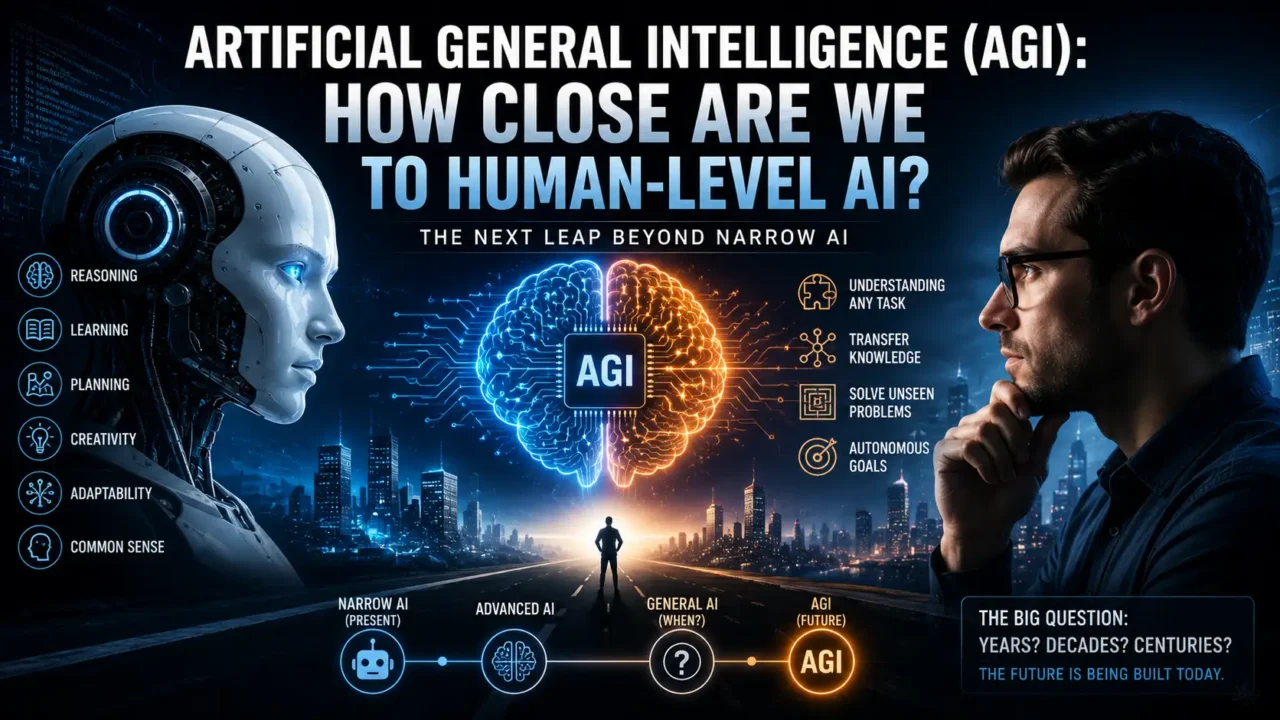
Artificial intelligence has advanced at a pace that few people predicted. Systems that once struggled to recognize images can now write software, summarize research papers, generate realistic videos, translate dozens of languages, solve mathematical problems, and engage in conversations that often resemble interactions with human experts. These rapid improvements have revived one of the biggest questions in computer science: How close are we to Artificial General Intelligence (AGI)?
The idea of AGI captures the imagination because it represents something fundamentally different from today’s AI systems. Current artificial intelligence excels at many specific tasks, sometimes outperforming humans within narrowly defined domains. Yet even the most advanced models remain limited in important ways. They do not possess the broad adaptability, continuous learning ability, or real-world understanding that characterize human intelligence.
Determining how close we are to AGI is not simply a technical question. The answer has profound implications for science, medicine, education, business, economics, and society. If machines eventually reach human-level intelligence across a wide range of activities, the consequences could rival previous technological revolutions such as electricity or the internet. Understanding what AGI actually means—and what challenges remain—helps separate realistic expectations from speculation.
What Is Artificial General Intelligence?
Artificial General Intelligence refers to a hypothetical form of AI capable of understanding, learning, and applying knowledge across virtually any intellectual task that humans can perform. Unlike today’s systems, which are typically optimized for particular problems, AGI would transfer knowledge between domains, adapt to unfamiliar situations, reason independently, and learn continuously from experience.
This distinction is essential.
Modern AI systems belong primarily to the category of Artificial Narrow Intelligence (ANI). A language model may generate impressive essays, while another system identifies diseases from medical images. Although these capabilities are extraordinary, they remain specialized. Success in one area does not automatically translate into competence in another.
Humans operate differently. A person who learns mathematics can often apply logical reasoning to science, engineering, finance, or everyday decision-making. Children continuously acquire new skills without requiring complete retraining for every task. AGI aims to achieve this kind of flexible, general intelligence rather than isolated expertise.
Why Today’s AI Is Not Yet AGI
Recent AI systems have narrowed the gap between human and machine performance in many fields. Large language models can explain complex ideas, write computer programs, assist with research, and generate creative content. Vision models recognize objects with remarkable accuracy, while robotics continues making steady progress.
Despite these achievements, important limitations remain.
Current AI often lacks persistent understanding of the physical world. It predicts patterns from enormous amounts of data rather than developing genuine causal models of reality. It can produce convincing explanations while occasionally generating incorrect information with equal confidence. Long-term planning, autonomous scientific discovery, common-sense reasoning, and adapting reliably to entirely unfamiliar situations remain difficult challenges.
Another important limitation involves continuous learning. Humans accumulate knowledge throughout life without forgetting previous experiences. Many AI systems require substantial retraining to incorporate new information or improve performance significantly.
These differences suggest that impressive performance on individual tasks should not be confused with general intelligence.
The Scientific Challenges on the Road to AGI
Building AGI requires solving problems that extend far beyond increasing computing power.
One challenge involves reasoning. Human intelligence combines memory, logic, abstraction, creativity, intuition, and contextual understanding. Researchers continue exploring how these capabilities emerge and how they might be reproduced computationally.
Another challenge concerns world models. Humans understand cause and effect through direct interaction with their environment. We know that objects fall because of gravity, that fire produces heat, and that social interactions involve emotions, intentions, and cultural norms. AI systems often infer statistical relationships without possessing the same grounded understanding of reality.
Researchers are also investigating lifelong learning, improved memory systems, multimodal reasoning that combines text, images, audio, and physical interaction, and more efficient methods for planning over long time horizons. Each represents an active field of research rather than a solved engineering problem.
Progress therefore depends not only on larger models but also on deeper scientific breakthroughs.
Artificial Intelligence Explained: How AI Is Changing the World
Different Expert Views on the Timeline
One reason AGI generates intense debate is that experts disagree sharply about when—or even whether—it will arrive.
Some researchers argue that rapid improvements in computing infrastructure, model architecture, and data efficiency suggest AGI could emerge within the next decade or two. They point to the accelerating capabilities of modern AI systems as evidence that general intelligence may result from continued scaling combined with algorithmic innovation.
Others remain more cautious. They argue that current AI demonstrates impressive pattern recognition without solving the deeper problems of reasoning, consciousness, common sense, and autonomous learning. According to this perspective, today’s systems represent significant progress but remain fundamentally different from human cognition.
Importantly, no universally accepted scientific definition of AGI exists.
Without agreement on exactly what qualifies as human-level artificial intelligence, predicting precise timelines remains inherently uncertain.
What AGI Could Mean for Society
If AGI eventually becomes reality, its effects would likely extend far beyond today’s AI applications.
Medicine could accelerate as intelligent systems help design new drugs, analyze enormous biological datasets, and assist physicians with increasingly personalized treatments. Scientific research might advance more rapidly through automated hypothesis generation and experimental design. Education could become highly individualized, with AI tutors adapting continuously to each student’s strengths and weaknesses.
Businesses would likely experience another major productivity transformation. Routine cognitive tasks could become increasingly automated, allowing professionals to focus more heavily on creativity, judgment, leadership, and interpersonal relationships.
At the same time, AGI would introduce complex challenges. Labor markets could undergo significant disruption as certain occupations evolve or disappear. Questions surrounding regulation, cybersecurity, misinformation, privacy, and economic inequality would become even more important than they are today.
The technology itself is only one part of the equation.
How governments, businesses, researchers, and societies respond will determine whether its benefits are broadly shared.
Why Responsible Development Matters
As AI systems become increasingly capable, discussions surrounding AI safety and AI alignment have grown more prominent.
Alignment refers to ensuring that advanced AI systems behave consistently with human intentions and values. Even highly intelligent systems must remain reliable, transparent, and controllable when making important decisions.
Researchers are actively studying methods for improving robustness, reducing harmful biases, increasing interpretability, and developing governance frameworks capable of supporting increasingly advanced AI technologies.
History shows that transformative technologies often create both opportunities and unintended consequences. Responsible innovation therefore requires technical progress alongside thoughtful regulation, international cooperation, and ongoing public discussion.
Preparing for advanced AI involves building institutions capable of managing both its remarkable potential and its associated risks.
Quantum Computing Explained: Will It Change Everything?
Conclusion
Artificial General Intelligence remains one of the most ambitious goals in modern science and engineering. While today’s AI systems have demonstrated extraordinary capabilities, they still differ fundamentally from human intelligence in adaptability, reasoning, continuous learning, and real-world understanding.
Whether AGI arrives within years, decades, or much later remains uncertain. What is clear, however, is that artificial intelligence will continue becoming more capable and more deeply integrated into everyday life. Each breakthrough brings society closer to machines that can assist with increasingly sophisticated intellectual tasks, while simultaneously raising important scientific, ethical, and economic questions.
The most productive way to think about AGI is neither through fear nor exaggerated optimism.
It is through informed curiosity.
Understanding both the possibilities and the limitations of artificial intelligence allows us to prepare thoughtfully for a future in which intelligent machines may become some of humanity’s most powerful tools—provided we develop them with wisdom, responsibility, and a clear understanding of the values we want them to serve.
Call to Action
Artificial intelligence is advancing rapidly, and understanding its evolution is becoming essential for students, professionals, and lifelong learners alike. Explore the Aziz Publishing Knowledge Library for in-depth, evidence-based articles on AI, science, technology, and the innovations shaping the future of humanity.