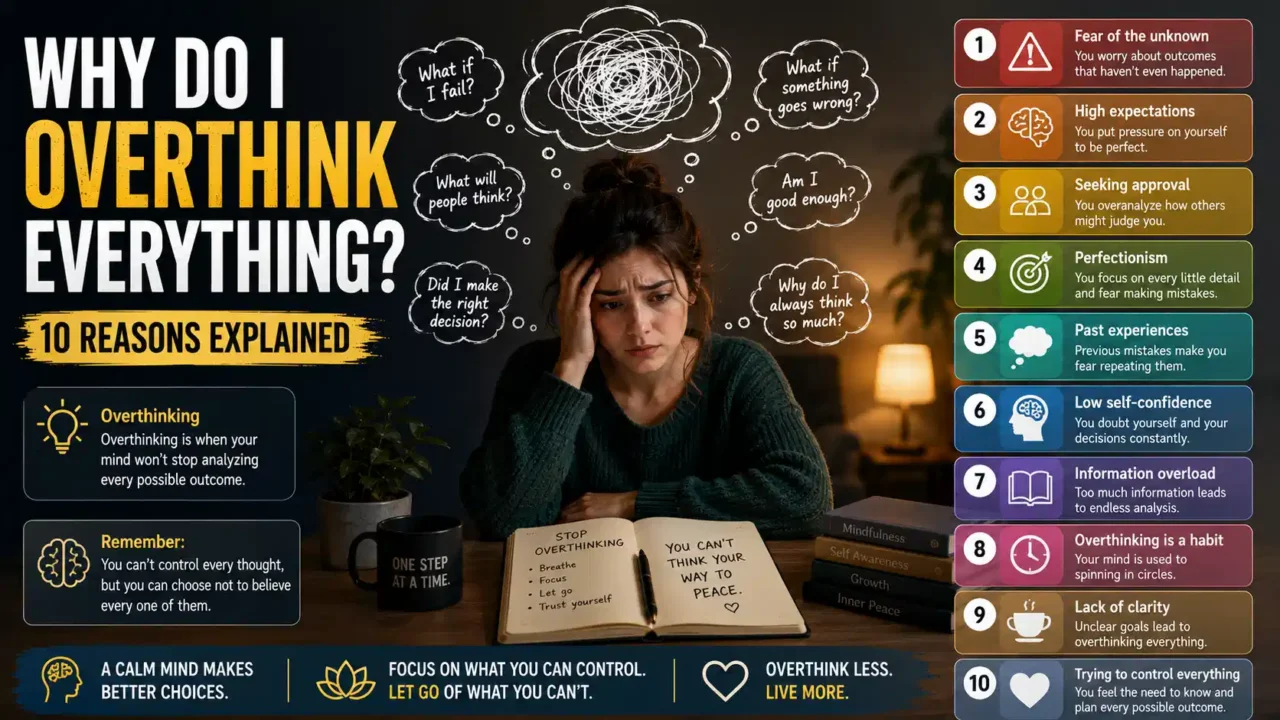
You’ve replayed that conversation for the fifth time today, even though nothing new happened since the fourth. If your mind constantly loops on the same thoughts, there are real, specific reasons behind it, not just a vague personality quirk. Here are 10 of the most common ones.
Your Brain Is Wired to Scan for Threats
The first reason traces back to evolution, your brain’s threat-detection system historically kept early humans safe by constantly scanning for danger in an uncertain environment. This system doesn’t distinguish well between a genuine physical threat and a stressful email, so it fires the same alarm regardless of actual risk level. This explains why overthinking often feels disproportionately intense compared to the actual stakes involved. Your brain isn’t malfunctioning, it’s running old survival software on modern, lower-stakes problems.
Perfectionism Turns Thinking Into Endless Refinement
A second major driver is perfectionism, where the fear of making any mistake keeps you mentally revising a decision or piece of work long after it was genuinely ready. This isn’t the same as having high standards, perfectionism specifically resists finishing or committing, since something could always theoretically be improved further. A third related reason is fear of judgment, worrying so much about how others will perceive a choice that you analyze it from every possible angle before acting. Both patterns keep you stuck in analysis specifically to avoid the discomfort of an imperfect or judged outcome.
The Science of Mental Resilience: How to Build Psychological Strength That Lasts
Uncertainty Feels Genuinely Intolerable
A fourth reason involves a lower tolerance for ambiguity, some people experience unresolved uncertainty as significantly more distressing than others, which drives compulsive mental review in an attempt to resolve it. A fifth, closely related reason is a strong need for control, since continuing to think about a situation can create an illusion of control over an outcome that’s actually already decided or entirely out of your hands. Both patterns share the same underlying discomfort, an unresolved question feels intolerable, so your mind keeps circling back to it. Recognizing that you’re seeking illusory control, not real answers, often reduces the pull to keep thinking.
Past Experiences Taught You to Over-Prepare
A sixth reason involves learned caution from past experiences where being underprepared led to a genuinely bad outcome, teaching your brain that extensive advance thinking prevents future problems. This creates a pattern where thorough preparation, which is useful in moderation, tips into excessive, unproductive rumination that goes well beyond what any situation actually requires. This learned pattern often generalizes far beyond the original context, applying the same intense preparation instinct to low-stakes situations that never needed it. Recognizing when a past lesson is being over-applied to a much lower-stakes present situation can help recalibrate the response.
Unfinished Business Nags at Your Brain
A seventh reason relates to a documented psychological pattern called the Zeigarnik Effect, where unfinished tasks or unresolved situations get remembered and revisited far more persistently than completed ones. An ambiguous text message or an unresolved conversation can occupy disproportionate mental space precisely because it lacks the closure your brain is looking for. This explains why overthinking often clusters around specifically unresolved situations rather than settled ones, even when the unresolved situation is objectively minor. Your brain isn’t trying to torture you, it’s technically seeking closure, even though the method feels uncomfortable.
Why Smart People Still Sabotage Their Own Progress
Anxiety and Overthinking Reinforce Each Other
An eighth reason is a self-reinforcing loop between anxiety and rumination, where anxious thoughts trigger more thinking in an attempt to feel more in control, which then generates more anxious thoughts to process. This loop can run largely on its own momentum once it starts, independent of whatever originally triggered it. A ninth reason involves this pattern becoming a habitual, well-worn mental pathway over time, since the brain defaults to whatever pattern gets used most frequently, and overthinking, once established, becomes the brain’s default response to any uncertainty. Breaking this loop usually requires an active interruption, not just recognizing that it’s happening.
Certain Thinking Styles Naturally Lean This Way
A tenth reason involves genuinely analytical, detail-oriented thinking styles, which are valuable in many contexts but can tip into excessive rumination when applied indiscriminately to situations that don’t actually require deep analysis. People who naturally think in thorough, multi-angle ways sometimes struggle to turn that same analytical mode off for lower-stakes personal decisions. This isn’t a flaw in the thinking style itself, it’s a matter of applying the right tool to the right situation, deep analysis for genuinely complex problems, quicker intuition for smaller ones. Recognizing which mode a given situation actually calls for is a learnable, practical skill.
What Actually Helps Once You Know the Reason
Once you’ve identified which of these patterns is driving a specific instance of overthinking, the response can be more targeted, scheduled worry time for anxiety-driven loops, deliberate practice finishing things imperfectly for perfectionism-driven patterns. Naming the specific mechanism, “this is the unfinished-business pattern,” creates enough distance to interrupt the loop rather than getting fully absorbed in it. Small, structured interventions tend to outperform simply trying to will yourself to stop thinking. Understanding the actual cause turns a vague, frustrating pattern into something concrete and addressable.
Final Thoughts
Overthinking has real, specific psychological roots, from ancient threat-detection wiring to perfectionism to a genuine need for closure, not just a vague personality trait you’re stuck with. Identifying which of these ten patterns applies to your specific situation makes it considerably easier to interrupt.
Next time you catch yourself looping on the same thought, try naming which of these ten reasons feels most accurate before deciding how to respond. If this breakdown helped you understand your own overthinking a little better, share it with someone who could use the same clarity.
Call to Action
Overthinking is only one piece of the larger puzzle of human behavior. Continue exploring the Aziz Publishing Knowledge Library for evidence-based articles on psychology, mindset, habits, productivity, and emotional well-being. The more you understand how your mind works, the more intentionally you can shape the way you think, decide, and live.

