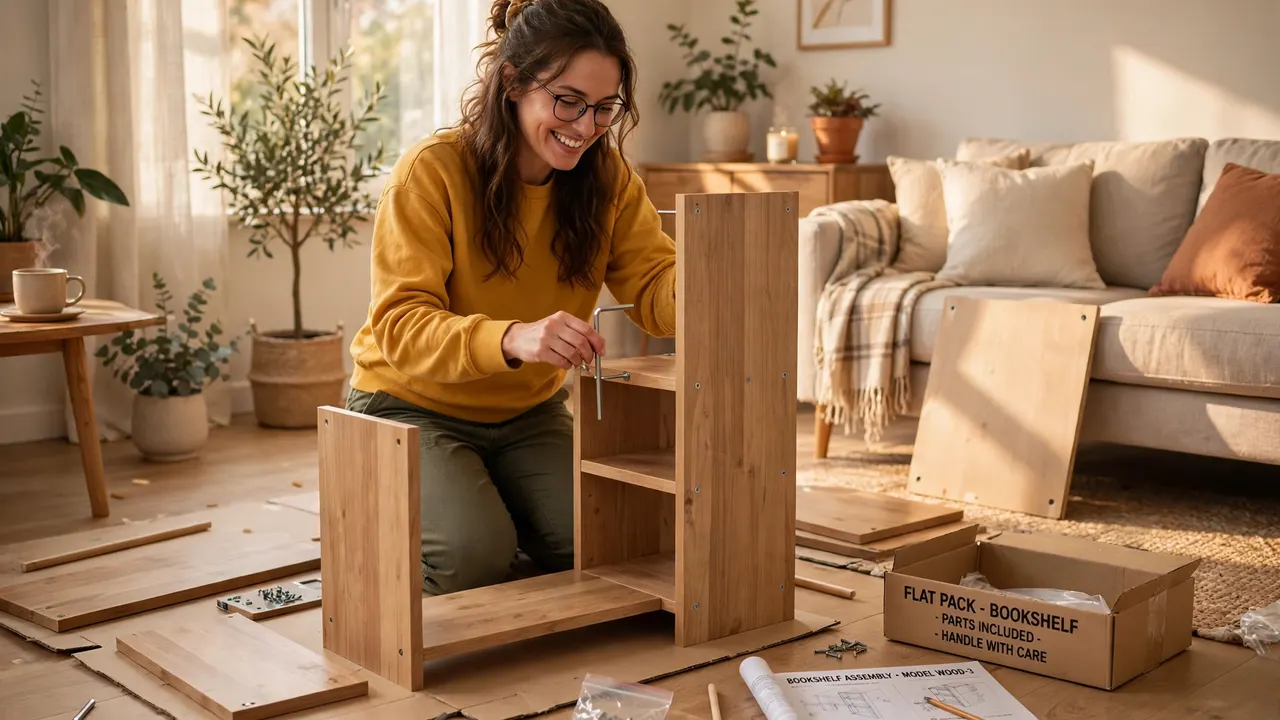
You would pay more for a wobbly bookshelf you built yourself than for a perfect one built by someone else. That strange preference has a name, the IKEA effect, and here is what the research shows about why labor makes things feel more valuable, and when the feeling misleads you.

What the IKEA Effect Is
The IKEA effect is the tendency to place a disproportionately high value on things you partly created yourself. A box you assembled, a meal you cooked from a kit, or a paper crane you folded can feel worth more than the same thing made by someone else, even when your version is objectively worse. The work becomes part of how you value the result.
The term comes from behavioral economists Michael Norton, Daniel Mochon and Dan Ariely, who named it in a 2012 paper, “The IKEA Effect: When Labor Leads to Love,” published in the Journal of Consumer Psychology. The name comes from the furniture retailer whose products arrive in flat boxes that the customer must assemble. The effect is not about furniture, though. It shows up wherever people finish something themselves and then have to judge it, as explained in a 2026 glossary entry on the IKEA effect.
The key point is that the value jump comes from your own labor, not from the object itself. Two identical boxes can sit side by side, and the one you assembled will feel like the better one. That gap between what you feel and what the object is worth is the bias at work.
The 2012 Study That Named It
Norton, Mochon and Ariely ran four studies to test the idea. Participants assembled plain IKEA storage boxes, folded origami figures, or built Lego sets, and then said what they would pay for their own creation and for an identical one made by someone else. Again and again, builders valued their own handiwork more highly, and even expected strangers to share that rosy view.
The numbers were striking. Builders valued their own boxes about 63 percent above what non-builders would pay for the same object. In the origami studies, participants bid an average of 23 cents to keep the frog or crane they had just folded, while other participants bid only 5 cents for those same creations, and 27 cents for the same figures folded by experts. In other words, people priced their own amateur folding at nearly the level outside bidders set for expert work.
The effect held for people who described themselves as keen do-it-yourselfers and for those who did not, and it appeared for both practical and decorative objects. The boxes and Lego sets allowed no customization, so this was not about self-expression. Assembly alone was enough, as detailed in a 2026 explainer on the IKEA effect experiments.
Why Building Something Raises Its Value
Three psychological forces combine to produce the effect. First, completing a task signals competence. Finishing something yourself is evidence of what you can do, and the finished object carries that signal with it. A wobbly shelf is not just a shelf, it is proof you built a shelf.
Second, effort justification pushes you to value what you worked hard for. This idea comes from cognitive dissonance theory: when you put real effort into something, deciding it was worth it resolves the discomfort of the effort. The classic demonstration is Aronson and Mills’ 1959 study, in which people who endured an embarrassing initiation to join a discussion group rated the deliberately dull group more favorably than people admitted easily. The IKEA effect applies the same logic to physical objects, and it connects to the discomfort described in cognitive dissonance explained.
Third, building creates ownership. Once you have made something, it feels like yours in a deeper way, and ownership itself raises value. That is the same force behind loss aversion explained: people demand more to give up something they own than they would pay to get it. The IKEA effect adds labor on top of ownership, and the two together inflate the price in your head.
The Completion Rule
Effort alone does not raise value. In follow up studies, when participants built something and then disassembled it, the premium vanished. When they were allowed to complete only half the assembly steps, it vanished again. An hour spent is an hour spent either way, so the result rules out simple time and trouble accounting. Effort that produces a finished thing raises value, and effort that produces nothing does not.
This completion rule matters for everyday life. A half finished project sitting in a drawer does not carry the glow of a finished one, which is one reason unfinished work feels so unsatisfying. The pride lives in the finished object, not in the hours you put in.
The rule also sets a limit on the bias. The effect needs a finished result you can look at and claim. Tasks that never end, or work that gets torn down as soon as it is done, will not trigger the same overvaluation.
Where the IKEA Effect Shows Up in Daily Life
Once you know the pattern, you start seeing it everywhere. Here are the most common places it appears.
- Home cooking: A meal you cooked yourself tastes better than the same dish from a restaurant, and meal kit companies charge a premium for food you still have to cook.
- DIY and crafts: A self knit scarf with gaps in it gets worn with pride, and a handmade candle feels more valuable than a better one from a shop.
- Parenting: Parents feel intense pride in their children’s small achievements, partly because of the years of effort invested in raising them.
- Work: A manager favors the plan the team drafted over a better one bought in, because the team built it and the plan carries their effort.
- Games and apps: Players feel attached to characters they built or virtual homes they customized, which is why games like Minecraft and The Sims lean on building so heavily.
- Software: An onboarding flow that asks you to configure a tool before use makes you value the tool more, because you helped build your version of it.
Companies know this well. Build-a-Bear lets children spend hours customizing a stuffed toy, and parents pay a premium for it, while the company saves on production. Cake mix makers learned the same lesson decades ago: adding one egg yourself makes the cake feel homemade, as explained in a 2026 interactive guide to the IKEA effect.
When the IKEA Effect Misleads You
The IKEA effect becomes a problem when it distorts a decision. The most common trap is overpricing your own work. Sellers who built or renovated a home themselves often set an asking price far above what buyers will pay, because they are pricing their labor and their memories, not the house. The same trap appears when a team refuses to abandon a project it built, even when the evidence says to stop.
A second trap is defending a bad idea because you made it. When you helped draft a plan, criticizing it feels like criticizing yourself, so flawed plans survive longer than they should. The fix is to judge the result as if someone else made it. Ask what you would pay for this object, or what you would think of this plan, if a stranger had produced it.
There is also a limit on who the effect helps. Walasek, Rakow and Matthews ran three experiments with 476 volunteers who built science kits, Lego models, or a wooden butterfly. People who built a kit they owned asked for more money to sell it than owners of a ready made kit, but building did little for people who were bidding to buy the same kit. The premium belongs to the maker, not the buyer, so do not expect others to share your valuation.
Finally, a 2026 meta-analysis of 55 studies covering over 5,400 participants found a significant moderate effect of self-assembly on valuation, around d = 0.57, along with consistent secondary effects on liking, sense of ownership and self-concept. The effect is real and reliable, but moderate, which means it nudges your judgment rather than hijacking it. Knowing about it is usually enough to correct for it.
- The IKEA effect is the tendency to value things you partly made yourself far above identical things made by someone else, even when your version is worse.
- Norton, Mochon and Ariely named it in 2012: builders valued their own boxes about 63 percent above what non-builders would pay, and priced their own origami near expert level.
- Competence, effort justification and ownership drive the effect, and it only appears when the work is finished: disassembling the object or stopping halfway erases the premium.
- A 2026 meta-analysis of 55 studies and over 5,400 participants found a moderate effect of self-assembly on valuation, around d = 0.57.
- The bias misleads you when you overprice your own work or defend a plan because you built it, so judge the result as if a stranger made it.
Frequently Asked Questions
What is the IKEA effect in simple terms?
The IKEA effect is the tendency to place a higher value on things you have partly made yourself, from flat pack furniture to a folded paper crane, than on identical things made by someone else, even when your own work is amateurish.
Who discovered the IKEA effect?
Behavioral economists Michael Norton, Daniel Mochon and Dan Ariely coined the term in their 2012 paper “The IKEA Effect: When Labor Leads to Love,” published in the Journal of Consumer Psychology. Participants assembled IKEA storage boxes, folded origami and built Lego sets, then priced their own creations higher than identical ones made by others.
Does the IKEA effect work for everyone?
Yes, broadly. The original studies found the effect for keen do-it-yourselfers and non-DIY people alike, and children show it from about age 5. A 2026 meta-analysis of 55 studies and over 5,400 participants found a significant moderate effect, though the size varies by person and situation.
How can I avoid the IKEA effect when making decisions?
Judge the result as if someone else made it. Ask what you would pay for the object or think of the plan if a stranger had produced it, and compare it against an outside benchmark, such as a market price or a competing proposal, before you decide.
Final Thoughts
The IKEA effect is not a flaw to eliminate, it is a feature of how pride and ownership work. Building something yourself genuinely makes it more meaningful to you, and that meaning is real. The problem starts only when you mistake your feeling for the market value, so enjoy the shelf you built, and price it like a stranger built it.
Call to Action
If this breakdown helped you spot the IKEA effect in your own home and work, share it with someone who swears their homemade version is better. Explore the Aziz Publishing Knowledge Library for more guides on psychology, including anchoring bias explained and confirmation bias everyday examples.

