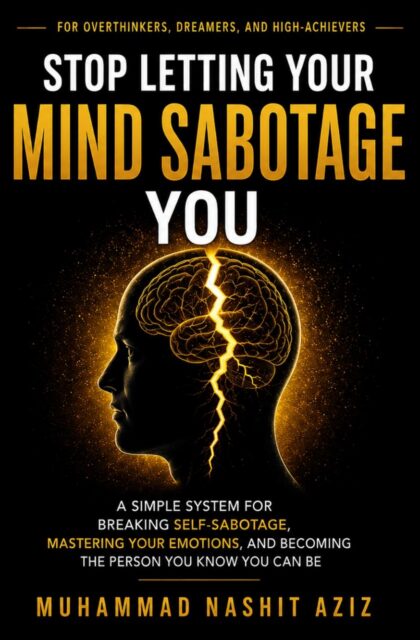
There is a reason most people begin every year with genuine optimism and end it wondering why so little has changed. The enthusiasm is real. The goals are meaningful. The intentions are sincere. Yet weeks or months later, many find themselves standing in the same place, carrying the same frustrations they hoped to leave behind.
It is tempting to blame a lack of discipline or motivation. Modern culture often tells us that lasting change belongs to people with exceptional willpower—the individuals who wake before sunrise, never skip workouts, always resist temptation, and somehow maintain perfect consistency regardless of circumstances. While this narrative is inspiring, it is also deeply misleading.
Human behavior is rarely driven by motivation alone. In fact, motivation is one of the least reliable forces we possess because it fluctuates with mood, energy, stress, and countless external influences. If lasting change depended solely on feeling motivated, very few meaningful achievements would ever occur.
The more interesting question is not why people occasionally succeed. It is why certain behaviors become automatic while others constantly require effort. Why does one person brush their teeth every day without thinking but struggle to exercise consistently? Why does checking a smartphone become instinctive while reading a book often feels like work? Why do some habits quietly shape extraordinary lives while others gradually erode health, relationships, and productivity?
The answer lies in understanding habits—not as isolated actions, but as the invisible architecture of everyday life.
The Quiet Power of Small Behaviors
When people think about change, they usually imagine dramatic moments. They picture major career decisions, life-changing opportunities, or sudden breakthroughs. Yet most human lives are shaped far less by extraordinary events than by ordinary routines repeated over months and years.
Consider two individuals who differ by only one small decision each day. One spends twenty minutes reading before bed. The other spends those same twenty minutes scrolling endlessly through social media. On any single evening, the difference appears insignificant. Neither person’s life changes overnight. After one week, the gap remains almost invisible.
But time rarely rewards isolated decisions. It rewards repeated ones.
Months later, one individual has finished several books, expanded their knowledge, improved their vocabulary, and developed new ways of thinking. The other has consumed hundreds of short videos, countless notifications, and information that disappears almost as quickly as it arrives.
Neither outcome resulted from a single dramatic choice. Both emerged from tiny behaviors repeated consistently.
This illustrates one of the most important principles behind atomic habits: small actions compound just as investments do. Their immediate impact is often negligible, but their long-term consequences can be extraordinary.
Why Habits Exist in the First Place
Habits are often misunderstood as behaviors that simply happen through repetition. In reality, they serve an important psychological purpose.
The human brain constantly seeks efficiency. Every conscious decision consumes mental energy. If we had to deliberately think about every routine activity—walking, driving, brushing our teeth, making coffee, locking the front door—we would quickly become mentally exhausted.
Habits solve this problem by allowing frequently repeated behaviors to become increasingly automatic. As behaviors move from conscious effort toward automatic execution, the brain frees its attention for new challenges and more complex decisions.
This process is remarkably adaptive. Without habits, everyday life would become overwhelming.
The difficulty is that the brain does not distinguish particularly well between helpful and harmful routines. It automates both.
The same neurological efficiency that makes daily exercise effortless after years of repetition also makes mindless phone checking almost automatic. Both behaviors began as conscious choices. Both eventually became mental shortcuts.
The Habit Loop: Why Repetition Creates Automatic Behavior
Psychologists have long observed that habits tend to follow a predictable pattern. Although different researchers describe the process in various ways, the underlying structure remains remarkably consistent.
Every habit begins with a cue—something that signals the brain to initiate a familiar behavior. The cue may be a location, a particular time of day, an emotional state, another person, or a preceding action.
That cue leads to a routine—the behavior itself.
Finally comes a reward, which reinforces the behavior by teaching the brain that repeating it is worthwhile.
Imagine someone who checks their phone immediately after waking up. The cue is waking up. The routine is reaching for the phone. The reward may be novelty, entertainment, social connection, or relief from boredom. Repeated often enough, this sequence becomes automatic.
The same structure explains many positive habits as well. Finishing dinner may become the cue for taking an evening walk. The walk becomes the routine. Improved mood, relaxation, or physical well-being becomes the reward that encourages repetition.
The important insight is that habits rarely exist in isolation. They are embedded within larger behavioral patterns. When we understand the cues and rewards surrounding a behavior, changing it becomes far more realistic than simply relying on willpower.
[Guide to Building Better Habits]
Identity: The Missing Piece Behind Lasting Change
One of the most valuable ideas in modern habit research is that sustainable behavior change begins not with goals, but with identity.
Many people approach habits by asking, “What do I want to achieve?”
A more powerful question is, “Who do I want to become?”
The difference may appear subtle, but psychologically it changes everything.
Suppose two people are offered a cigarette. One responds, “I’m trying to quit smoking.” The other says, “I don’t smoke.”
Both decline the cigarette, yet their identities are fundamentally different.
The first still sees themselves as a smoker resisting temptation. The second has adopted a new self-concept that naturally guides behavior.
Identity influences habits because people generally strive to remain consistent with how they perceive themselves. Someone who believes they are a healthy person is more likely to make food choices that align with that belief. A person who sees themselves as a lifelong learner naturally looks for opportunities to read, study, and ask thoughtful questions.
Why Motivation Is Overrated
Few ideas are more deeply rooted in modern self-improvement culture than the belief that motivation comes first. We often assume we need to feel inspired before we begin working, exercising, studying, or making meaningful changes. Entire industries are built around helping people feel motivated again.
The problem is not that motivation lacks value. The problem is that it is unreliable.
Think about your own experience. Some mornings you wake up energized, ready to tackle difficult tasks. Other days even simple responsibilities feel exhausting. Stress, poor sleep, unexpected setbacks, illness, and emotional challenges all influence motivation in ways we cannot fully control.
If our most important habits depended on consistently feeling motivated, our progress would fluctuate as dramatically as our emotions.
Highly consistent people are often misunderstood. From the outside, they appear unusually disciplined, but closer observation reveals something different. They have simply learned to reduce their dependence on motivation.
A writer does not wait to feel inspired before sitting at the keyboard. A musician does not practice only when enthusiasm appears. A committed athlete trains on ordinary days, not because those days are exciting, but because consistency has become part of their identity.
Psychologists sometimes describe this as reducing decision fatigue. When a behavior becomes a scheduled routine rather than a daily debate, less mental energy is spent deciding whether it should happen.
The question changes from “Do I feel like doing this?” to “This is simply what I do.”
That distinction may appear small, yet it transforms behavior over time.
Your Environment Is Quietly Shaping Your Behavior
People often imagine habits as products of character. They believe disciplined individuals succeed because they possess exceptional inner strength. Character certainly matters, but it is only part of the story.
Our environment continuously influences our behavior, often without our awareness.
Walk into a room where fresh fruit sits on the kitchen counter while sweets remain hidden inside a cupboard. Without consciously intending to, you become slightly more likely to choose the healthier option. Rearrange the environment so cookies occupy the most visible location, and the probability shifts in the opposite direction.
Neither scenario reflects a sudden change in personality.
The environment changed first.
Human beings are remarkably responsive to visual cues. What we repeatedly see becomes easier to remember, easier to access, and ultimately easier to choose.
Technology companies understand this principle exceptionally well. Smartphone notifications are carefully designed environmental cues. Social media applications are intentionally placed where they can be accessed within seconds. Streaming platforms reduce the effort required to continue watching another episode because every additional barrier increases the likelihood that users will stop.
The lesson extends far beyond technology.
If your guitar remains locked inside a closet, you will probably practice less often. If books are visible beside your favorite chair, reading becomes more likely. If running shoes sit beside the front door every morning, exercising requires one fewer decision.
Small environmental adjustments produce surprisingly large behavioral changes because they reduce friction.
Rather than relying entirely on self-control, successful habit formation often begins by making desirable behaviors easier and undesirable behaviors slightly more difficult.
The goal is not to become stronger than temptation every day.
The goal is to encounter temptation less frequently.
Breaking Bad Habits Requires More Than Willpower
When people attempt to eliminate unhealthy habits, they often focus almost exclusively on stopping the behavior itself.
“I’ll stop procrastinating.”
“I’ll stop eating unhealthy food.”
“I’ll stop scrolling through social media.”
While these intentions are understandable, they overlook an important psychological reality.
Every habit serves a purpose.
Habit Stacking: Let Existing Habits Do the Work
One of the simplest yet most effective strategies for building new habits involves connecting them to routines that already exist.
Instead of asking yourself to remember an entirely new behavior, attach it to something your brain performs automatically every day.
Suppose brushing your teeth already happens without conscious effort.
Instead of deciding randomly when to meditate, you might tell yourself:
“After I brush my teeth, I will meditate for two minutes.”
The existing habit becomes the cue for the new one.
Likewise:
After making morning coffee, read one page.
After dinner, take a ten-minute walk.
After arriving home from work, prepare tomorrow’s schedule.
These connections reduce mental effort because the brain no longer searches for the appropriate time to begin. One behavior naturally triggers the next.
Over months, individual habits begin forming routines, and routines eventually become lifestyles.
Rarely does transformation arrive through one perfect habit.
More often, it emerges through many small habits working together.
The Compounding Effect of Habits
If there is one idea that explains why habits are so powerful, it is this: habits compound.
Most people understand compound interest in finance. Money that earns interest begins earning interest on its previous interest, creating exponential growth over time. The remarkable thing about habits is that they follow a similar principle.
A single healthy meal does not transform your body.
One workout does not make you fit.
Reading ten pages today will not suddenly make you knowledgeable.
Writing for thirty minutes will not instantly produce a bestselling book.
Individually, these actions appear almost insignificant.
Yet they are not designed to change your life in a day. They are designed to change the direction of your life.
Imagine standing at the edge of a large forest with two paths in front of you. At first, the trails appear almost identical. Walking just one degree to the left or right seems meaningless. After a few steps, the difference is impossible to notice.
But continue walking for several miles, and those paths lead to entirely different destinations.
Habits work in exactly the same way.
Every small action is like taking one more step down a particular path. One choice rarely determines your future. Thousands of similar choices almost certainly will.
This perspective is both encouraging and humbling.
The Real Purpose of Atomic Habits
It is easy to misunderstand the purpose of habit formation.
Many people believe habits exist primarily to increase productivity or efficiency.
Those outcomes are certainly valuable.
But their deepest purpose is something more profound.
Habits shape identity.
Every repeated action quietly answers the question:
“Who am I becoming?”
Each time you choose to learn instead of making excuses, you reinforce the identity of a learner.
Each time you keep a promise to yourself, you strengthen self-trust.
Each time you choose long-term growth over immediate comfort, you become slightly more aligned with the person you hope to become.
Identity is rarely transformed by dramatic declarations.
It is transformed through repeated evidence.
This explains why habits influence confidence more deeply than motivational speeches ever can.
Confidence grows when your actions repeatedly prove that you are capable of becoming the kind of person you aspire to be.
Eventually, the habits you once forced yourself to perform begin feeling natural because they are no longer separate from your identity.
They are simply part of who you are.
[The Identity Shift That Makes Success Feel Natural]
Conclusion
Lasting change rarely begins with a life-changing decision.
More often, it begins with an almost invisible one.
Reading one chapter.
Taking one walk.
Writing one page.
Preparing one healthy meal.
Going to bed thirty minutes earlier.
None of these actions appear remarkable on their own. Yet they share something extraordinary: they are repeatable.
Atomic habits remind us that success is not built through occasional moments of greatness but through ordinary behaviors performed consistently enough to shape identity.
The temptation will always be to search for dramatic breakthroughs. We imagine that somewhere there exists a perfect strategy, a secret technique, or a surge of motivation that will suddenly transform our lives.
In reality, transformation usually arrives much more quietly.
It appears when small improvements stop being isolated actions and become daily routines.
It appears when consistency replaces intensity.
It appears when systems replace wishes.
And it appears when we stop asking how quickly our lives can change and start asking whether today’s choices are moving us in the direction of the person we hope to become.
Because the smallest habits, repeated faithfully, rarely stay small forever.
Call to Action
Every lasting transformation begins with a single repeated action. If you enjoyed this exploration of how habits shape identity and long-term success, continue exploring Aziz Publishing’s collection of articles on psychology, mindset, productivity, and personal development. The more you understand how your mind works, the better equipped you’ll be to build habits that create a stronger future.