Walk into any bookstore, and you’ll find shelves filled with books promising a better life. Some claim they will make you more productive. Others promise confidence, wealth, happiness, or discipline. Yet many readers experience a familiar frustration. They finish a highly praised self-improvement book feeling inspired, only to realize that a few weeks later, very little has changed.
This raises an important question.
If self-improvement books are filled with valuable ideas, why do so few produce lasting behavioral change?
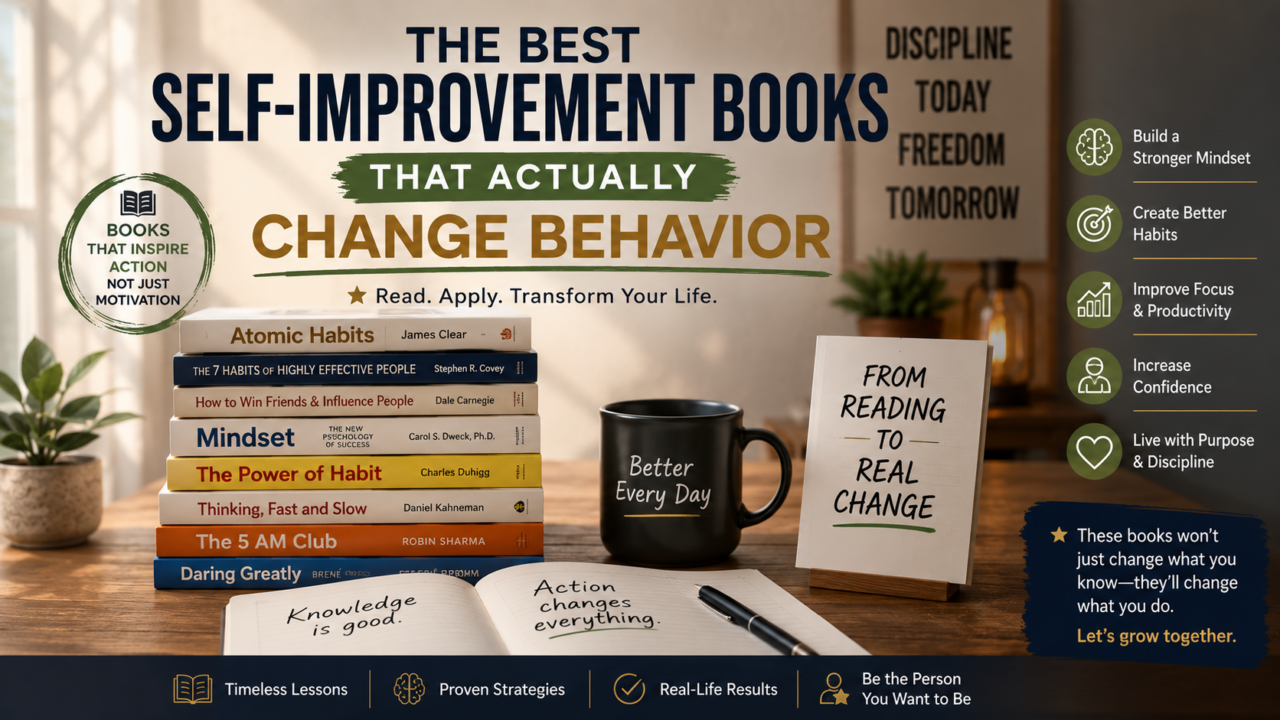
The answer lies partly in the difference between knowledge and implementation. Reading changes what you know. Behavior changes only when knowledge becomes action repeated over time. The most effective personal development books understand this distinction. Rather than simply motivating readers, they reshape how people think, make decisions, and build habits.
The books in this guide have earned their reputation because they provide practical mental models, evidence-based insights, and systems that continue influencing behavior long after the final page. If your goal is genuine personal growth rather than temporary inspiration, these are among the most valuable books you can read.
Atomic Habits — James Clear
Few modern books have influenced personal development as profoundly as Atomic Habits. Instead of encouraging dramatic life changes, James Clear argues that meaningful transformation comes from improving by small, consistent amounts every day.
The book explains why habits form, how environments influence behavior, and why identity matters more than motivation. One of its most powerful ideas is that every habit casts a vote for the type of person you become. Rather than asking, “What do I want to achieve?” readers begin asking, “Who do I want to become?”
The lasting value of Atomic Habits is that it replaces willpower with systems. Readers finish the book with practical methods they can immediately apply to health, productivity, learning, and work.
Mindset — Carol S. Dweck
Carol Dweck’s research transformed how psychologists understand achievement and learning. Her concept of the growth mindset demonstrates that people who believe abilities can be developed consistently outperform those who see talent as fixed.
This idea extends far beyond education. It influences careers, leadership, relationships, and resilience.
Readers often discover that many limitations they considered permanent were actually beliefs rather than facts. By shifting attention from proving intelligence to developing it, Mindset encourages greater persistence, curiosity, and willingness to embrace difficult challenges.
Behavior changes because failure begins to represent information instead of personal inadequacy.
The 7 Habits of Highly Effective People — Stephen R. Covey
Decades after its publication, Stephen Covey’s classic remains remarkably relevant because it focuses on principles rather than trends.
The book emphasizes responsibility, proactive thinking, long-term planning, and aligning daily actions with personal values. Instead of teaching productivity techniques alone, Covey encourages readers to examine the character behind their decisions.
Perhaps the book’s greatest contribution is demonstrating that sustainable success begins internally. External achievements become more meaningful when supported by integrity, discipline, and intentional living.
Many readers return to this book repeatedly because different lessons become relevant at different stages of life.
10 Life-Changing Psychology Books Everyone Should Read
Deep Work — Cal Newport
Modern life rewards constant connectivity while quietly reducing our ability to concentrate.
Cal Newport argues that focused, uninterrupted work has become one of the most valuable skills in today’s economy. The book explains how distractions weaken cognitive performance and why deliberate concentration creates exceptional results.
More importantly, Newport offers practical methods for protecting attention. Readers learn how to structure work environments, eliminate unnecessary interruptions, and develop routines that support sustained focus.
For professionals, students, writers, and entrepreneurs, Deep Work changes behavior by demonstrating that productivity depends less on working longer hours than on working with greater intensity.
The Psychology of Money — Morgan Housel
Although often categorized as a finance book, The Psychology of Money is fundamentally about human behavior.
Morgan Housel explains that financial success depends less on mathematical knowledge than on emotional decision-making. Through memorable stories, he explores why intelligent people sometimes make poor financial choices and why patience often outperforms complexity.
Readers frequently discover that wealth is shaped by habits such as delayed gratification, consistency, humility, and long-term thinking rather than constant pursuit of higher income.
The lessons extend beyond money into broader questions about happiness, expectations, and decision-making.
Man’s Search for Meaning — Viktor E. Frankl
Few books influence perspective as deeply as Viktor Frankl’s account of surviving Nazi concentration camps.
Rather than offering productivity techniques or motivational advice, Frankl explores humanity’s remarkable capacity to find meaning under unimaginable hardship. His psychological framework, known as logotherapy, argues that purpose enables people to endure suffering while maintaining dignity.
Readers often experience profound behavioral change because the book reframes adversity itself. Difficult experiences become opportunities to choose one’s response rather than reasons for surrender.
Its lessons remain timeless because meaning continues to shape resilience across every area of life.
How to Read Self-Improvement Books for Real Change
Choosing excellent books is only part of the process.
The way you read determines whether ideas become lasting behavior.
Many people consume self-improvement books as entertainment. They finish one title and immediately purchase another without applying anything they learned. Knowledge accumulates while behavior remains unchanged.
A more effective approach is slower and more deliberate.
Highlight important concepts. Write reflections in your own words. Identify one practical lesson worth implementing immediately. Apply it consistently before moving to the next book.
Reading fewer books deeply often produces greater transformation than reading dozens superficially.
Behavior changes through repetition, not information overload.
Conclusion
The best self-improvement books do more than inspire. They change the mental models through which we understand ourselves, our habits, our relationships, and our decisions. They encourage readers to replace temporary motivation with consistent action, fixed beliefs with continuous learning, distraction with focused effort, and external success with meaningful personal growth.
Ultimately, no book can transform your life on its own.
Books provide perspective.
Readers create change.
The most valuable self-improvement library is not the one containing the greatest number of titles. It is the one whose lessons quietly become part of your daily behavior.
When knowledge consistently becomes action, reading stops being a hobby.
It becomes a lifelong advantage.
Call to Action
The best books do more than fill your bookshelf—they reshape how you think and act. Continue exploring the Aziz Publishing Knowledge Library for in-depth articles on psychology, habits, productivity, writing, and lifelong learning. Every thoughtful book and every practical idea you apply becomes another step toward meaningful, lasting personal growth.