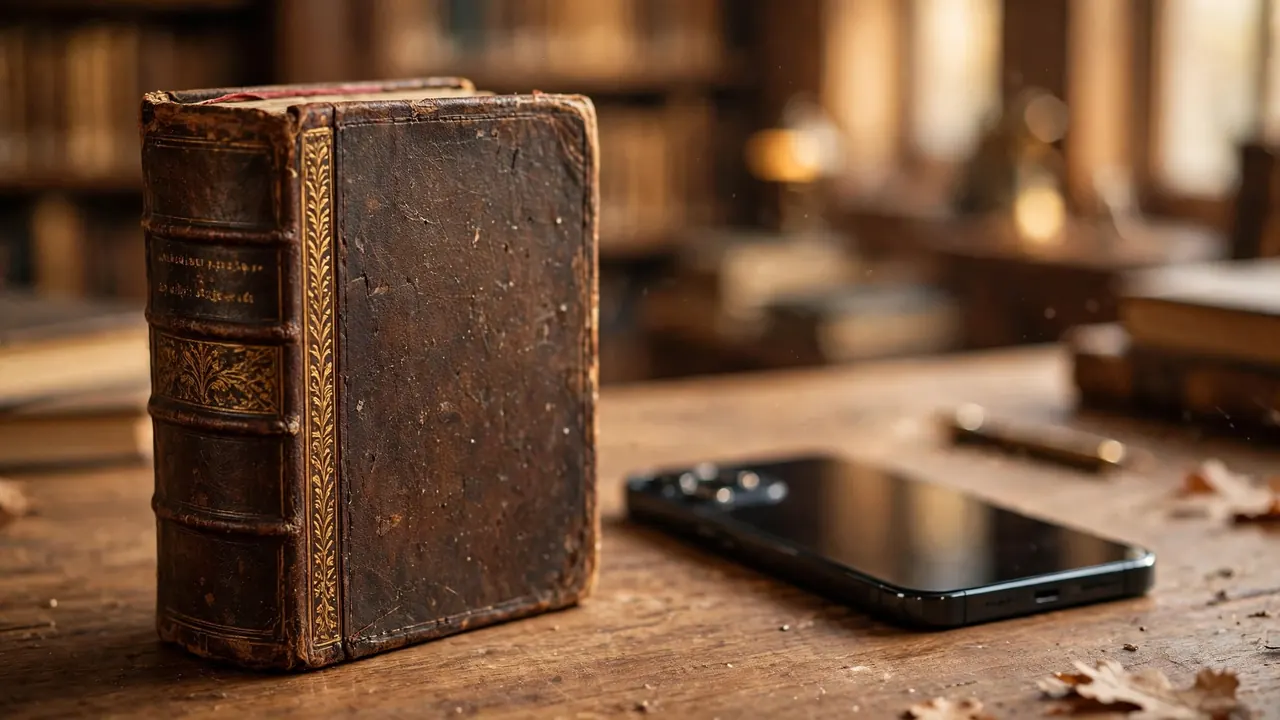
A book published in 1776 is still shaping how economists think today, while most books published last year are already forgotten. The Lindy effect explains why, and in 2026 it offers a simple test for everything from the books you read to the technology you bet on. Here is what the effect actually says, where it works, where it fails, and how to use it without turning age into worship.

What the Lindy Effect Is
The Lindy effect says that, for some non-perishable things, future life expectancy is proportional to current age. In plain language, in many domains the old wins over the new. A book that has been in print for 100 years is likely to remain in print for another 100 years. A technology that has been used for 50 years will likely be used for 50 more. Every extra year of survival is a small sign that the thing may survive more years.
The key phrase is non-perishable things. The Lindy effect applies best to ideas, books, institutions, practices, technologies, and cultural artifacts that can survive through time. It does not apply cleanly to living organisms or anything governed by a biological clock. A 90-year-old human is not expected to live another 90 years, and a phone battery does not get a longer life the older it gets. Lindy estimates life expectancy, not guaranteed lifespan, and life expectancy is probabilistic, not fixed.
It is worth separating the Lindy effect from a nearby idea the site already covers. First principles thinking breaks a problem down to its basic truths, a method that starts from scratch. The Lindy effect does the opposite. It starts from the past and treats survival itself as evidence. One asks what is true. The other asks what has lasted, and treats lasting as a clue to what will keep lasting.
From a New York Deli to a Rule of Thumb
The effect is named after Lindy’s delicatessen in New York, where comedians gathered in the early 1960s and joked about career longevity. Their theory was simple. A comic has only so much material, so the more often you appear on television, the faster you burn out. In 1964, writer Albert Goldman wrote it up in The New Republic as “Lindy’s Law,” and the idea entered the culture as a joke about show business.
Mathematician Benoit Mandelbrot turned it around. The longer a body of work keeps going, the longer we should expect it to continue, because survival is itself evidence of robustness. Nassim Nicholas Taleb then widened it in Antifragile: Things That Gain from Disorder, published in 2012, to anything without a natural expiration date, including books, ideas, and technologies. Taleb has called the Lindy effect one of the most useful, robust, and universal heuristics he knows, and a 2026 guide to the effect updated in May 2026 makes the same point.
The reason it works is survivorship. Time works like disorder. It exposes everything to shocks, and whatever survives has been stress-tested in ways a two-year-old trend has not. In survival-analysis terms, the effect implies a falling hazard rate. The chance of ending in any given period declines as the thing ages, because the fragile versions have already been weeded out and only the robust ones are still standing.
The 2026 Test Cases
The year 2026 gives the Lindy effect two unusually clean test cases. The iPhone launched in 2007, which means it is 19 years old in 2026. Given how fast technology moves, a simple Lindy estimate would suggest at least another 19 years before it becomes obsolete. That sounds bold for a gadget, and it is a reminder that Lindy works on categories and platforms, not on single models. The iPhone as a platform has survived nineteen years of competition. The individual model in your pocket has not.
The second case is bigger. The United States of America is one of the world’s oldest continuous democracies, and in 2026 America marks 250 years of independence. Per the Lindy effect, we can expect democracy to exist for at least another 250 years. That is a heuristic, not a promise, and it is exactly the kind of long horizon the effect is built for. Short lived things tell you almost nothing. Things that have lasted centuries tell you a great deal.
The same pattern shows up in books. Adam Smith’s The Wealth of Nations was published in 1776 and remains foundational to economics. Double-entry bookkeeping was published by Luca Pacioli in 1494, and its essentials have barely changed in more than 500 years. The book as a format has survived for over 600 years since Gutenberg’s printing press, through the newspaper age, radio, television, and now the digital revolution. Books have demonstrated their utility across centuries of competition, and a 2026 guide reviewed in October 2026 puts it plainly: a business practice that has survived 100 years has been stress-tested in ways a two-year-old trend has not.
Where Lindy Fails
Lindy is a heuristic, not a law, and the honest version of it includes its limits. The first limit is perishability. The effect does not apply to people, machines, or anything that wears out, because their hazard rate rises with age instead of falling. A 90-year-old human, a ten-year-old car, and a phone battery all get more likely to fail the older they get. Lindy would predict the opposite, and it would be wrong.
The second limit is protection. Time is an honest filter only when something could have killed the idea. A monopoly, a subsidy, a regulation, or a tradition enforced by law can keep a bad idea alive for decades without ever testing it. Age tells you the idea survived. It does not tell you whether it survived because it was good or because it was protected. The same warning applies to habits. A habit can survive for years just because nobody questioned it, not because it works.
The third limit is the simplest one. Old does not mean right. It means battle-tested. Old things do die, and age tells you nothing about whether something is still healthy. A related rule from physicist J. Richard Gott, the Copernican estimate from 1993, makes the same point in different language. If you observe something at a random moment in its existence, there is a 50 percent chance you are in the middle half of its lifetime, which implies a 50 percent chance its remaining duration is between one third and three times its current age. Treat Lindy and Copernican estimates as rough priors, not answers, as a 2026 guide to survival-time estimates updated in November 2026 advises.
How to Use the Lindy Effect Well
Used carefully, the Lindy effect is one of the cheapest decision tools you own. It asks a single question, how long has this lasted, and turns the answer into a prior for how long it will keep lasting. The trick is to ask that question in the right places, and to ask two more questions after it.
- Read old books first: Works that have remained relevant for centuries contain more durable wisdom than this year’s bestseller. Plato, Seneca, and Sun Tzu have passed the Lindy test. The latest management book probably has not, and reading nonfiction changes how you think most when the book you pick has already survived its first test, which is time.
- Favour established technology: When choosing tools, favour solutions that have survived real competition. SQL databases have been around for 50 plus years, and they will likely outlast the latest database fad. HTTP has survived for 30 plus years, and any replacement faces a high bar. New is not bad, but new has told you almost nothing yet.
- Ask whether it could have died: Before you trust an old idea, ask whether anything could have killed it. If it survived open competition, its age is evidence. If it survived because it was protected, subsidised, or never questioned, its age tells you far less.
- Ask whether it is still healthy: Age is a record of survival, not a certificate of health. Check whether the idea still works, whether people still choose it freely, and whether its best days are behind it. An old thing in decline is still an old thing, and Lindy does not save it.
The final question is the one that keeps the effect honest. Before you replace anything, ask how long it has lasted, and then ask whether the replacement has earned its place or merely arrived. The Lindy effect does not say never change. It says make the new thing prove itself, the way the old thing already did, one year at a time.
- The Lindy effect says that, for some non-perishable things, future life expectancy is proportional to current age. A book in print for 100 years is likely to stay in print for another 100 years.
- The effect is named after Lindy’s delicatessen in New York, written up by Albert Goldman in 1964, formalised by Benoit Mandelbrot, and popularised by Nassim Nicholas Taleb in Antifragile in 2012.
- It works through survivorship and robustness. Time exposes everything to shocks, and whatever survives has been stress-tested. In survival-analysis terms, the chance of ending in any given period declines as the thing ages.
- In 2026, the iPhone turns 19, which Lindy turns into at least another 19 years, and the United States marks 250 years of independence, which Lindy turns into a 250 year expectation. Double-entry bookkeeping has barely changed in more than 500 years.
- Lindy fails for perishable things like people and machines, for ideas protected from competition, and for anything in decline. Old does not mean right, it means battle-tested.
- To use it well, read old books first, favour established technology, ask whether the idea could have died, and ask whether it is still healthy before you trust its age.
Frequently Asked Questions
What is the Lindy effect?
The Lindy effect is the idea that for some non-perishable things, such as ideas, books, technologies, or institutions, the longer they have already lasted, the longer they are likely to last. A book that has been in print for 100 years is likely to remain in print for another 100 years. It is a heuristic, a rule of thumb, not a law, and it estimates life expectancy rather than guaranteeing a lifespan.
Where did the Lindy effect come from?
The effect is named after Lindy’s delicatessen in New York, where comedians gathered in the early 1960s and joked about career longevity. Writer Albert Goldman wrote it up as “Lindy’s Law” in The New Republic in 1964. Mathematician Benoit Mandelbrot formalised it, and Nassim Nicholas Taleb popularised it in Antifragile: Things That Gain from Disorder, published in 2012.
Does the Lindy effect apply to people?
No. The Lindy effect applies only to non-perishable things, ideas, books, institutions, practices, technologies, and cultural artifacts that can survive through time. It does not apply to living organisms or anything governed by a biological clock. A 90-year-old human is not expected to live another 90 years, because a person’s hazard rate rises with age instead of falling.
How can I use the Lindy effect?
Use it as a prior, not an answer. When choosing what to read, read old books first, because works that have remained relevant for centuries contain more durable wisdom than this year’s bestseller. When choosing technology, favour established solutions over trendy ones. Before replacing anything, ask how long it has lasted, whether it could have died, and whether it is still healthy.
Final Thoughts
The Lindy effect is a reminder that time is the most honest filter we have, as long as the thing was free to fail. The old ideas that survived did so by passing test after test, and that record is worth more than any launch-day promise. Trust age where it was earned, question it where it was protected, and let the new prove itself the same way the old did.
Call to Action
If this guide helped you judge what will last and what will fade, share it with someone choosing a book, a tool, or a habit this week. Explore the Aziz Publishing Knowledge Library for more guides on science and technology, including how to practice in a way that actually improves you and why the first number you hear pulls every number after it.